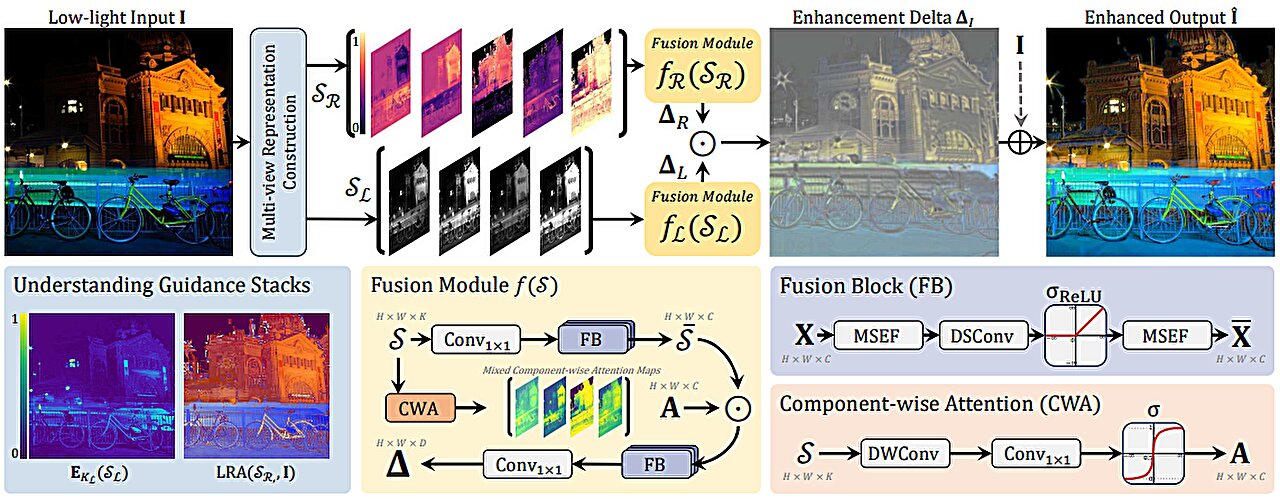
Illustration of Multinex Architecture. Credit: arXiv (2026). DOI: 10.48550/arxiv.2604.10359
A University of Manchester student has developed a powerful new ultra-lightweight tool that can turn dark, noisy footage into clear, detailed and usable images. Multinex, a new model for low-light image enhancement (LLIE), was created by Computer Science undergraduate Alexandru Brateanu during his third-year project, working with academic supervisors.
The model outperforms comparable compact systems, recovering detail and clarity from images that would previously have been considered unusable. The advancement has significant implications for photography, security, and a wide range of computational imaging tasks.
Low-light image enhancement seeks to restore natural visibility, color fidelity, and structural detail in scenes captured under poor illumination. While recent LLIE models have achieved impressive results, many rely on heavy architectures with large parameter counts, resulting in high computational cost and limited real-time applicability. Efficiency has therefore become a central research challenge: how to enhance images more effectively while dramatically reducing model size.
In the paper presented at the IEEE/CVF Conference on Computer Vision and Pattern Recognition (CVPR 2026), held in Denver, June 3–7, the team proposes a structured solution grounded in classical color vision theory and implemented using modern neural components within the Retinex framework. Retinex, a foundational approach in image enhancement, decomposes an image into illumination (light) and reflectance (color) components to better handle low-light scenes. The study is also available on the arXiv preprint server.