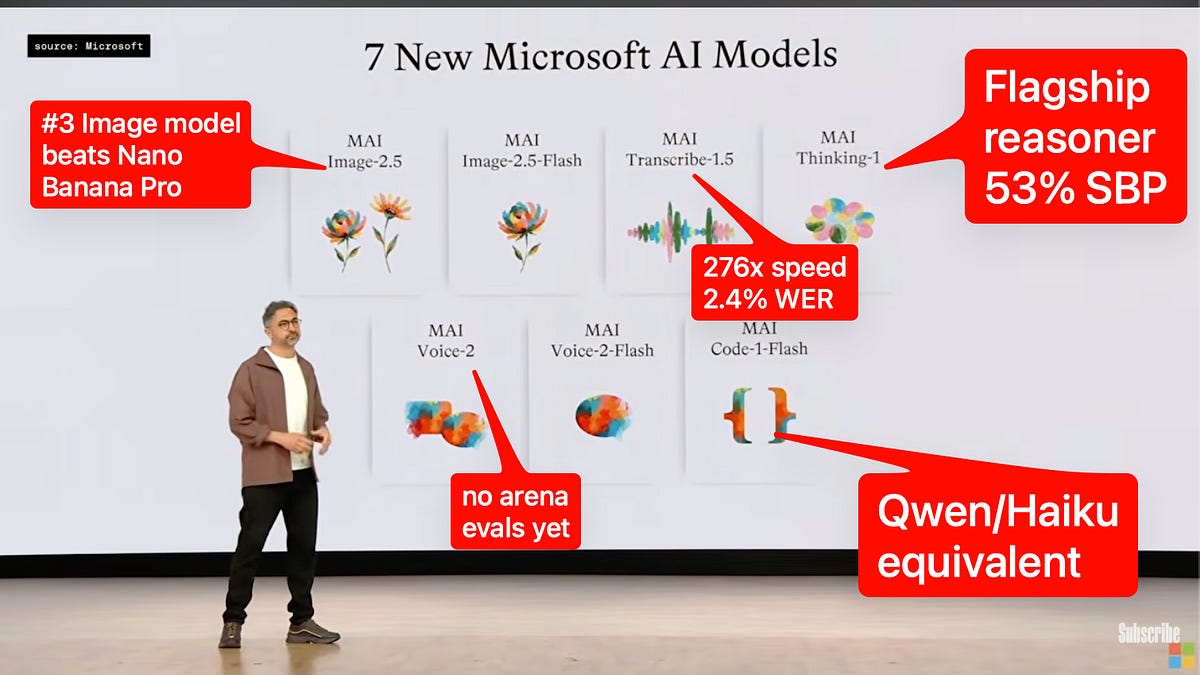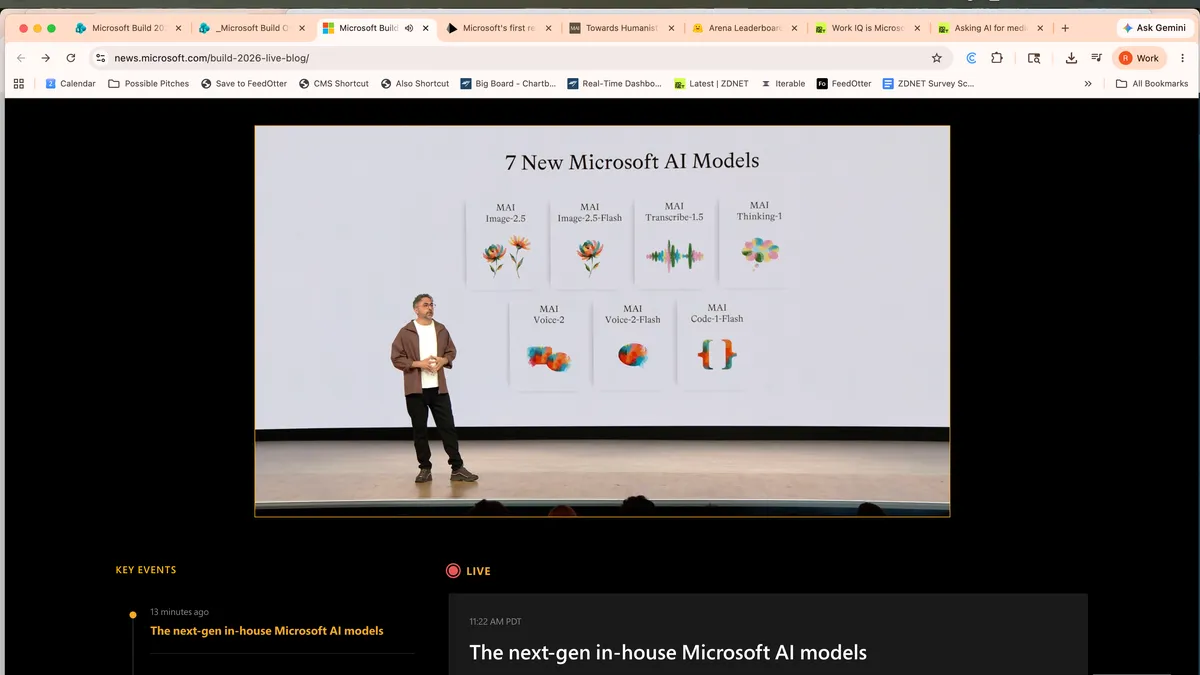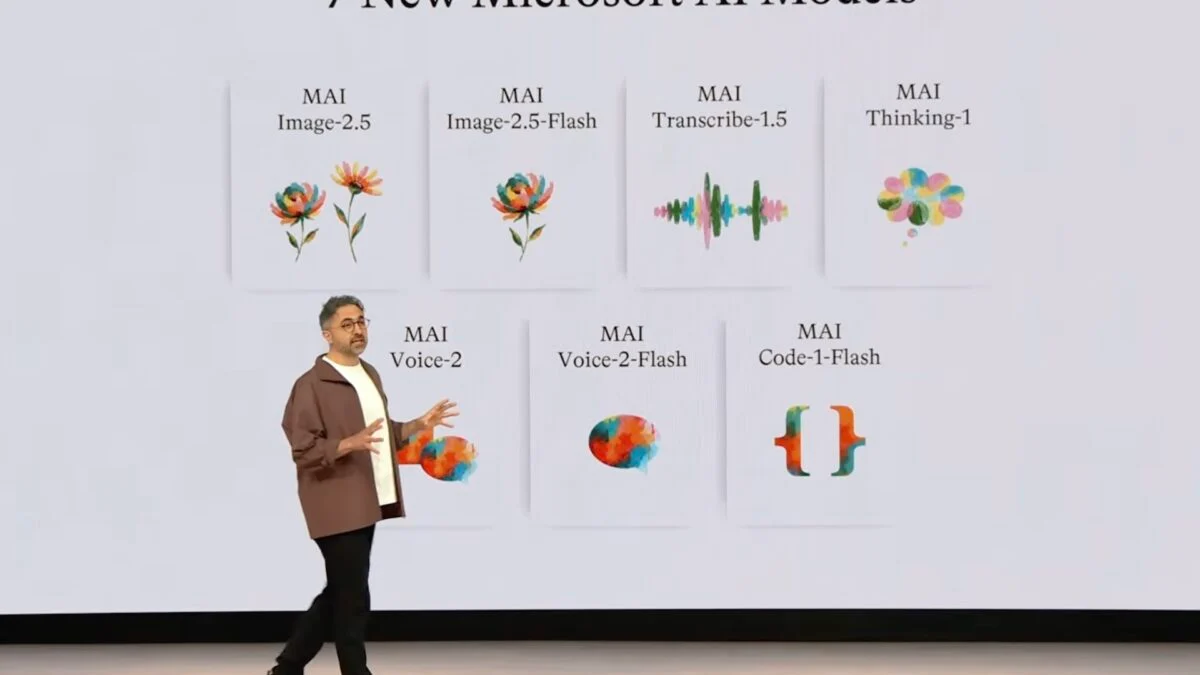
Figure 1. Image generation from Reve’s Reve 2, which uses a layout representation to combine high-quality details and fine-grained control on image outputs.Beyond these models, we’re building a superintelligence lab – a system and an approach we believe will define the next phase of AI. - Microsoft AIThe top AI model announcement for this week has been Microsoft announcing a new family of seven in-house MAI models at Build 2026. The new AI model lineup spans reasoning, coding, image generation, transcription, and voice, and includes MAI-Thinking-1, MAI-Code-1-Flash, MAI-Image-2.5, MAI-Transcribe-1.5, MAI-Voice-2, and Flash variants for image and voice.Microsoft launched MAI-Thinking-1 is a Mixture of Experts model with 1T total parameters and 35B active parameters; it’s their flagship reasoning model. Comparing it to Sonnet 4.6, Microsoft says it was trained from the ground up without third-party distillation and is competitive in its class on coding (52.8% on SWE-Bench pro, but only 46% on Terminal Bench 2.0) and mathematical reasoning benchmarks.Almost as impressive as the model itself is Microsoft’s 109 page technical report “MAI-Thinking-1: Building a Hill-Climbing Machine,” which shares details on the model architecture and how Microsoft AI trained their model. This is the most open an American AI lab has been about their work in some time.Microsoft also highlighted MAI-Image-2.5, including a Flash variant, as its new image model that ranks number two on Arena for image editing. Microsoft is rolling it out to support PowerPoint visuals and OneDrive Photos editing tools.Some of Microsoft’s other Build announcements:Microsoft unveiled the Surface RTX Spark Dev Box that uses Nvidia’s RTX Spark superchip to enable users to run powerful AI models on local Windows machines.Microsoft introduced their ‘always on’ AI agent Microsoft Scout, their entry into the general local AI agent, based on the OpenClaw framework and OpenShell.Microsoft introduced Work IQ APIs, a context layer for autonomous task execution and enterprise customization that leverages Microsoft’s ecosystem with Work, Fabric, Foundry, and Web IQ components.Microsoft unveiled the Majorana 2 quantum chip that features qubits that are 1,000 times more reliable than previous generations.Microsoft introduces Microsoft Execution Containers (MXC) to secure AI agents. MXC is a policy-driven execution layer built into Windows that allows developers and administrators to define sandbox environments and enforce access boundaries for AI agents.The bigger picture is that Microsoft is making a strategic shift toward in-house superintelligence development, directly challenging leading AI labs by becoming one. Microsoft also found itself behind the curve with its chatbot-based Copilot suite and is now trying to catch up with AI agent offerings and support.Nvidia made several announcements at Computex, including several new AI models. Nvidia released Nemotron 3 Ultra, a 550B parameter sparse MoE open-weights model with 55B active parameters, designed for long-context and agentic workloads. This Mixture-of-Experts model utilizes a hybrid Transformer-Mamba architecture, which supports a longer 1 million tokens of context as well as faster and lower cost inference for agentic workloads. Nemotron 3 Ultra and is being released with model weights, training assets, datasets, and related tooling. It is available on Amazon SageMaker JumpStart and other platforms.Nvidia also released Nemotron 3.5 ASR, a 600M parameter multilingual streaming speech recognition model. This model uses a cache-aware FastConformer-RNNT architecture to deliver high-quality speech-to-text in both streaming and batch mode transcriptions. Nemotron 3.5 ASR supports 40 language locales and adds punctuation and capitalization to transcripts.Nvidia announced RTX Spark, a new Windows PC platform built for local AI agents. Built on the same hardware used in Nvidia’s DGX Spark, the Windows RTX Spark delivers up to 1 petaflop of AI performance and up to 128GB of unified memory, offering the ability to run large and powerful AI models on Windows laptops and compact desktops.We wrote more on RTX Spark in “RTX Spark: AI Comes Home to the PC” as well as other Nvidia announcements, including the release of Cosmos 3, the latest iteration of their open-source frontier omni model for physical AI, which integrates world generation, physical reasoning, and action generation into a single framework.MiniMax announced M3, a native multimodal AI model with a 1 million token context window that is frontier-class at coding and agentic AI. Minimax touts M3’s impressive benchmarks such as 59.0% on SWE-Bench Pro and 66.0% on Terminal Bench 2.1, competing with Gemini 3.1 Pro and GPT 5.5. Minimax promises a fuller technical release with open weights in 10 days. When it does release, it will be SOTA for open weight AI models. In the meantime, access is via their API ( at $0.60 / $2.40 per million input / output ) and on the Minimax platform.OpenAI upgraded GPT-Rosalind for life sciences with new GPT-Rosalind capabilities aimed at enterprise-scale biology, genomics, medicinal chemistry, and drug-discovery workflows. The new GPT-Rosalind model release pairs GPT-5.5-style coding and tool use with life-sciences reasoning, adds research and analysis plugins in Codex. This places GPT-Rosalind as a domain-specific scientific AI workbench with provenance, tools, and controlled access. OpenAI is expanding access to eligible research organizations through a trusted-access model.OpenAI is significantly updating its Codex agentic AI platform for non-coding knowledge work. Codex is adding six role-specific plugins - data analytics, creative production, sales, product design, public-equity investing, and investment banking - that integrate over 60 business applications, such as Salesforce and Figma, to automate complex enterprise workflows.Codex is also being updated with a Sites features for hosting interactive, semi-private web applications and an Annotations feature for in-place content editing and refinement. These enhancements are designed to expand Codex’s utility for non-technical workplace users by deeply integrating it with existing professional tools and workflows. Codex has more than 5 million weekly users and non-developers make up about 20% of usage.Google released Gemma 4 12B, a new natively open multimodal model in the Gemma 4 family. With 12B parameters, performance that is SOTA for its size, and ability to process audio natively, it is a great laptop-runnable AI model for local AI use. Google also updated their Gemma 4 lineup with Quantization-Aware Training (QAT) to reduce memory footprints and help quantized Gemma models perform better.Ideogram released Ideogram 4.0 as its first open-weight text-to-image diffusion transformer foundation model. Ideogram 4.0 he model is a 9.3B-parameter text-to-image system trained from scratch, uses Qwen3-VL-8B-Instruct as its text encoder, and is built around structured JSON prompts with optional layout and color controls.Reve released Reve 2, a new text-to-image model centered on layout-aware generation and editing. As Reve says:Layout is a structured, hierarchical description of an image where every element has a location, a size, a local description, and other optional attributes like image references or color. A layout is an image’s backbone — separating semantic intent from pixel rendering, much like HTML is to a webpage or SVG to a vector image.Reve says the system separates planning from rendering, represents images in a structured form that makes individual elements addressable, and renders at native 4K resolution for more precise editing control.Figure 2. Reve defines an image using a layout structure that can be directly edited. With this, users can control the creation and editing of images more precisely.LMArena launched Agent Arena, a benchmark and comparison platform for AI agents rather than one-shot chat prompts. The platform evaluates agents built from models, tools, and frameworks across real-world tasks, and the launch included a public release of 2,000 pairwise agent battles and user preference data.ChatGPT is rolling out a new memory architecture called Dreaming, a more scalable memory synthesis system for ChatGPT designed to keep user context fresh, relevant, and correct over longer time periods. OpenAI says Dreaming improves how ChatGPT carries forward context, follows user preferences, and stays current. Memory for AI is evolving from explicit saved notes toward automated synthesis across conversations. The feature is available to Plus and Pro users in the U.S., with broader rollout planned for coming weeks.JetBrains open-sourced Mellum2, a 12B MoE model with 2.5B active parameters per token that is positioned for production AI workloads such as routing, summarization, and intermediate reasoning over natural language and code. The model was built from scratch and released under Apache 2.0 with weights available on HuggingFace.H Company launched Holo3.1, a family of local computer-use agent models ranging from 0.8B to 35B-A3B. H Company says the release improves robustness across web, desktop, and mobile environments, and raises AndroidWorld results from 67% to 79.3% on its 35B-A3B model.Alibaba released Qwen3.7-Plus, a multimodal model with frontier-level performance and a 1-million token context window. It is 60% cheaper than the previous text-only Qwen3.7-Max, but the release marks a departure from Alibaba’s open-source strategy, as the model is available only via proprietary APIs.Anthropic published “When AI builds itself,” a report on recursive self-improvement and AI-driven AI R&D. AI has progressed from chatbot to single agents to multiple autonomous AI agents, and now Anthropic lays out the next step, where AI agents “close the loop” and AI development becomes substantially automated. They show early evidence of this trend by noting Anthropic itself is shipping 8 times more code per person than in previous years. This near-future AI trend implies both AI acceleration and huge leaps in productivity in some companies.Figure 3. Anthropic engineers are becoming vastly more productive by leveraging AI tools. Most of Claude Code is written using Claude Code itself.Anthropic has filed confidentially for an IPO following an oversubscribed $65 billion fundraise at a $965 billion valuation. The IPO depends on SEC review and market conditions, but it is expected later this year and could be the second trillion-dollar IPO following the SpaceX IPO. Anthropic’s annualized revenue surpassed $47 billion in May, up from roughly $9 billion at the end of 2025.SpaceX is becoming a hyperscale AI compute provider as it preps for its historic IPO on June 12. SpaceX has secured a deal with Google to provide approximately 110,000 Nvidia GPUs and related components from October 2026 through June 2029. Google will pay $920 million per month to secure bridge capacity for surging demand on its Gemini Enterprise AI platform, follows a similar computing agreement between Anthropic and SpaceX.OpenAI called for global action on youth AI safety through a dedicated AI Safety Institute. OpenAI is advocating for the establishment of an international institute to provide continuous oversight and standardized guidance for youth AI safety. President Trump signed an executive order on AI innovation and AI security. The new Executive Order NSPM-11 emphasizes promoting appropriate AI adoption and AI innovation for national security, while coordinating with the private sector on security risks. It also directs federal agencies to prioritize AI-related cybersecurity, establish an AI cybersecurity clearinghouse with voluntary industry collaboration, and expand federal cybersecurity hiring pathways. Senior U.S. officials have been discussing with AI firms such as Open AI the potential for the federal government to acquire shares in those companies. Giving the U.S. government equity stakes in AI companies could have seismic consequences. While the arrangement could fund public purposes like dividend payments, critics warn that government ownership could create conflicts of interest in technology regulation.OpenAI and other AI leaders have backed synthetic DNA screening rules, with executives and scientists from leading US AI labs signing a letter urging U.S. lawmakers to require screening of synthetic DNA and RNA orders. The DNA-screening letter expresses the concern that advanced AI is lowering the knowledge barrier for designing dangerous biological materials, making gene-synthesis oversight more urgent.Character.AI and Google reached settlements with families over teen suicide claims, notifying a Florida federal court of a mediated settlement to resolve all claims. The litigation included a high-profile lawsuit alleging that the chatbot encouraged a 14-year-old to commit suicide.Meanwhile, OpenAI is responding to a lawsuit filed by the family of a teenager who died by suicide, arguing that the chat logs used in the allegations ‘require more context.’ They also claim the chatbot frequently directed the user to crisis resources and that the incident resulted from improper use of the platform.The Linux Foundation unveiled plans for the Tokenomics Foundation to address rising AI token costs. The Tokenomics Foundation charter is to establish open industry standards, benchmarks, and best practices for the economical use of AI infrastructure. The new standards body aims to establish a framework for tracking, auditing, and optimizing AI token usage and billing.The New York State legislature passed a one-year moratorium on large new data centers. The bill directs an environmental agency to assess the electricity, water, and land usage of large-scale facilities.Meta has built data centers in tents to accelerate AI infrastructure deployment. The company has constructed six “rapid deployment structures” in New Albany, Ohio, to reduce construction time by half. These structures will house AI chips and are powered by 200 megawatts of modular gas turbines.
AI Week in Review 26.06.06
Microsoft's MAI-Thinking-1, MAI-Code-1-Flash, MAI-Image-2.5, Scout AI agent. Nemotron 3 Ultra & 3.5 ASR, RTX Spark, Minimax M3, Gemma 4 12B, Reve 2, Ideogram 4.0, Mellum2, Qwen3.7-Plus, Holo 3.1.
2,090 words~10 min read