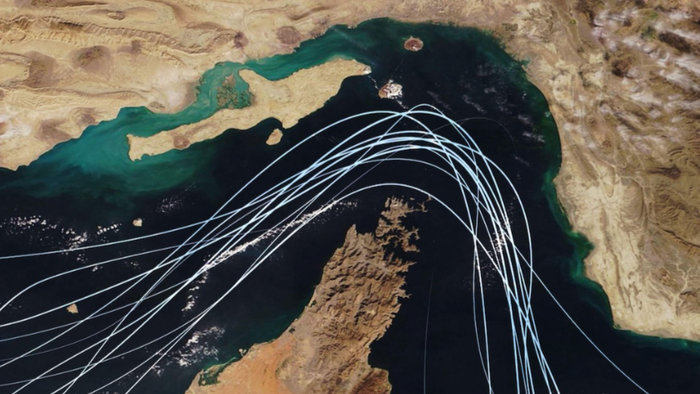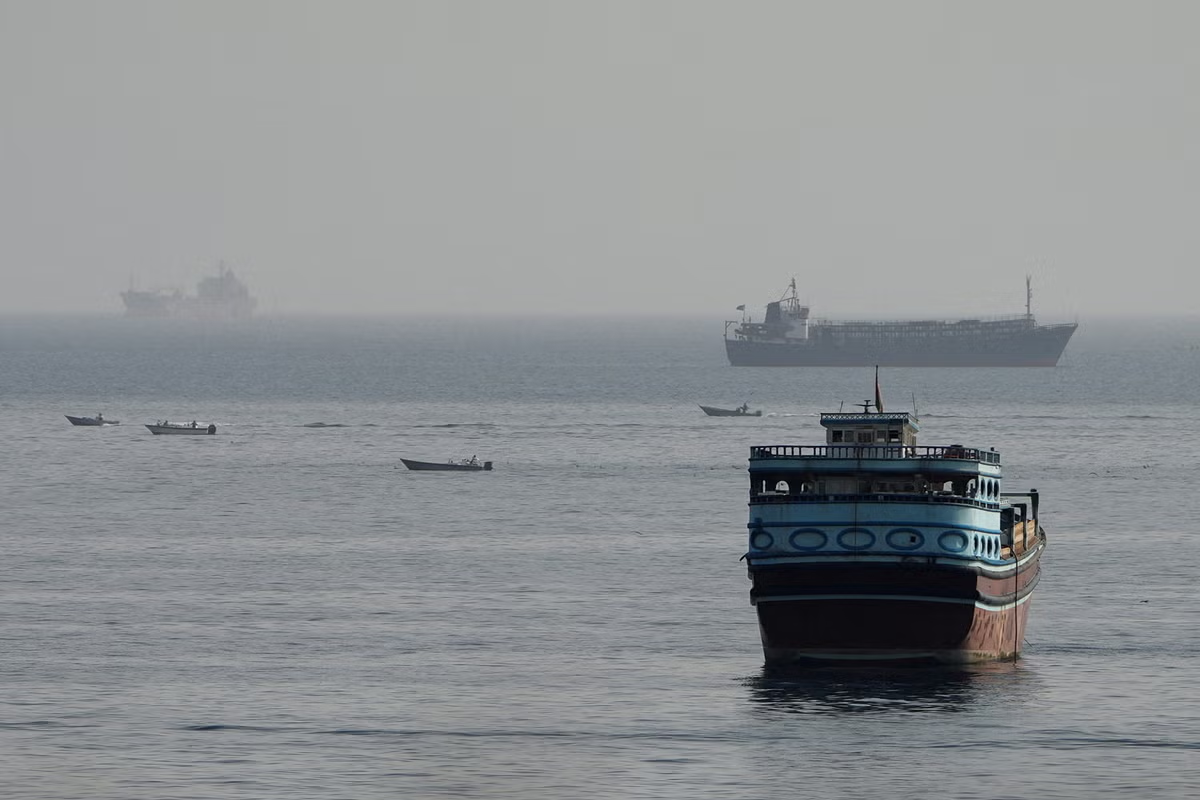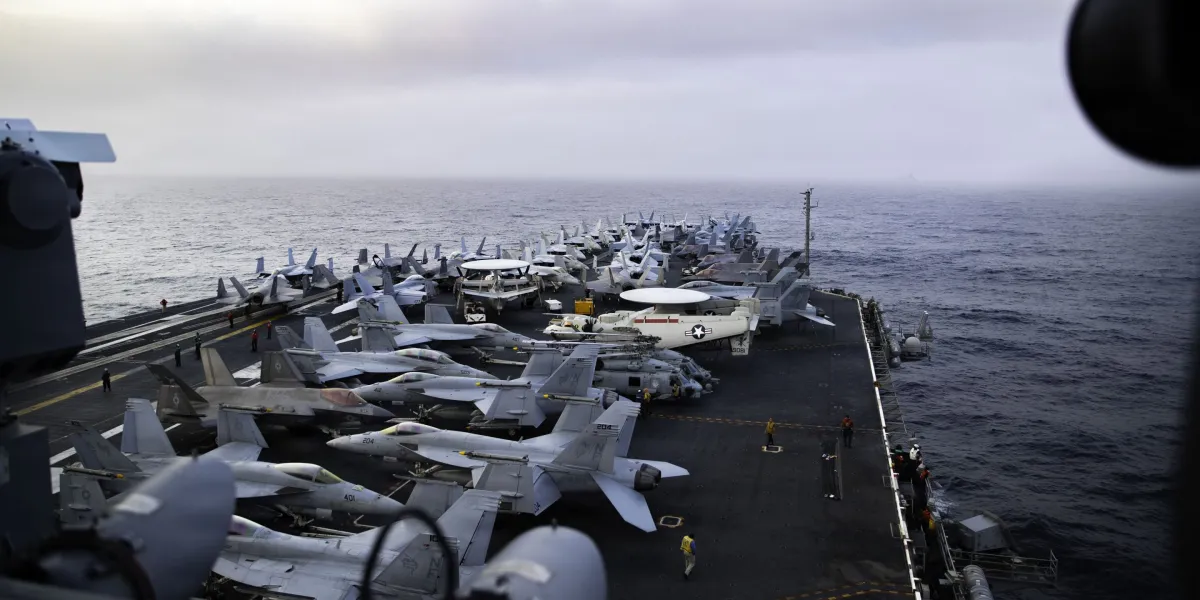
As one deadline for a peace deal in the U.S./Israel-Iran war passes another, the chance of no firm agreement being struck to end the conflict in the coming months is rising dramatically. There are good reasons why Washington under President Donald Trump may be perfectly happy to keep this conflict simmering as it is, including the effective closure of the world’s critical transit route, the Strait of Hormuz. There are also good reasons why Tehran under the Islamic Revolutionary Guards Corps (IRGC) might wish to do the same. So, it may be that both sides are simply playing at the peace talks game to placate dissenting voices at home, rather than meaningfully seeking an early end to the war. If this is the case, then what are the short-term and longer-term implications for the oil markets?The underlying reasons for each side keeping the stalemate going are compelling. For the IRGC, which acts as the guardian of the philosophy underpinning Iran’s 1979 Revolution at home and the promulgators of those ideas abroad through its proxies, any peace deal with the U.S. could turn into an existential threat. The key thrust of all such deals by Washington -- from the original version of the Joint Comprehensive Plan of Action (‘JCPOA’, or colloquially ‘the nuclear deal’) formulated by former President Barack Obama’s team to its latest iteration under Trump -- is the eradication of the IRGC in its present form, as analysed in full in my latest book on the new global oil market order. The underlying idea of the U.S. and its key allies has been to strip away the unique financial, business, and political support structures for the IRGC across the basic fabric of Iran, and to roll it into the regular army. This, the argument runs in Washington, would eventually prove terminal to the Islamic regime itself, which would be replaced by a democracy of one sort or another over time. For Washington now, this remains the long-term objective for Iran, and because of the Pentagon’s dire wargaming outcomes involving a U.S. ground invasion of the Islamic Republic, it is believed that further tightening sanctions on it -- however long that takes -- is the only realistic option to achieve that aim. While critical to the U.S.’s long-term security plan for the Middle East, this strategy also has far-reaching implications globally. Ongoing U.S. efforts in and around the Strait of Hormuz to reduce China’s previous tight control over the waterway (through all-encompassing cooperation agreements with Iran also fully detailed in my latest book) reflect Washington’s broader strategy to secure key global pressure points at China’s expense. Aside from moves to reinforce U.S. influence over other critical transit routes — including the Greenland–Iceland–UK Gap and the Panama Canal — the U.S.–Indonesia ‘Major Defense Cooperation Partnership (MDCP)’ signed on 13 April is a further example highlighted recently by OilPrice.com. Given this, the longer Washington has for rolling out this strategy to the detriment of Beijing, the better for it.But these are not the only major globally strategic benefits for Trump in keeping the stalemate in Iran as it is. The U.S.’s ‘2025 National Security Strategy’ (NSS) officially put the Trump 2.0 worldview on paper. It explicitly introduces what it calls ‘The Trump Corollary to the Monroe Doctrine’, stating: “After years of neglect, the United States will reassert and enforce the Monroe Doctrine to restore American pre-eminence in the Western Hemisphere, and to protect our homeland and our access to key geographies throughout the region.” It added: “We will deny non-Hemispheric competitors the ability to position forces or other threatening capabilities, or to own or control strategically vital assets, in our Hemisphere. This ‘Trump Corollary’ to the Monroe Doctrine is a common-sense and potent restoration of American power and priorities, consistent with American security interests.” Back in 1823, when the ‘Monroe Doctrine’ was propounded by U.S. President James Monroe, the aim of the policy was to keep European colonial powers out of the Americas. This new iteration -- termed the ‘Donroe Doctrine’ -- means a dramatic shift away from a post-Cold War model of global American dominance into a highly transactional, realpolitik vision of a world effectively carved into three distinct spheres of influence. China would hold the primary role in Asia, while Russia would either dominate or significantly influence Europe, depending on how any future conflict between European NATO members and Moscow unfolds. But, at the top, the U.S. would maintain overall dominance and exert direct influence across North and South America. The practical consequence of this for global oil flows is that the U.S. aims to orchestrate a dramatic ramping up of oil production not just domestically but across key countries in its Americas sphere of influence -- notably Venezuela, Argentina, and Brazil -- to compensate for losses from the Middle East, as also fully examined recently by OilPrice.com.The relative subduedness of front-month oil prices so far in the U.S./Israel-Iran war has entirely been due to an unprecedented, temporary wall of global emergency supply and historic pre-war inventory cushions. But these factors will be increasingly difficult to maintain the longer the current stalemate lasts. One key element was the March triggering of the largest emergency stock release in history, as the 32 member countries of the International Energy Agency (IEA) flooded the market with 400 million barrels of emergency oil. That said, this can be regarded as essentially a ‘one-shot strategy’, with over 250 million barrels having already been used during the heavy inventory drawdowns of April and May alone. Additionally, heading into the crisis, the U.S. oil industry was already pumping at absolute record highs, providing a vital supply baseline of 13.6 million barrels per day (bpd). Again, though, despite calls from President Trump for this figure to be ramped up, big independent producers and majors are maintaining pre-war capital expenditure plans, with many having stated that they are already running close to full capacity and cannot expand overnight. And finally, the commercial market is burning through global inventories at an unprecedented, record-breaking pace. Combined with the Strait of Hormuz blockade and infrastructure damage in the Gulf (which has shut in roughly 9 to 13 million bpd of production and refining capacity), the IMF has officially warned that global oil inventories are on track to hit a critical five-year low by July this year.After July, the deceptive subduedness of early 2026 appears likely to start disintegrating, with the benchmark Brent crude oil price breaching its recent US$95–110 range. Front-month prices are projected to spike rapidly into the US$120-135 a barrel window by late summer, according to the World Bank’s ‘Large Disruption Scenario’. This initial rise would be driven by refiners seeking to replace missing Middle Eastern heavy barrels and by localised product shortages as commercial inventories fall to five?year lows. Looking further ahead, the markets might yet recall the US$200 a barrel target referenced by Iran at the onset of the hostilities. As time passes after the July cliff, traders are likely to pay an increasing premium for immediate physical supply, with the price boosted further as governments and central planners realise they have emptied their Strategic Petroleum Reserves. This could well trigger a secondary wave of even more concerted buying, adding massive artificial demand to an already ultra-tight market, pushing prices yet higher toward the US$200 a barrel mark. At that point, the global economic engine would simply stall while the world economy rebalances to a new normal oil price considerably higher than where it is now.By Simon Watkins for Oilprice.comMore Top Reads From Oilprice.comEU Says No Jet Fuel Shortage Coming Despite Middle East Supply LossUK Conservatives Blast Labour North Sea Ban as 'Utter Madness'Australia's 344-Million-Barrel Oilfield Could Finally Get the Green Light
The Iran Stalemate Could Be the Next Oil Supercycle Trigger | OilPrice.com
U.S.-Iran peace talks appear stalled, with both Washington and Tehran potentially benefiting from a prolonged conflict rather than a rapid settlement, keeping the Strait of Hormuz effectively disrupted.
1,284 words~6 min read