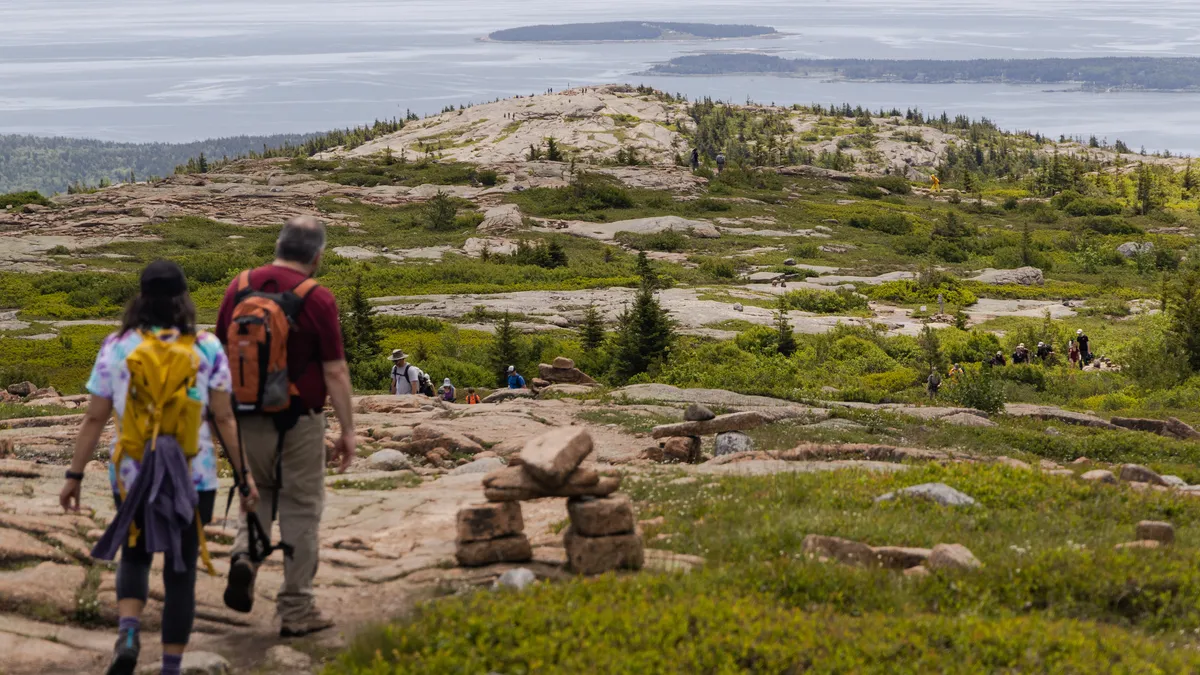
Visitors can carry soil to Acadia’s fragile mountain summits while enjoying a free guided hike and helping restore damaged ecosystems.Show Caption
High visitor traffic at Acadia National Park is causing erosion and damage to unique summit vegetation.A program called Save Our Summits allows volunteers to help restore the ecosystem by carrying soil on guided hikes.The free, guided hikes run on Wednesdays and Fridays from late June through late September.Acadia National Park is one of the most visited national parks in the U.S., with more than 4 million visitors last year – each one impacting that park.Many travelers are drawn to Mount Desert Island’s mountain tops, with panoramic views of the ocean. Cadillac Mountain is so popular that reservations are required to drive up its summit road each summer. All those visitors, however, can and often do unwittingly harm the very things that make that experience so special."(The summits) have a really unique vegetation community that's low lying, so you can see those beautiful vistas of the ocean," said Dr. Chris Nadeau, a climate change adaptation scientist at the Schoodic Institute, a nonprofit science organization that partners with the park. "As you get lots of people up there and they want to get a unique view of the sunset, et cetera, they will often step on that vegetation ... and after not that many steps, that vegetation starts to die. And then once the vegetation's dead, we just get a big rainstorm or a big windstorm and that washes or blows the soil off the mountain. And then once the soil's gone, getting plants back in those places is really, really tough."Recent research from Expedia Group found that more than half of the 2,500 global respondents say having an immersive trip is more important today than it was five years ago. And more than 90% say taking part in local activities contribute to a more immersive travel experience.This summer, visitors can help immerse themselves and contribute to reversing Acadia’s erosion, while also getting a free guided hike in the park. Here’s how.Saving the summitsFrom late June through late September, the nonprofit conservation organization Friends of Acadia runs a Save Our Summits program in partnership with the Schoodic Institute and the park.Twice a week, on Wednesdays and Fridays, volunteers can take a guided hike up either Penobscot Mountain or Sargent Mountain with a backpack full of soil to leave at the top, for restoration projects in the fall."Soil’s the secret sauce," Nadeau said. "If we can get soil back there, then plants will naturally kind of recolonize that soil."Unlike Cadillac Mountain, which can be accessed by dump trucks, hiking is the only way to bring soil up Sargent and Penobscot. Since Save Our Summits began in 2023, Nadeau said nearly 800 volunteers have carried over 13,000 pounds of soil up."We’ve been able to restore a lot of area on the summits," he said. "There’s still lots to be done, so we still need people to be carrying soil up there."What to expect Save Our Summits hikes are about 4 miles roundtrip and capped at 20 volunteers, who are typically a mix of locals and visitors.Registration begins June 8 on Friends of Acadia’s website. Slots open up two weeks before each hike, with the first one beginning June 24.Volunteers bring their own backpack for carrying soil and water to stay hydrated and should also wear appropriate shoes. On the day of their hike, they meet up at the trailhead for Parkman Mountain Carriage Road, off Route 3, within the park."We walk along the carriage roads about a mile, which is a nice, pretty easy level walk. And then we hit our soil pile, which is just a giant mound of soil, and we measure out the weight and the volume of the soil and load that into bags for people to load into their backpacks," said Lauren Knierim, a community volunteer ambassador supporting Friends of Acadia and Schoodic Institute programs. "I remind them it will get heavier as we walk."She said volunteers usually carry 5 to 25 pounds of soil, depending on their personal comfort level, but they're welcome to carry less or none at all if they just want to join the hike.From there, they head up the Hadlock Brook Trail, which Knierim described as pretty steep, before branching off to either Penobscot Mountain or Sargent Mountain, depending on the destination that day. "It's definitely a push near the top," she said, noting that she’s heard the hikes referred to as nature’s most beautiful StairMaster. "You get all these really flat granite surfaces that you're sometimes crawling up, but volunteers really hang in there. I'm usually the one tired."The whole group stays together on the way up."You kind of go as fast as the slowest person, really," said Lauren Gibson, who coordinates Friends of Acadia’s Wild Acadia program, which focuses on park restoration. While Save Our Summits hikes are primarily aimed at restoring summits, she noted they also build community. “It's really a feel-good participatory event for people to engage in.""People start out as strangers at the bottom of the mountain and at the top, they’re best friends," said Knierim.Once Save Our Summits volunteers reach the top, they drop off the soil, take a group photo and celebrate a bit. Then, Gibson said volunteers can choose their own adventure. "They can hike back down the way that they came, at their own pace, or visit Sergeant or Penobscot – the other peak that is close by that they didn’t get to – or take a different trail down."Most people spend about four hours total on the experience.Visiting Acadia National ParkThe hikes are free and voluntary, but there is a fee to enter Acadia National Park for most visitors, who don’t have an America the Beautiful public lands pass.Standard entry fees are $35 per private vehicle, $30 per motorcycle and $20 per person age 16 and over entering the park without a vehicle.Entry fees are waived for U.S. residents on certain fee-free days throughout the year. They’re also waived year-round for veterans, active-duty service members, Gold Star families, fourth graders and U.S. residents with disabilities, with special America the Beautiful passes.However, new this year, non-U.S. residents age 16 and over must pay an extra $100 per person fee to enter Acadia, as well as several other popular national parks. That’s on top of the standard entrance fee. Non-residents can also buy America the Beautiful annual passes, but theirs cost $250 instead $80 for U.S. residents.