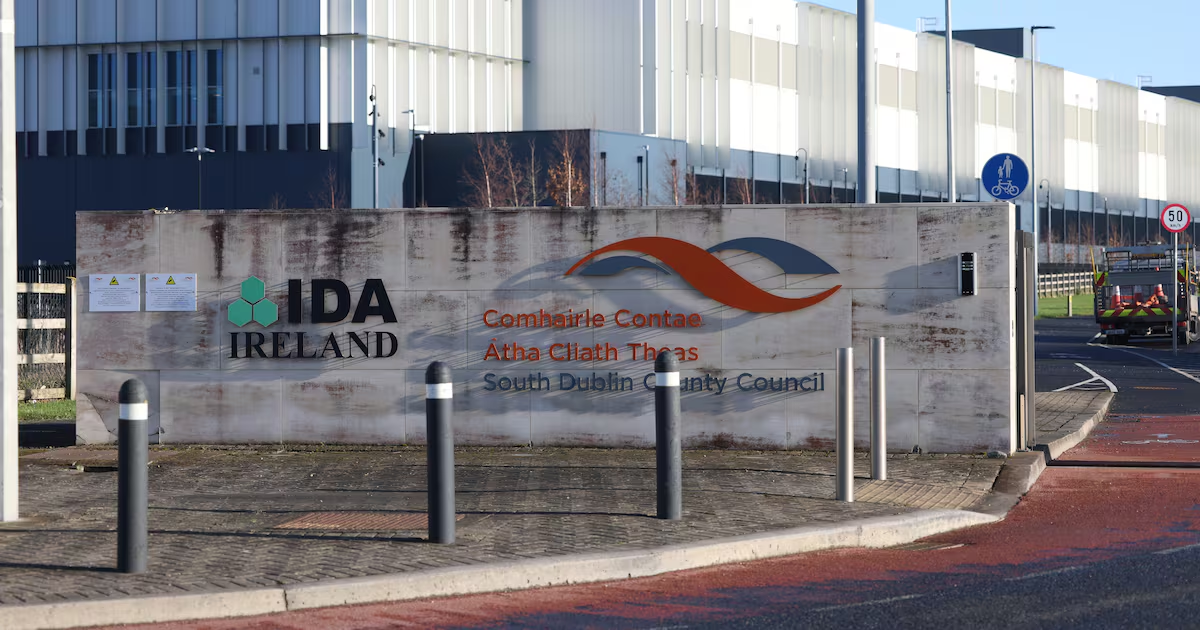
Sir, – In reference to the article “Ireland’s data centre strain a ‘cautionary tale’ for rest of world, UN says,” (June 3rd), the author makes the valid point that Ireland’s energy sector is failing to cope with the rapid development of data centres. However, the comparison with other countries is unfair and fails to portray it as an opportunity rather than a burden. In Australia, for example, the mining industry accounts for 20-35 per cent of total electricity use. In the United States, many heavy industrial and mining operations generate their own electricity on-site from fossil fuel production. Ireland has an essentially negligible extractive and heavy industries sector by international standards so it is not unreasonable that a large percentage of our energy usage is directed to high-tech industries.The issue with Ireland’s data energy and water usage is a lack of foresight from successive governments. Due to our current high-tech industrial base and abundance of water and wind resources, we are in an excellent position to lead on sustainable data centre development. This would require foresight and investment which Ireland has not arguably had since the early foundation of the State; requiring the funding of a large new industrial port capable of manufacture and transport of offshore turbines, substantial investment in our abundant water resources, and investment in smart grid and battery technologies. If wind and water could be viewed as traditional resources, the Government would not hesitate in making a generational investment in the large infrastructural projects to bring it online. As data centres proliferate in the rest of the world where governments have a history of investment and delivery of large-scale industrial projects, Ireland risks missing a significant opportunity to develop both its renewable and data sectors in a mutually beneficial way. – Yours, etc,JOHN BRAZIL,Melbourne, Australia. Sir, – The credit card industry has a name for customers who pay their bill in full every month – “Deadbeats”. This is because they earn no interest from these canny customers. The electricity debate in Ireland also increasingly features a “deadbeat” customer – the household consumer with solar panels and batteries.Investors in large-scale renewable power projects are not chasing household customers who will have zero or negative bills for significant periods of the year. These companies are investing to supply industrial-scale users like factories and data centres – hence the more favourable rates. Households with tiny sporadic seasonal usage are simply not attractive customers.The popular narrative that households would have cheaper power but for data centre demand is deeply flawed as it unreasonably assumes that new generation would continue to come on stream without industrial-scale demand. This is by no means certain and the academics should well know it.Data centres are also deemed fair game as they employ so few people but Ireland should be less concerned with the numbers employed and more focused on taxable value creation. We left make-work schemes behind long ago.If AI lives up to a fraction of the hype, the location of the data centres powering it will become key to taxing rights and critical to Ireland’s future prosperity. We shun them at our peril. – Yours, etc,ALEX WILSDON,Dublin Road,Kilkenny.Making peace for UkraineSir, – Ukraine president Volodymyr Zelenskiy’s call for Russia-Ukraine talks in a neutral third country presents Ireland with an opportunity to make a practical contribution to peace. The Government should publicly offer Ireland as a venue.Ireland is uniquely placed to do so. As an EU member committed to international law, yet outside Nato, it occupies a position that combines political credibility with a tradition of independent diplomacy. Our long-standing contribution to UN peacekeeping and our own experience of conflict resolution give Ireland a reputation as a constructive and trustworthy host.There is a precedent. During the Cold War, Iceland provided the setting for pivotal East-West diplomacy, most notably the 1986 summit between Ronald Reagan and Mikhail Gorbachev in Reykjavík. While that meeting did not immediately end superpower rivalry, it helped foster the conditions that eventually did. Small states can sometimes provide the political space that larger powers cannot. The Oslo Accords of the 1990s are another good example.Offering to host talks would not imply moral equivalence between the parties, nor would it require Ireland to abandon the support it has offered to Ukraine. It would rather reflect our long-standing Irish commitment to the peaceful settlement of disputes, and our wish that peace should prevail.Of course, negotiations may or may not succeed. But if the parties are seeking a neutral venue, Ireland should be prepared to answer the call. – Yours, etc,PROF CIARÁN BURKE,Jena Center for Reconciliation Studies,Friedrich-Schiller-UniversitätJena,Germany.Aughinish AluminaSir, – Justine McCarthy raises several questions about exports of alumina from Ireland to Russia. Is it 45 per cent or 83 per cent of output? (“Wilful ignorance is no excuse in Aughinish Alumina’s case”, June 5th.)Whether it is one or the other, or some figure in between, that percentage of total export should be stopped, stockpiled and sold to other markets. To do so will not make the total workforce redundant. How can we weigh the theoretical loss of jobs with the certainty of the loss of innocent lives in Ukrainian cities? – Yours, etc,JIM HOLOHAN,Stranorlar,Co Donegal. Private maternity coverSir, – Well done to Minister for Health Jennifer Carroll MacNeill for taking on the power of private consultants in the field of obstetrics. And well done to Fintan O’Toole for his column (“Rotunda’s defiance of public policy shows us how some are born more equal”, June 2nd). If the defenders of the private consultants wish to block the Minister’s reforms, they should be asked to develop an alternative plan for managing healthcare in Ireland so that we get value for money. Currently, we spend more public money on the health service than comparable jurisdictions but get a low return by international standards. The cause? Powerful vested interests and a weak State.France has a centrally co-ordinated universal public-private model of healthcare that is known to deliver on both health outcomes and cost effectiveness. Without slavishly following that model, it is past time for facing down powerful private interests in the Irish health service. – Yours, etc,DAVE ALVEY,Daingean,Co Offaly.Fertility rates alarmSir, – Perhaps the most alarming and far-reaching news in Ireland this year comes from the Central Statistics Office, with the recent release of details of the fertility rate for 2025. It has amazingly dropped to 1.5. This is far below the 2.1 rate which is considered the value required for the population to sustain itself in the long term. This, coupled with the increase in average age of first-time mothers to 31.8 years, is a wake-up call to Government that something must be done as soon as possible. Otherwise the situation will result in great upheaval, socially, economically, culturally and existentially.If we ask ourselves what are the main causes of this unfortunate situation, we might come up with an answer. The cost and scarcity of affordable housing is certainly one factor. Another one is the immense pressure on mothers today who are forced by economic pressure to work outside the home in an effort to make ends meet. Many of these mothers would prefer to be given the Constitutional guarantee of State support that would enable them the option not to send their infants to creches. They would prefer to be given the choice to raise their children at home, at least for the first three or four years. If Government supported them financially, it could greatly ease the burden and might help raise the fertility rate. – Yours, etc,BOBBY CARTY,Templeogue,Dublin 6W.Ireland, Israel and boycottsSir, – I am disturbed by the furore about Ireland’s forthcoming Uefa Nations League fixtures against Israel on September 27th and October 4th. Anti-Israel sentiment seems to me uniquely obsessive in this country, amplified in media and public discourse to a greater extent than elsewhere outside Israel’s traditional enemies. Particularly disturbing is the inconsistency of outrage. Last week 28,981 people attended Ireland v Qatar at the Aviva Stadium. Qatar shelters and finances the leaders of the Hamas terrorist group, which waged a sickening attack on Israel, and the worst pogrom on Jews since the Holocaust, on October 7th, 2023 . In 2021 the Guardian newspaper concluded that more than 6,500 migrant workers from India, Pakistan, Nepal, Bangladesh and Sri Lanka had died in Qatar on construction sites for the 2022 soccer World Cup. Yet there was no protest against Qatar in the Aviva. Nor are there signs of opposition to the Ireland cricket team’s planned five one-day internationals against Afghanistan in August, despite the appalling human rights violations of the ruling Taliban. Women and girls are being systematically erased from public life, education and healthcare in Afghanistan. We saw no protests outside the Iranian Embassy in January and February when, according to international media, about 30,000 civilians were murdered in just three days after protests against the brutal regime. Iran sponsors Hizbullah, whose terrorists murdered Pte Seán Rooney in Lebanon in 2022. Iran and Hizbullah propped up the Al-Assad regime in Syria during the civil war of 2011 to 2024 in which nearly 600,000 civilians are estimated to have been killed. I was shocked to see the new Iranian Ambassador being welcomed by President Catherine Connolly at Áras an Uachtaráin last month. The civilian death toll in Gaza is a tragedy, and informed criticism of Israel is valid, yet I have heard few voices criticising Hamas for using innocent Gazans as human shields, refusing them shelter in their underground tunnels, and operating militarily in schools and hospitals. What message is Ireland sending to the wider world? That we shrug off the brutalities of Hamas, Hizbullah, Qatar and Iran while obsessing about Israel, the world’s only Jewish state and home to half the world’s remaining 16 million Jews, who make up just 0.2 per cent of the global population? The continued focus on the forthcoming matches, not least in the Dáil which surely has more urgent issues to grapple with, feels unbalanced and frankly somewhat unhinged. Irish people can claim all we might that anti-Semitism and Israelophobia are not the significant problems I believe them to be in our country, but we should not be surprised if much of the rest of the world begs to differ. – Yours, etc,DR PETER BOYLAN,Ranelagh, Dublin 6.Remembering Fergus SlatterySir, – The death of Fergus Slattery is a sad day for his family, for rugby, and for the wider sporting world. In his tribute Gerry Thornley (June 5th) described him as “arguably the greatest openside in the world.” For those of us fortunate enough to have met him, that greatness extended far beyond the rugby field.I recall my involvement with Ballyfermot Community Television during the 1980s. One evening, our sports reporter, Frank, announced that he had secured a very special guest for our weekly one-hour programme. To our amazement, that guest was Fergus Slattery.At the height of his sporting reputation, he was a world-class rugby player and one of Ireland’s most recognisable sportsmen. Yet he willingly travelled to Ballyfermot, a community far removed from the rugby traditions of Blackrock, to share his experiences with local viewers.He arrived with remarkable humility, warmth and generosity. During the interview, he provided a fascinating insight into the game of rugby and encouraged local people to consider establishing a rugby club. As he left the studio, he quietly remarked, “I am happy to come back if you do.”That simple comment spoke volumes about the man. It reflected not only his passion for rugby but also his willingness to inspire others and support grassroots sport. Fergus Slattery was a sporting giant but, more importantly, he was a genuine gentleman.May he rest in peace. – Yours, etc,THOMAS MORRIS GORMALLY.Rathangan,Co Kildare.Inheritance tax in IrelandSir, – I have nieces and nephews in Ireland and America to whom I would like to give a substantial inheritance. In America,where I and my assets reside, I can pass along these monies without anyone paying estate or inheritance tax. If I include my Irish clan, in contrast, the Irish Government limits each gift to a de minimus level (€40,000) and then takes one-third of the balance. This Government policy hurts everyone in Ireland as it makes little sense to include my Irish relatives under such circumstances. Is Ireland really so fixated on inequality that it would rather its citizens get nothing from overseas uncles than watch a few relatives gain something? In reality my nieces and nephews would spend and invest this money in Ireland, paying VAT and other taxes as they did so. The country as a whole would benefit. The Irish tax system is already so onerous and progressive that it seems totally counterproductive to discourage windfalls from abroad for its citizens. – Yours, etc,BRIAN O’ REILLY,New York.
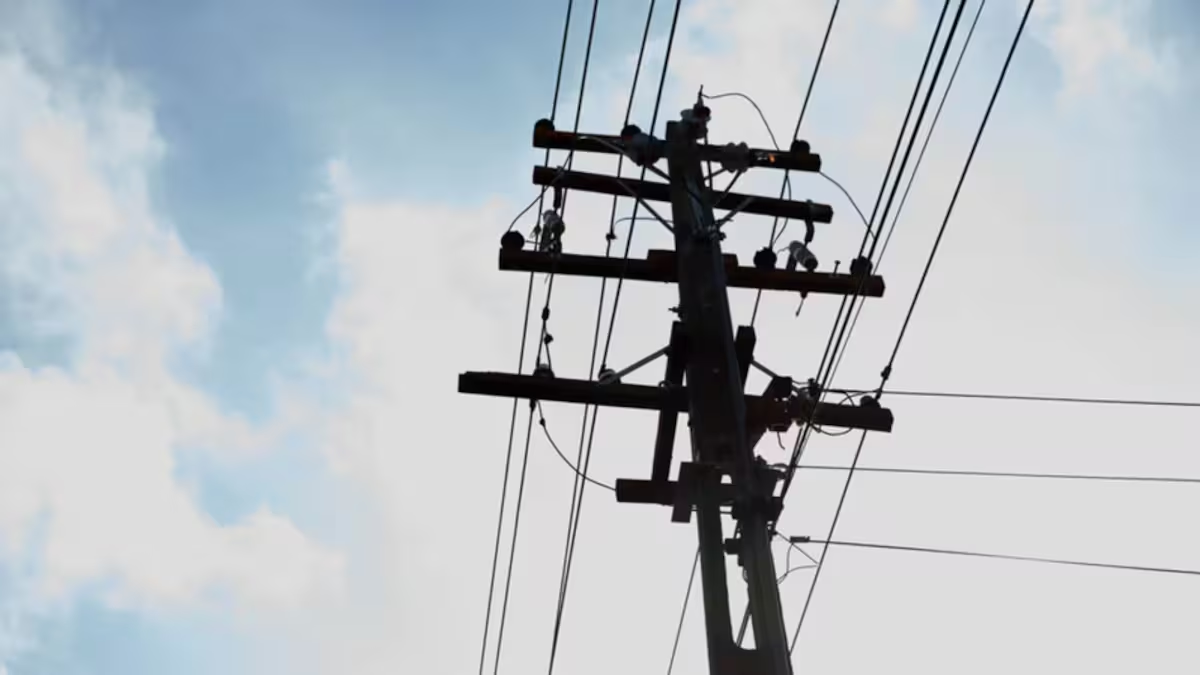
Letters to the Editor, June 8th: On crunching the data centre numbers, private maternity cover and inheritance tax
The comparison with other countries is unfair and fails to portray it as an opportunity rather than a burden.
2,119 words~10 min read