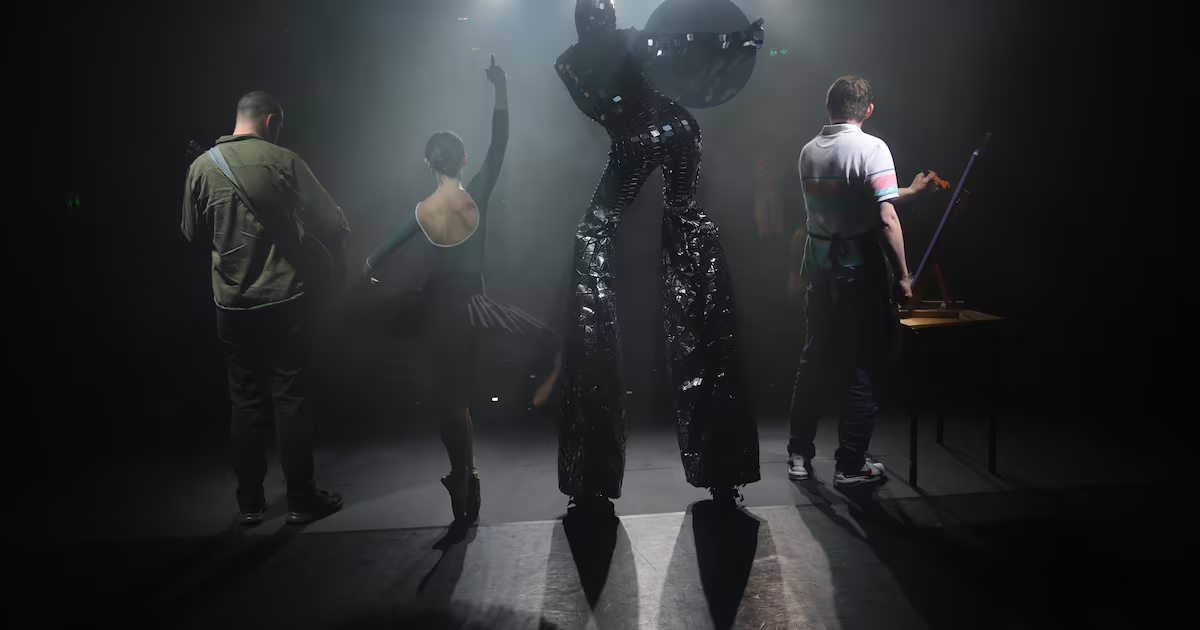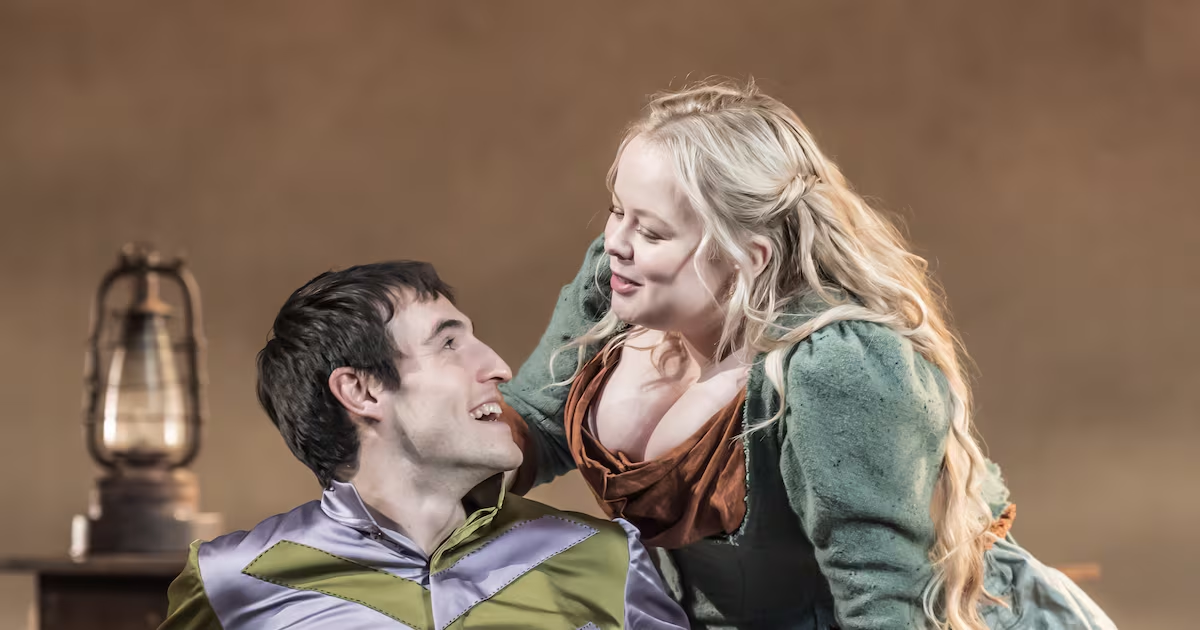
Walk by theatres in Dublin on a Sunday night and you’ll see the shutters drawn. Catch a glimpse inside and you might spot the ghost light shining on an empty stage. Although exceptions are made during panto season, Sundays have traditionally been a day of rest for actors and audiences alike. One recent Sunday evening, however, the foyer at the Pavilion Theatre in Dún Laoghaire was packed with an eager audience who were queuing to take their seats for a sold-out production of All My Sons featuring the Hollywood star Bryan Cranston and the Oscar nominee Marianne Jean-Baptiste. The production was directed by the visionary Belgian Ivo van Hove, and it deserved every plaudit bestowed on it during its recent five-star West End run. The full-to-capacity audience in Dún Laoghaire agreed.This mass gathering of theatre fans on the traditional day of rest is not such an unusual occurrence. On another Sunday earlier this year, after missing out on tickets to see Jodie Comer in Prima Facie at the Gaiety Theatre, I settled for watching another Suzie Miller play, Inter Alia, in which Rosamund Pike delivers a devastating portrayal of a judge confronted with her son’s misdemeanours. This was just before the production transferred to the West End, where it’s a smash hit.I secured my tickets to see the Irish stars Nicola Coughlan, Siobhán McSweeney and Éanna Hardwicke in The Playboy of the Western World as soon as the show was announced. These Sunday-night showings at the Pavilion are extremely popular, even more so when Irish actors are involved.What all of these seductively starry productions have in common is that they were produced by the National Theatre in London. The catch for Irish audiences, if you want to think of it that way, is that they’re part of the National Theatre Live initiative, a digital platform that is available to international theatre fans on big screens around the world, including in Ireland.If streamed theatre sounds like a Covid legacy, National Theatre Live actually has a more illustrious history: it began in 2009 as a pilot programme to give the prestigious theatre a true national reach, and the model was soon an international success too. The first screening I saw was of Hamlet, in 2010, starring Ruth Negga as Ophelia. Eight years later she would take the title role in the same play at the Gate Theatre, in Dublin, and later on Broadway, before securing an Oscar nomination for Loving.Over the years I’ve made it a habit to see great Irish actors get their big breaks abroad. I have seen Andrew Scott shapeshift to play every role in Uncle Vanya, Denise Gough mesmerise as a struggling actor in People, Places & Things, and Jessie Buckley as Juliet opposite Josh O’Connor’s Romeo in Shakespeare’s romantic tragedy. The Playboy of the Western World, staged by the National Theatre. Photograph: Marc Brenner All My Sons: Bryan Cranston, Marianne Jean-Baptiste, Hayley Squires and Paapa Essiedu in the National Theatre prodcution. Photograph: Jan Versweyveld I have watched these performances on my laptop in my bedroom as part of the National Theatre at Home option, but I far prefer the screenings with a live audience at my local theatre or cinema, where there’s a shared pact of attention, and camaraderie before and after the show, or at the interval if there is one. The actors may not be in the auditorium with us, but there’s an unmistakable togetherness among those gathered for the occasion.[ Poison review: Full of emotional texture, this play deserves richer characterisationOpens in new window ]Make no mistake: the experience is not the same as live theatre. But it doesn’t reduce my interest in the live event. Recent independent research for the National Theatre confirmed that “there is very little evidence that filmed theatre reduces in-person attendance of theatre overall”. In fact, “filmed theatre has the potential to grow audiences rather than being a threat to the live experience. The vast majority of people watching are also committed, frequent theatregoers.”Many people might conclude it’s a poor substitute, and if they could see the same repertoire with the same star casts for €15 on a Sunday night they would choose to watch the performance live.Certainly, despite the illustrious history of plays on film – they were a regular feature of Sunday-night programming throughout the 1970s on RTÉ and the BBC – filmed theatre is frequently poor enough to turn you off the live event altogether. The National Theatre’s sophisticated multicamera recordings are uniformly excellent. Despite that, every time it announces a new season of screenings I have to persuade myself again that it’s worth the gamble. Even as I take my seat in front of the big screen, as the preshow set appears and the sound of the real audience – the audience there, in the room with the actors as they take their starting positions – is piped in, I’m not convinced it’s going to work. But then the lights dim, those around me settle and all of a sudden I’m somewhere else. Not in the warm, fan-shaped embrace of the Olivier Theatre, or the balcony above the Lyttelton stage. Not even in the auditorium of the Pavilion with the other 450 people sitting around me. I’m in an American suburb, or a London kitchen, or a shebeen in Co Mayo, watching great actors perform work of world-class quality. What a treat.National Theatre Live screeningsNational Theatre Live screens throughout the year in cinemas and arts centres across Ireland, including Vue cinemas, the Lighthouse Cinema, the IFI, the Arc in Drogheda, the Odeon in Stillorgan, the Omniplex in Rathmines and the Pavilion in Dún Laoghaire. Their current programme, as below, is heavy on Irish actors.The Playboy of the Western WorldScreening in Ireland until August 9thWorried that this production, directed by the Abbey Theatre’s artistic director, Caitríona McLaughlin, is presenting paddywhackery to an audience of former colonisers? Watch before you judge. The angle is heavy on the comedy, however, with Nicola Coughlan and Siobhán McSweeney, old Derry Girl collaborators, reunited as the rivals Pegeen Mike and the Widow Quin, seeking the hand of Éanna Hardwicke, as the meek self-proclaimed murderer Christy Mahon. Les Liaisons Dangereuses: Lesley Manville and Aidan Turner in the National Theatre production Les Liaisons DangereusesScreening in Ireland until July 1stThe Irish actor Aidan Turner is smouldering on TV screens across the world in Rivals, but this production of Christopher Hampton’s adaptation of the classic French novel offers a chance to see him seduce up close as the magnetic Vicomte de Valmont. Directed by Marianne Elliott, and costarring Lesley Manville, this show has been almost impossible to get a seat for live in London, where it finishes its sell-out run this month, so this may have been the only way you’d get to see the star turns.All My SonsScreening at the Pavilion Theatre on Saturday, June 27th Demand has prompted the Pavilion to add an encore to its screening programme after the limited release dates for All My Sons expired. All My Sons: Paapa Essiedu and Bryan Cranston in the National Theatre prodcution. Photograph: Jan Versweyveld Arthur Miller’s 1946 family drama achieves new relevance in Ivo van Hove’s gripping production, which was met with universal five-star reviews – and then received six Olivier Awards nominations – when it premiered in the West End in 2025. Starring Bryan Cranston, Marianne Jean-Baptiste and Paapa Essiedu, it’s a searing portrayal of the complexities of the war machine through the intimate experience of one family.What else to catchThe National Theatre is not the only international arts organisation presenting work on the big screen in Ireland. The Royal Ballet & Opera have just announced their season of screenings for 2026-27, which includes new productions of Kenneth MacMillan’s ballets Manon and Romeo and Juliet, as well as a rare opportunity to see Wagner’s Götterdämmerung, conducted by Antonio Pappano.Manon, choreographed by Kenneth MacMillan, set to the music of Jules Massenet, conducted by Koen Kessels, in the Royal Ballet's production Giant: Aya Cash and John Lithgow in Mark Rosenblatt’s play about Roald Dahl. Photograph: Sara Krulwich/The New York Times News from New York, meanwhile, sees dates at 900 cinemas in 18 countries for the filmed play Giant, in which John Lithgow stars as the controversial children’s author Roald Dahl. They start on November 19th, with tickets on sale from July 9th. Astonishingly, this is the debut play from the theatre director Mark Rosenblatt, with Nicholas Hytner directing, and it doesn’t shy away from the complexities of Dahl’s public persona and private views, including his anti-Semitism – themes that seem remarkably pertinent.
Theatre at the cinema: How to see star-studded London and Broadway productions in Ireland
Digital platform extends the reach of the stage and gives us all a chance to see the brightest lights shine
1,428 words~6 min read