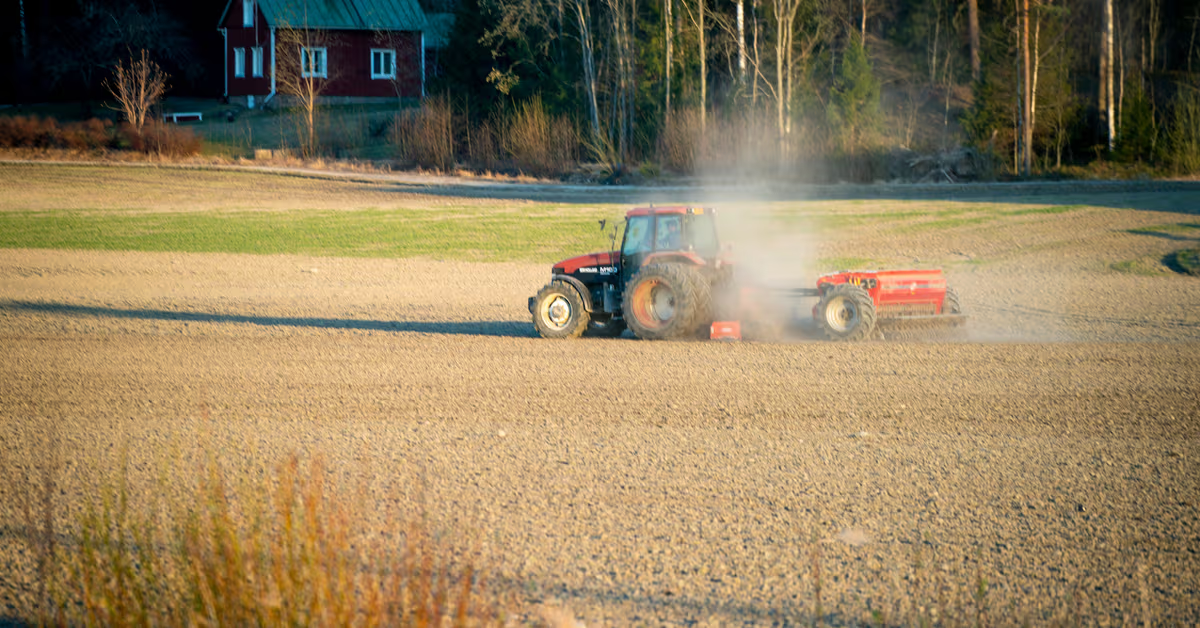
Before Ireland joined the then European Economic Community (EEC) in 1973, the Irish taxpayer provided substantial subsidies to Irish farmers, amounting to almost 3 per cent of national income. There was some tension between resources to subsidise farmers, and funding needed for better public services and welfare payments. Ireland voted to join the EEC in 1972 by a substantial majority, despite the campaign making it clear that, while farm incomes would rise, so too would food prices. As farming was then a key sector of the economy, there was general recognition that higher prices for agricultural exports would benefit Ireland as a whole, even at some cost to Irish consumers. EEC membership also meant Brussels took over responsibility from Irish taxpayers for subsidising our agriculture. So, over the last half century, generous subsidies for Irish farmers under the Common Agricultural Policy had no direct cost for the rest of our population. As the new EU budget for 2028-34 is being negotiated, it will be important for Irish farmers that funding for agriculture is again ringfenced, even if it is at a lower level than today. If agriculture had to fight for a share of national rather than EU funds, it could return us to the 1970 situation, where more money for farmers meant less money for everyone else.Back in 1970, farming constituted 12 per cent of our economy, and food processing another 3 per cent. Farm leaders today, harking back to the past, often exaggerate the economic importance of the agri-food sector by including in figures for food output and exports the high value output of Pepsi and Coca-Cola concentrate, which owe nothing to the work of Irish farmers. [ Ireland needs multi-functional farms with biodiversity benefits. But how can they be supported?Opens in new window ]Today the value to the economy of the agri-food sector is about 3 per cent, compared to 15 per cent in 1970, and less than the value added of the pharmaceuticals sector. EU farm subsidies amount to another 0.7 per cent of national income. Although agri-food is today a small sector of the economy, this does not mean farming is unimportant: farmers constitute 4 per cent of the workforce and they are the guardians of the land. The arguments for supporting farmers are social and environmental, not economic.Farmers are, on average, older than most of the rest of the working population, and many of them earn very little over and above the EU subsidy. It is a minority of full-time farmers, mainly in the dairying sector, who earn a good living, operating profitable businesses.In the recent energy-cost protests, some farm leaders argued for the economic importance of the sector, exaggerating its economic significance. As custodians of the land, continuing financial support for farming is justified – but it needs to be linked to making real progress in reducing farming’s carbon footprint and water pollutionThose farmers operating profitable businesses, like all other businesses, will ride out the energy price shock, eventually seeing higher prices reflecting their higher cost base. These businesses did not warrant special support from Government. As a net fuel importer, Ireland is worse off due to the Iran war price shock, and we cannot shield all businesses from the new economic reality. [ Irish farmers tackling emissions and water quality issues but more needs to be done, says TaoiseachOpens in new window ]People living in rural Ireland are generally dependent on kerosene, not gas, for home heating. Developments in the price of this fuel will be particularly important for them. For all of those on low incomes, higher energy costs, if sustained, will pose a big challenge for heating homes next winter. This impact of the energy crisis for rural households was not one raised by the energy protesters – their focus was on their business costs. However, the role of the State is to focus its resources on protecting those who are most vulnerable, rather than subsidising businesses that will generally ride through the energy price crisis.As the Environmental Protection Agency has reported, while some progress has been made over the last five years on reducing our greenhouse gas emissions, it has been far short of what was needed or promised. While modest progress has been made on retrofitting homes, using more renewable energy sources and adopting electric vehicles, there’s been a virtual standstill on tackling emissions from farming. [ Farming for and with nature has entered the mainstreamOpens in new window ]The next Common Agricultural Policy needs to make a clear link between farming subsidies and achieving reductions in emissions from farming. As custodians of the land, continuing financial support for farming is justified – but it needs to be linked to making real progress in reducing farming’s carbon footprint and water pollution, and promoting greater biodiversity. It’s not about making radical changes to the farming way of life, but about tackling the issues with the biggest impact. Measures such as reduction of nitrates use, changing from ryegrass monoculture to clover-rich swards and switching more land into forestry all bring wider environmental benefits – and indeed may be more profitable.
EU agricultural policy needs to make clear link between subsidies and emissions reductions
There’s been a virtual standstill on tackling greenhouse gas emissions from farming - despite progress generally across society
850 words~4 min read