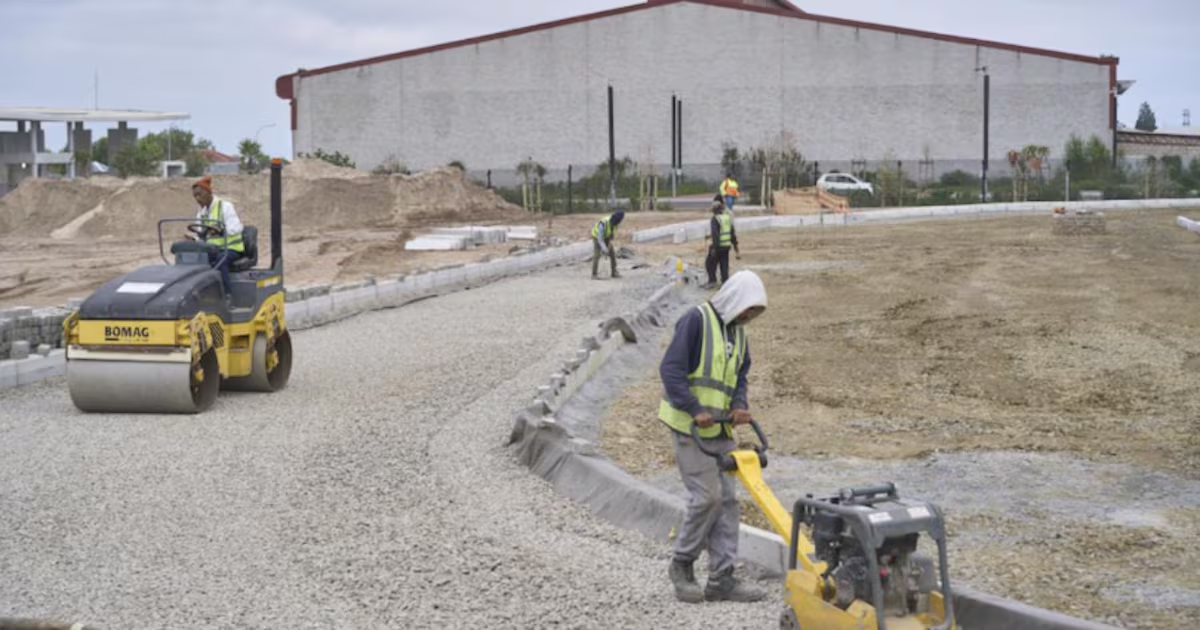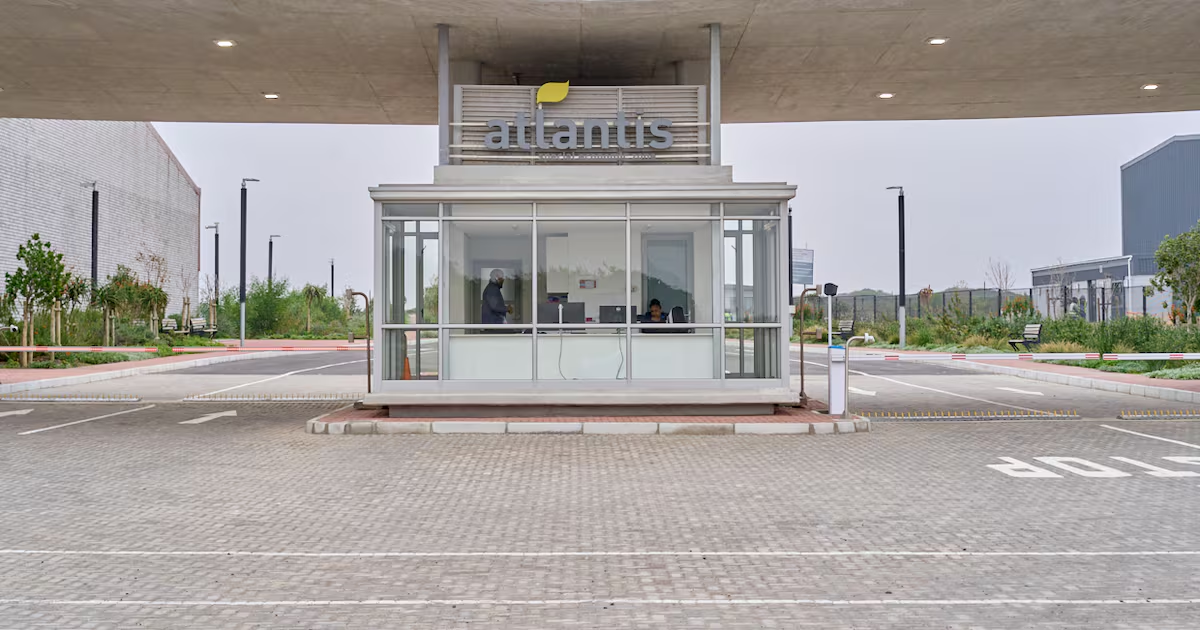
The Atlantis Special Economic Zone (Asez) in the Western Cape was established in 2020 to attract green economy investment and support local manufacturing.Oxpeckers visited the site in May 2026 to examine whether those ambitions are translating into jobs, skills development and opportunities for local businesses and workers participating in renewable energy value chains.According to the Asez, the project has attracted more than R3bn in investment and facilitated the creation of more than 800 jobs since its establishment.Spanning three development zones, the Asez is “positioning Atlantis as a leading hub for green manufacturing, advanced manufacturing, renewable energy, industrial technology, construction materials, and other growth sectors”, CEO Matthew Cullinan told Oxpeckers.Anthony Jila, project manager at the Atlantis Special Economic Zone. Picture: BARRY CHRISTIANSON/GROUND UP (Barry Christianson) It is also focused on localisation, ensuring that surrounding communities, businesses and workers benefit directly from investment and infrastructure development.It hosts a range of manufacturers spanning renewable energy, advanced manufacturing, construction materials, textiles and industrial technology.According to Anthony Jila, a sustainable infrastructure and zone operations technician at the Asez, community participation is built into the model.“There is a community group called the Community Stakeholders Network. That’s a group of individuals, elected by the community, that covers all spheres of the community,” he explained.The network represents youth, women, small businesses and people living with disabilities. It provides a mechanism for local engagement and oversight.The zone also requires that 30% of infrastructure project value be directed towards local businesses.The recently completed Zone 1 infrastructure project directed 32.02% of project expenditure to local small, medium and micro enterprises (SMMEs).Yet challenges remain.Local participationMany small businesses struggle to access finance, secure credit facilities or raise capital needed to fulfil contracts.“Even if local businesses have a contract, they do not have the finances to mobilise and start work. They do not have credit history and cannot access a line of credit,” said Jila.Yet despite these obstacles, he believes local economic participation is essential.“Ethically, I think it is only right that if we are bringing business into an area that the community benefits from it.”Atlantis offers one example of how localisation can be built into renewable energy development. Yet, while local procurement and community participation are being prioritised in some projects, much of the equipment powering South Africa’s renewable energy transition is still imported.A 2026 report by the Institute for Economic Justice (IEJ) found that localisation remains fragile. This is due to inconsistent enforcement, global supply chain pressures, and fiscal constraints.The IEJ’s research looked at independent power producers contracted under the renewable energy independent power producer procurement programme (REIPPPP), which includes specific requirements for local ownership and socioeconomic development. It also conducted an accountability audit of REIPPPP’s localisation promises between 2011 (bid window 1) and 2024 (bid window 7).Citing several examples, the audit demonstrated how localisation requirements have changed over time: Hopefield Wind Farm, which fell under bid window 1, is one of REIPPPP’s earliest success stories, with a strong sense of community involvement and development. The wind farm supports at least six local communities by conducting a needs analysis for each to address local skills gaps, build capacity, and promote economic independence. Meanwhile, the Gouda Wind Facility (bid window 2) was the first wind farm in South Africa whose towers were made of concrete instead of steel — these could be produced locally, unlike steel towers, which needed to be imported at the time.Several other examples with a focus on localisation exist under the REIPPPP (Find them on the #PowerTracker mapping tool here).
Are billions flowing into South Africa’s green economy?
Atlantis demonstrates how localisation can be built into renewable energy development
581 words~3 min read