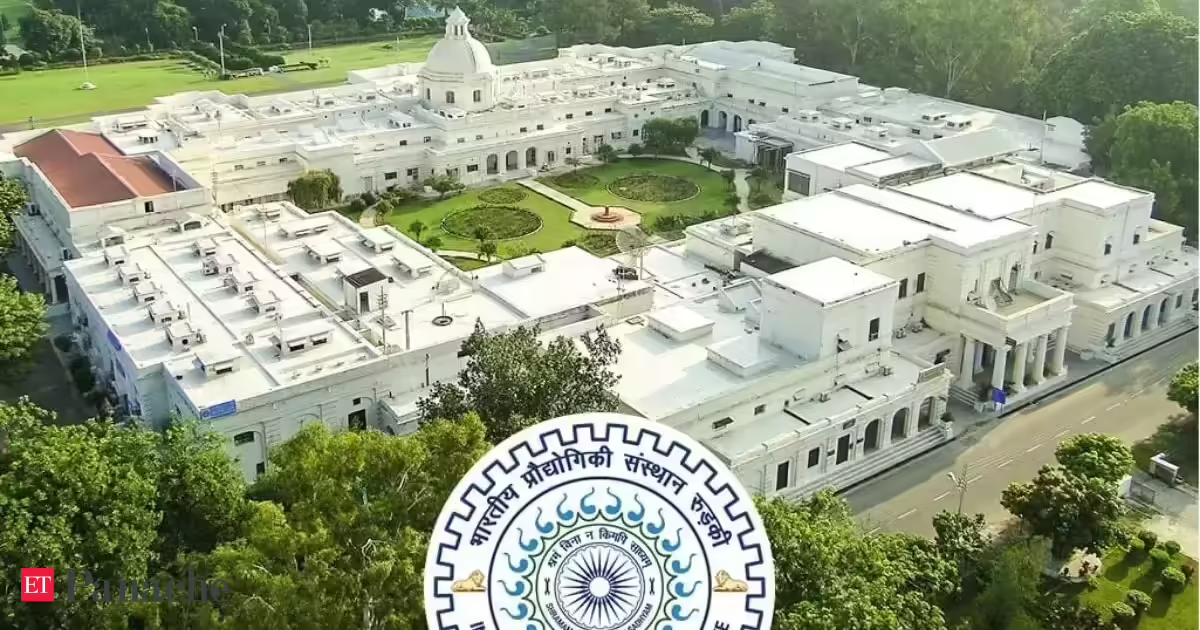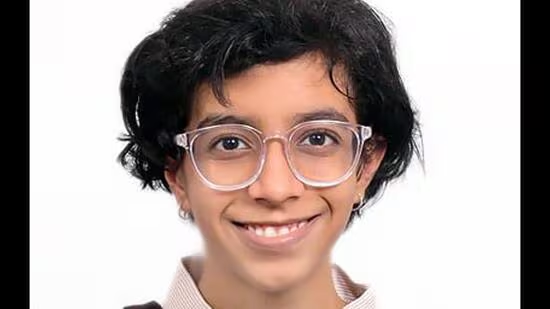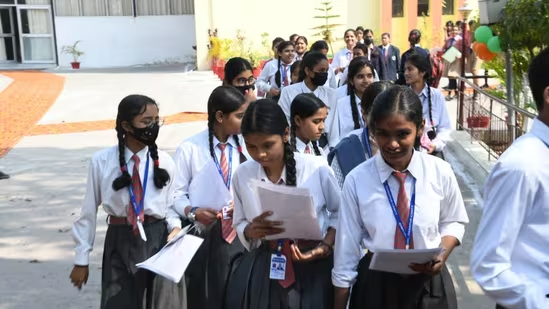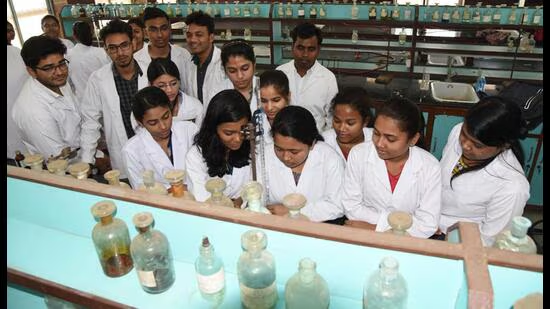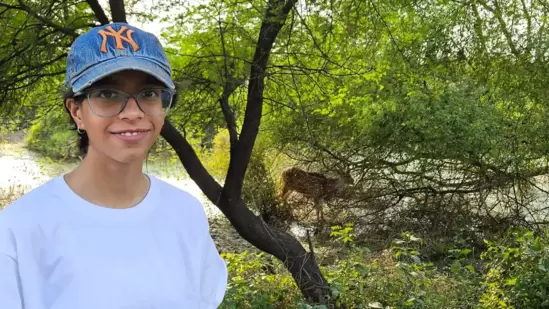
More girls than ever have cracked the IITs. Progress is real, but challenges remain. By the time she was in the ninth grade, Arohi Deshpande had decided she wanted to study engineering, and not just at any college but at India’s top-ranked engineering college, the Indian Institute of Technology.Face of a topper. (Arohi Deshpande)She had a role model at home. Her mum Amita, a civil engineer with a specialisation in environmental engineering, had done her M.Tech at IIT, Kanpur and works at a private company.Her dad Prasad is an electrical engineer with a master’s degree from the University of South Florida. A maternal uncle as well as a maternal great-aunt are in the sciences.So, when Arohi spoke about wanting to get into IIT, of course the family rallied behind her.That support extended to relocating from Pune to Kota, India’s best-known coaching hub, where Arohi would complete her school while preparing for one of India’s toughest competitive exams.“To get into a premier institution like the IIT, you need relentless preparation and family support for several years,” Prasad Deshpande told me on the phone.A family effort: Seated front row (from left) Arohi, her grandmother Padmaja, younger brother Shreyas and standing behind, Prasad and Amita Deshpande. (Pic courtesy: Arohi Deshpande)Rather than send Arohi on her own to Kota where thousands of students come from all over India, live in hostels and labour to crack India’s notoriously hard exams, the entire Deshpande family, including the grandmother, moved to Kota for four years to be with Arohi. “It was more difficult for them than for me,” Arohi said. “They had to leave everything behind.”But, explained her father, “It was important for Arohi to have family support and not miss out on celebrating all the festivals like Diwali.”When the results were announced on Monday, Arohi had topped among female students in the Joint Entrance Examination (Advanced) results with an overall India rank of 77.Along with Arohi a record number of girls, 10,107, have cleared the joint entrance exams to the IITs and other prestigious engineering institutions.A question of representationHT ArchivesUnlike many counties that struggle to get girls and women to study STEM (science, technology, engineering and maths), India exceeds global averages. The All India Survey on Higher Education for 2021-2022, the latest available, finds that 42.6% of students enrolled in STEM courses were female.Medicine has an equal ratio of male to female students. But in engineering and technology, there is a gap with just 28.8% of female students.This gender gap becomes even more pronounced when you compare elite institutions like the IITs with other colleges where female students comprise of around 30% of students. At the IITs, women students made up just 8% of the student population in 2017.There are several reasons for this lack of gender diversity. Family support is vital. Coaching classes even in the same city often run late in the evenings so there safety issues involved with dropping off and picking up daughters. Parents can be also be reluctant to send daughters off to live far away in hostels. And there is the cost of these classes, with some parents still believing there isn’t much point in investing large sums in the education of daughters.IIT, Delhi campus. (HT file picture)To rectify this imbalance, the IITs in 2018 came up with the idea of supernumerary seats. In other words, 20% additional seats to be earmarked for women in undergraduate courses across all the IITs. It’s these extra 20% seats that are now reflected in the female enrolment and have for the past six years remained resolutely stuck at around 20%—19.9% in 2020, 20.15% in 2025.This year isn’t very different. Of the total of 56,880 candidates who qualified, a majority of 46,773 are male candidates. Despite their improved gender representation, the IITs remain overwhelmingly male and still lag behind other engineering colleges.The euphoric headlines of “over 10,000 girls make it,” don’t tell the full story. Women STEM graduates represent 27% of the workforce; 16% in research and development; and just 11% as faculty in the IITs.But there is still plenty to celebrate. The number of women appearing for JEE Advanced has risen by 33% between 2018 and 2025, writes Ravinder Kaur, professor at IIT, Delhi and the lead at STEMtheGap which is dedicated to improve gender representation at the IITs.The other challengesWomen scientists might not be adequately represented but they do occupy a large space in public imagination. Women scientists from the Indian Space Research Organisation who played a role in launching Chandrayaan-3 to the moon, interact with prime minister Narendra Modi.Getting admission into prestigious institutions like the IITs is one challenge. Social norms, workplace biases and the “leaky pipeline” that result in qualified women dropping out of the workforce are others. India’s most educated women are leaving jobs faster than others, particularly at mid-career levels due to a combination of domestic and caregiving burdens, along with workplace-related challenges such as biases and stereotypes.A January 2026 report, Breaking the Code: The rise of women in India’s STEM landscape by EY India finds that women represented 28.9% of entry-level STEM employees in 2023, but this figure dropped to 18.1% at the director level and even further to 12.4% and 14% at the vice-president and C-level positions.Getting women to stay the course will require a multi-pronged approach. It will require mentorship. It needs gender-inclusive workplaces. And policies that recognise that some women might have to take short career breaks—a child’s Board exams, an ailing parent—and should not have to be penalised in terms of their career growth.Arohi Deshpande’s achievement is worth celebrating. But the real test of India’s commitment to women in STEM will come years from now when women like Arohi find the support, opportunities and workplaces they need to stay, succeed and lead.Namita Bhandare writes on gender and other social issues and has 35-plus years of experience in journalism. She has edited books and features in a documentary on sexual violence. She tweets as @namitabhandareRead More
The girls cracking India’s toughest exam
More girls than ever have cracked the IITs. Progress is real, but challenges remain.
992 words~5 min read