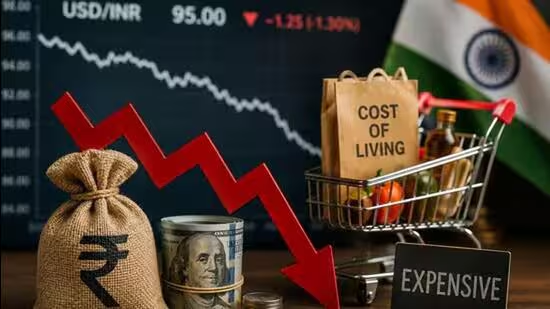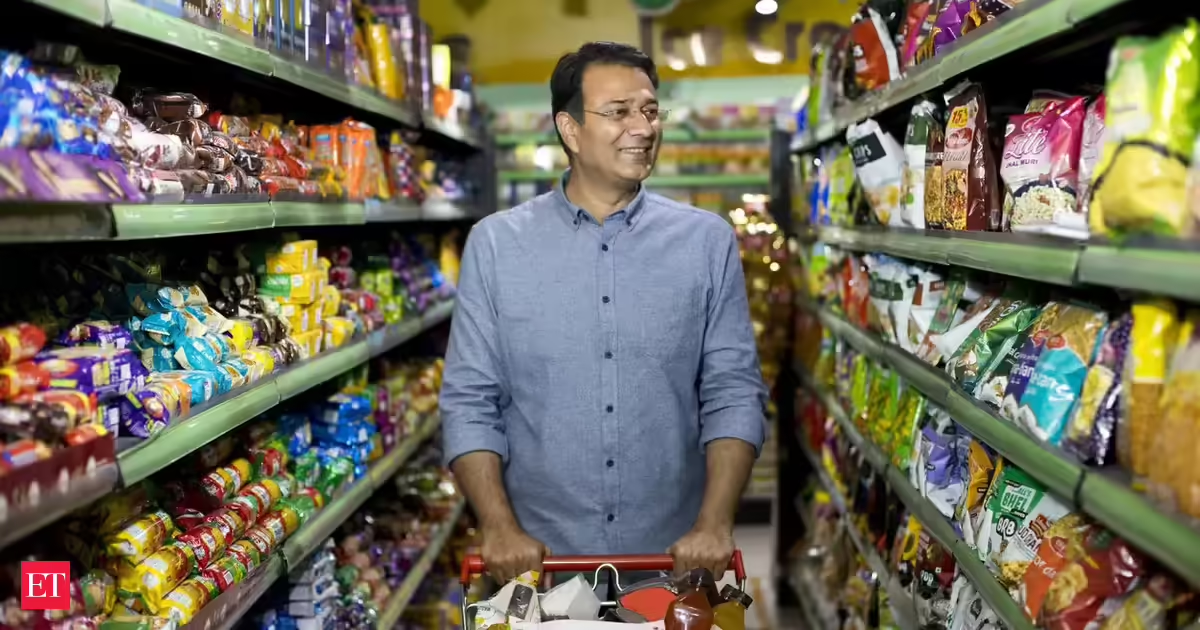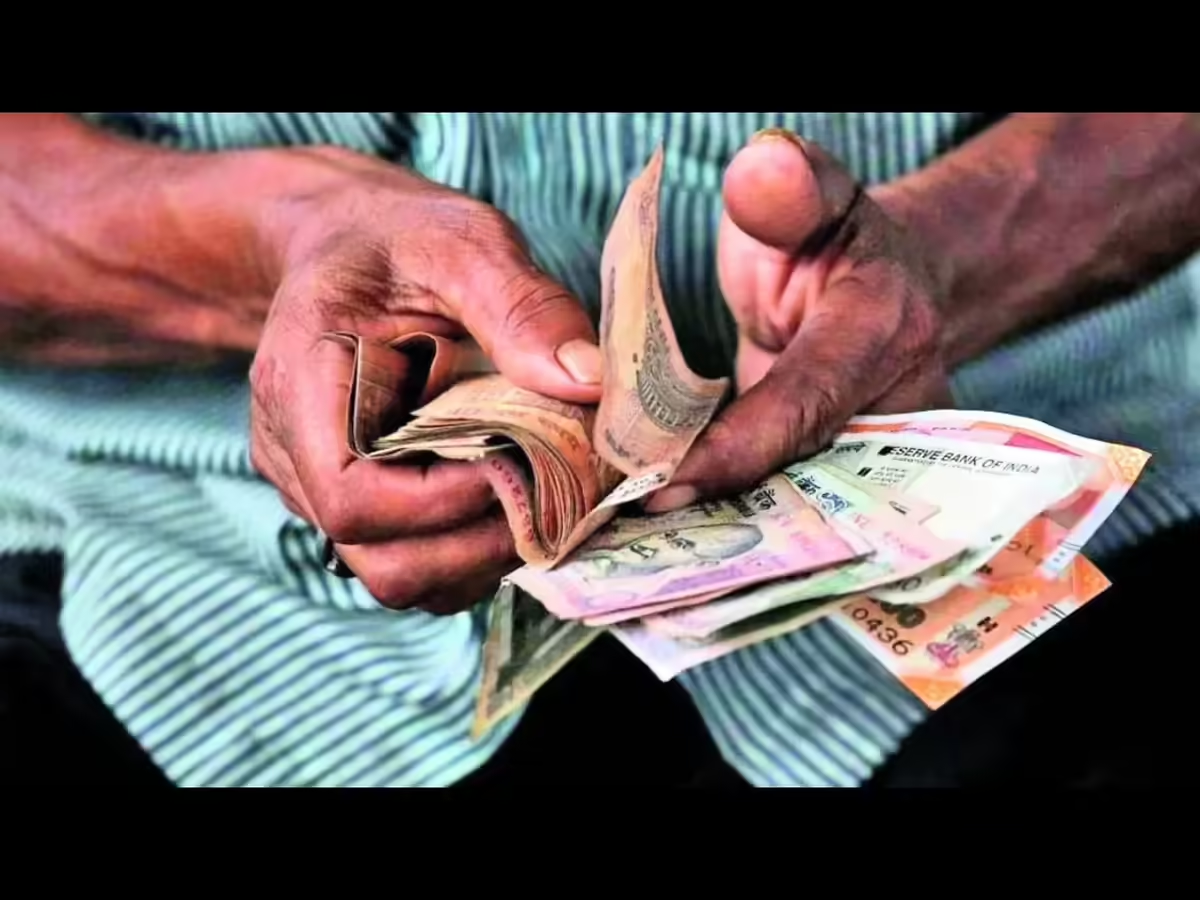
Economists tend to see global crises first in aggregates, while households feel them in fragments. GDP slows by 2%, inflation rises by 3%, and unemployment inches up. For most families, crisis comes in much smaller ways: they use less cooking oil, school fees are paid a month late.The cruel unevenness of resilience is also revealed. We instruct families to 'spend better', as if economic insecurity can be solved by financial prudence alone. But there's an awkward asymmetry here. Yes, an Indian middle-class professional may have to be more judicious with her spending in uncertain times. But for a low-income worker, spending is not the problem--earning is.This distinction is important because policymakers and politicians often underestimate psychological effects of uncertainty. During the 2008 US financial crisis, consumption fell not only because of income declines, but also because of increased household uncertainty. Post-Covid OECD studies found that precautionary savings surged across all major economies despite historically low interest rates, mainly because households feared prolonged instability rather than immediate income collapse.India is starting to show similar patterns. Aggregate growth numbers are still respectable. But there is a more anxious household economy underneath. India has a middle class of around 500 mn people, with household annual incomes of ₹6-36 lakh at 2026 prices. But much of this middle class remains financially insecure. Years of financial progress can be quickly undone by a medical emergency, long-term unemployment, or a period of high inflation.This uncertainty is felt most strongly by young professionals. India has one of the youngest workforces in the world, with almost 2/3rd of its population below 35. Every year, millions enter the labour market with educational loans, family obligations, and expectations of upward mobility. But the work itself is becoming less predictable. White-collar work is starting to be reshaped by AI and automation. A new anxiety is now not whether work exists, but whether the same work will have value 5 years from now.Education and healthcare costs have risen faster than household incomes for years. In cities, school fees increasingly resemble mortgage payments, with private school fees in some cities reportedly rising by nearly 50-80% in the past 3 years. Healthcare inflation, too, remains high at 12-14% annually.Small businesses are more fragile than most. A geopolitical conflict can affect fuel prices, logistics costs, import dependencies, or consumer demand. For millions of small businesses, Covid was a lesson in how quickly a temporary interruption could turn into a solvency crisis. Even now, many are more cautious and prefer survival to expansion.Crises are not novel. Oil shocks of the 1970s, Asian Financial Crisis of 1997, the 2008 global recession, and the pandemic have all changed household behaviour. What may be new is the speed at which global instability now affects ordinary households. A war in Europe alters fertiliser prices in rural India. Bengaluru's employment decisions are affected by China's supply-chain disruptions.This interconnection has altered the psychology of consumption. Economists sometimes assume that households respond rationally to incentives. They do, but only within bounds imposed by fear and uncertainty. If a family does not feel secure, it will not spend simply because interest rates drop a little.Perhaps, that's why so many economies today look better statistically than they feel socially. Stock markets bounce back from crises. But households take much longer to recover emotionally. In the years after the 2008 financial crisis, Americans remained cautious borrowers even as the economy recovered. Japan's prolonged stagnation after the 1990 asset bubble fundamentally changed consumer behaviour for an entire generation.India is in danger of entering a similar period of tentative aspiration. People still want to move up, but they are pursuing that ambition more defensively. Emergency savings grow. Insurance demand increases. Discretionary consumption falls outside the better-off segments. Families are less willing to take financial risks. Such caution, over time, affects the economy because consumption remains the bedrock of growth in a country like India.This is why the real challenge for governments is not merely to create growth, but to create reassurance. Sustainable growth requires that households believe there will still be jobs, that their savings will retain their value, and that upward mobility remains possible. Without that confidence, economies may grow statistically while societies grow steadily more anxious.And that, in the end, is the paradox of modern crises. The macroeconomy can recover long before households do emotionally.(Disclaimer: The opinions expressed in this column are that of the writer. The facts and opinions expressed here do not reflect the views of www.economictimes.com.)
Reassure homes, not just economy: Why India’s growth feels weaker at household level - The Economic Times
The ripples of global disruptions are felt in the everyday lives of Indian families, shaping individual narratives beyond simple data points. Young professionals are increasingly burdened by financial volatility, as soaring education and healthcare costs create a climate of anxiety. Meanwhile, small business owners are treading carefully amid these pressures.
743 words~3 min read