The latest National Family Health Survey has some heartening improvements in health status
| Photo Credit:
erdikocak
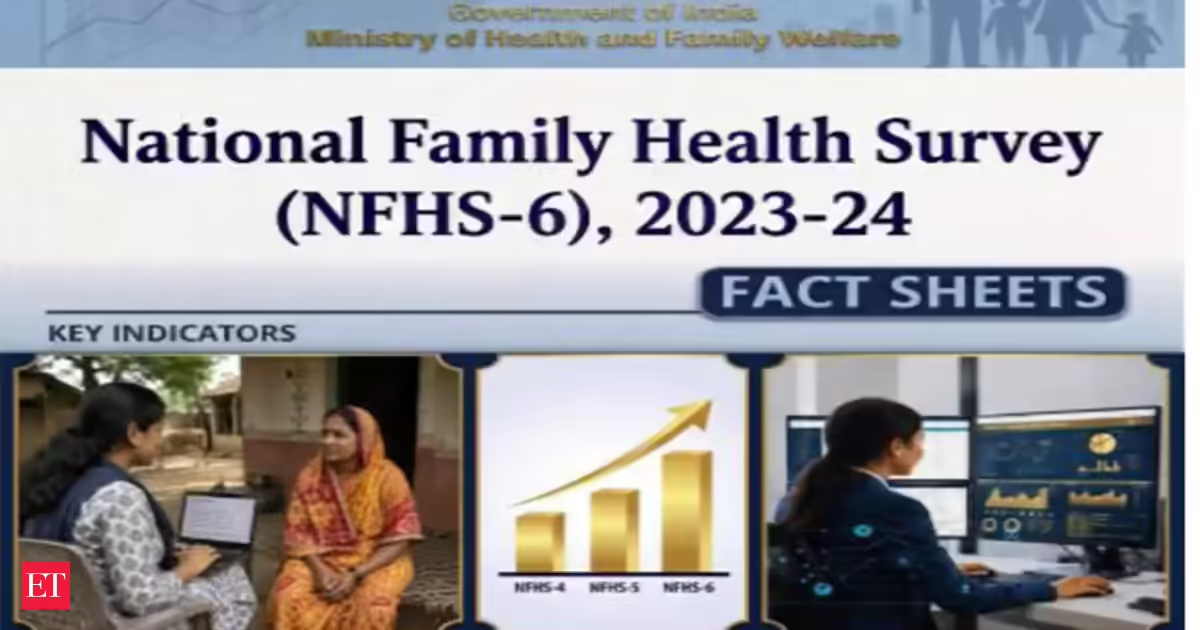
The recently released sixth edition of the National Family Health Survey, which covered 6.79 lakh households across 715 districts between May 2023 and December 2024, points to improvements in health metrics at an all-India level, even as detailed data on some indicators is awaited. The latest fact sheet has 101 indicators, against 131 in NFHS-5 (2019-21). Over 10 new metrics find a place in the fact sheet of NFHS-6, while about 40 have not been included in it. The Survey’s focus on new indicators, such as those pertaining to financial inclusion, vaccination coverage, share of elderly population is well thought-out.The achievements in the post-Covid period are notable. Institutional deliveries are up from 88.6 per cent in NFHS-5 to 90.6 per cent. Maternal health, child immunisation and nutrition have looked up. Stunting, wasting and underweight prevalence among children has fallen. Breastfeeding of infants, as well as complementary foods for them, has also improved. Health infrastructure as well as nutritional schemes have done their bit. On the flip side, there has been an increase in C-section deliveries, from 21.5 per cent to 27.2 per cent. There is a nutritional paradox at work, with the share of both the overweight and underweight increasing in both sexes. The Survey’s focus on hypertension and diabetes is a valid one.However, the differences between the fact sheets of NFHS-5 and 6 have become a subject of debate, and the Centre has issued a timely explanation. The omissions in the latest fact sheet can be put into three categories. First, omission of the parameter at the questionnaire stage itself, such as in anaemia and disability. The capillary testing method (finger pricking) is believed to distort anaemia readings, as a result of which NFHS 6 dropped tracking it. The ICMR will conduct a separate survey with venous blood sampling, the Centre has said. The second lot of omissions comprises parameters “tracked through specialised surveys and administrative platforms...making the duplication within Fact Sheets unnecessary.” These include clean cooking fuel coverage, sanitation, statistics relating to mortality and birth registration. These are expected to be covered by Sample Registration System, Civil Registration System and the Census. Third, “several indicators” such as those related to family planning, child health interventions, women’s health and HIV will be presented in a more detailed report later. This should be brought out soon, as a year and half has gone by since the conclusion of the survey.Notwithstanding the ‘duplication’ (multiple sources will enhance verification), a 360-degree overview of indicators should be placed in the public domain. It will also translate into better policy formulation, and assessment of existing schemes on sanitation and fuel use. Raw, unit data should be made available to researchers, as in the past, to provide critical insights. That said, the Centre’s assurance on data robustness is to be welcomed.Published on June 7, 2026