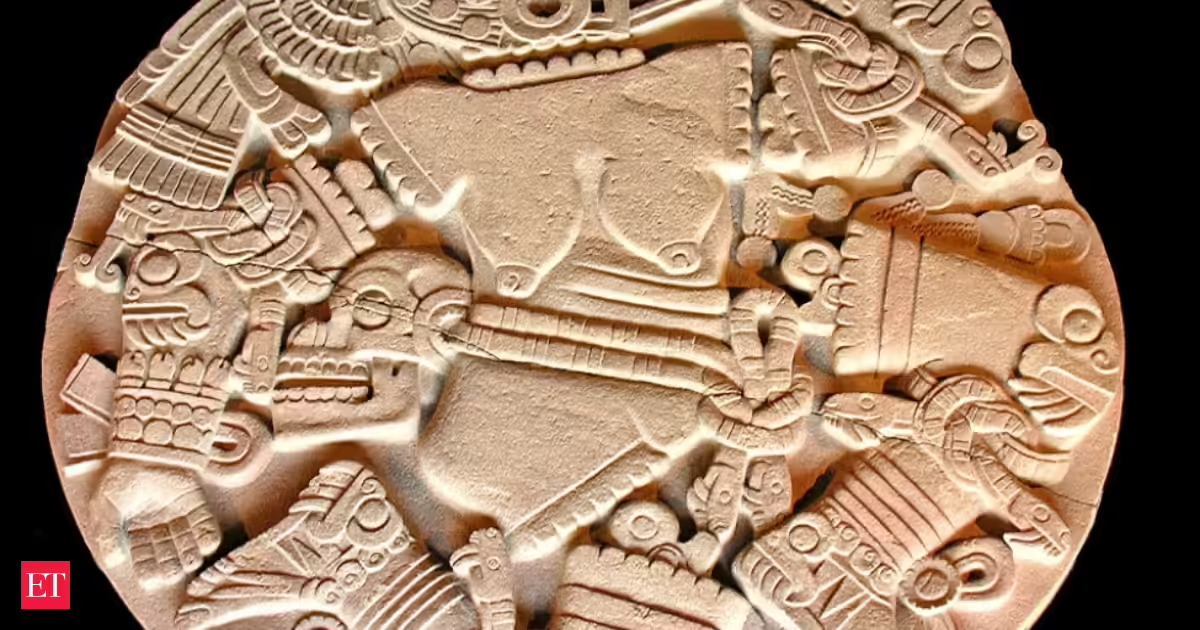
Some of the most important archaeological discoveries begin with a carefully planned excavation, while others begin when someone digging for an entirely different reason hits something unexpected beneath the ground. On February 21, 1978, utility workers carrying out electrical work near the Metropolitan Cathedral struck a massive carved stone disk buried beneath the modern city. According to Harvard University’s Templo Mayor Project, the discovery occurred during utility work at the intersection of Guatemala and Argentina streets, just steps away from the cathedral. What initially appeared to be an unusual obstruction quickly became one of the most important archaeological finds in modern Mexican history: the Coyolxauhqui Stone, a monumental sculpture depicting the Aztec moon goddess Coyolxauhqui.The discovery immediately attracted attention because of both its size and its location. Mexico City’s historic center sits directly above the former ceremonial heart of Tenochtitlan, the capital of the Mexica, often known as the Aztecs. Historians had long known that major remains of the ancient city likely survived beneath the streets, but the Coyolxauhqui Stone provided dramatic proof that important parts of the sacred precinct were still there. More importantly, the discovery triggered a new phase of archaeological investigation that would transform understanding of the Templo Mayor, the most important religious structure in the Mexica world.The Coyolxauhqui Stone | Wikimedia CommonsA routine construction project uncovered something extraordinaryWorkers were not searching for archaeological remains. They were simply carrying out infrastructure repairs in one of the busiest parts of the city. When their tools struck the buried stone, however, it quickly became clear that they had encountered something far more significant than a building fragment or loose piece of masonry.The object was enormous. Measuring more than three meters across and weighing several tons, the carved circular disk immediately stood out as a major ceremonial monument. Archaeologists soon identified it as a representation of Coyolxauhqui, a goddess who occupied an important place in Mexica religious belief and mythology. What made the moment so striking was the realization that the sculpture had remained hidden beneath one of the most heavily trafficked parts of Mexico City for centuries. The modern city had not erased the older one. Instead, layers of history remained stacked beneath the streets, waiting to be uncovered.The stone revealed far more than a single artifactThe importance of the Coyolxauhqui Stone extended beyond the sculpture itself. Harvard’s research materials describe the discovery as a gateway into the buried ceremonial center of Tenochtitlan. Once archaeologists recognized what had been found, attention quickly shifted from the stone to the surrounding landscape. If a monument of this scale survived beneath the city, what else might still be there?That question led to one of the most ambitious archaeological projects in modern Mexico. Research published through the National Institutes of Health notes that the discovery directly contributed to the launch of the Proyecto Templo Mayor, a long-term excavation program dedicated to uncovering and studying the sacred precinct of the Mexica capital. Rather than treating the sculpture as an isolated artifact, archaeologists used it as the starting point for a much broader investigation into the city’s religious and political center. The shift was significant because it changed the scale of archaeological work in the historic center. Researchers were no longer documenting scattered remains. They were attempting to reconstruct an entire ceremonial landscape buried beneath a modern capital city.Why Coyolxauhqui mattered to the MexicaThe identification of the stone also carried enormous cultural and historical importance. Coyolxauhqui was not a minor figure in Mexica belief. She played a central role in one of the civilization’s most important origin stories. According to interpretations discussed by Harvard’s Templo Mayor Project and later archaeological scholarship, Coyolxauhqui was associated with a myth in which she was defeated and dismembered by her brother Huitzilopochtli, the patron deity of the Mexica. The placement of her image at the Templo Mayor was deeply connected to ceremonial practices, religious symbolism, and the political identity of the empire itself.Because of that connection, the discovery immediately provided archaeologists with a powerful interpretive marker. The sculpture helped confirm the location of key sections of the sacred precinct and offered new insight into how ritual space was organized within Tenochtitlan. A recent scholarly analysis published through PubMed Central described the 1978 excavation as a defining moment in modern interpretations of the Templo Mayor, illustrating how the find continues to influence archaeological and historical discussions decades later.Archaeologists of the Instituto Nacional de Antropología e Historia working at the place where the stone was discovered, 1978 | Wikimedia CommonsThe discovery changed Aztec archaeologyMany archaeological finds are important because they add new information to what researchers already know, but the Coyolxauhqui Stone was different because it shifted the questions archaeologists asked. Before 1978, scholars knew that much of Tenochtitlan remained buried beneath Mexico City, but opportunities to investigate the ceremonial center were limited. After the discovery, the Templo Mayor became one of the most important archaeological sites in the Americas. Excavations revealed temples, offerings, sculptures, ritual deposits, and architectural features that dramatically expanded understanding of Mexica religion and state power.Historians and archaeologists often point to February 1978 as the moment when the buried sacred heart of Tenochtitlan began to be seen again. Rather than seeing the city solely as a colonial and modern capital, the excavation highlighted its identity as a place built directly atop one of the most important urban centers in pre-Columbian history. Every street, building, and utility trench suddenly carried the possibility of revealing another piece of that deeper past. More than four decades later, the Coyolxauhqui Stone remains one of the most recognizable archaeological discoveries in Mexico. Its importance comes not only from its artistic and religious significance but also from what it made possible: a routine construction project exposed a monumental sculpture, which in turn launched a major excavation program, and that program transformed understanding of an entire civilization. Few discoveries illustrate so clearly how a single moment of chance can reshape the study of history.
In 1978, electricians digging near Mexico City’s cathedral struck a giant carved stone disk, and an Aztec goddess returned to the light
A routine utility repair in Mexico City unearthed a massive carved stone disk in 1978. This artifact, the Coyolxauhqui Stone, depicted the Aztec moon goddess. Its discovery sparked a major archaeological excavation. This project revealed significant parts of the ancient Aztec capital, Tenochtitlan. It dramatically changed how historians understand Aztec civilization and its religious heart.
990 words~5 min read