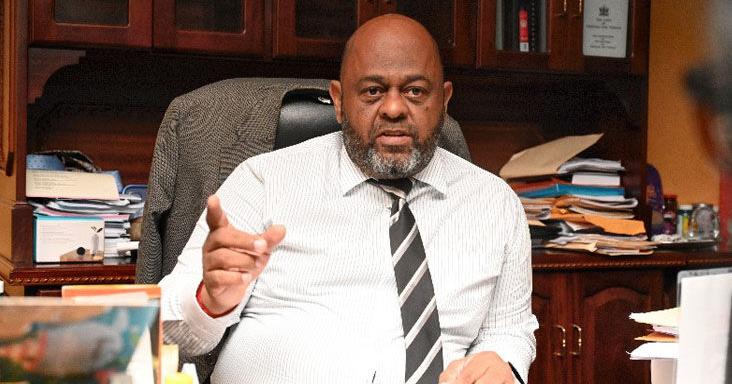
Can Trinidad and Tobago be governed without a state of emergency (SoE)?“I think we can govern without an SoE, but not at this time,” Defence Minister Wayne Sturge has said, adding that he personally believes the state of emergency should be extended for a further three months.He said while significant gains have been made against crime, gang warfare, and the illegal flow of guns and drugs into Trinidad and Tobago, more time is needed to consolidate those gains and strengthen the country’s security apparatus.In an interview with the Sunday Express at his ministry’s Port of Spain office in late May, Sturge said law enforcement agencies have made progress in addressing security threats, but key objectives are still being pursued.Since taking office in May 2025, the Kamla Persad-Bissessar administration has implemented two states of emergency as part of its response to escalating crime and national security threats.The first was declared on July 18, 2025, following intelligence from the Trinidad and Tobago Police Service (TTPS) of coordinated criminal activity linked to gangs and prison networks.The second was imposed on March 3, 2026, after advice from national security officials regarding a resurgence of gang violence and serious criminal activity.The 2026 SoE was later accompanied by regulations restricting public protests in designated areas.The Opposition People’s National Movement (PNM) has signalled that it will not support an extension of the SoE.The Express understands Prime Minister Kamla Persad-Bissessar met with the National Security Council (NSC) on Friday following the opening of Parliament and is expected to make a decision soon on whether the SoE, which expires on June 17, will be extended.Sturge said the final decision rests with the NSC.“We are making a significant dent. If it were up to me, I would recommend another three-month extension, but it is not up to me; it is up to the entire National Security Council,” he said.He said those discussions involve the leadership of the TTPS, the Chief of Defence Staff, and the Strategic Services Agency.“You have to remember that a large part of our problem is the proliferation of firearms and ammunition, because most murders in this country are carried out with firearms and ammunition, and that fuels the fight for drug turf and all sorts of wars,” he said.‘Explosion’ of crime preventedThe minister said an “explosion” of crime was prevented through the dismantling of elements within the Unemployment Relief Programme (URP).“We have gotten rid of the URP element. If we had not, you would have seen a serious explosion of violence. We are trying to deal with drug interdiction with the help of the US. They are, in essence, preventing a lot of vessels from reaching shore.“Beyond that, we are able to secure our borders. The recent rescue of a kidnap victim shows that we are strategically placed to prevent persons from going in and coming out. We can’t get it 100% right, but we are very close,” he said.Drug trade disruptedSturge said the impact of the SoE is being felt on the streets, claiming there has been a reduction in the availability of cocaine and a disruption in the flow of illegal firearms into the country.“You can get marijuana that is grown locally, but it is very difficult to get cocaine. We have been able to stem the flow of cocaine here, and the inflow of guns and ammunition. That might partly be the reason you are seeing criminals looking at other avenues.“We had lost 100 guns at one of the municipal police stations—that’s just one. We understand there were losses in other municipalities, but we have recovered a substantial amount of them. That basically shows you are not going to have the level of availability that existed before,” he said.The minister said he did not have information on the ongoing audit of firearms and ammunition at municipal corporations, but that the findings would be presented to the National Security Council when completed.He said authorities were also able to address the problem of criminal enterprises being directed from within the nation’s prisons.He said certain individuals are now “securely tucked away” at Staubles Bay and Teteron and can remain there even after the SoE ends, because both facilities have been designated as prisons.“When the SoE ends, Teteron and Staubles Bay—they have been designated as prisons. That is not dependent on an SoE. Once you are charged with a criminal offence and awaiting trial, instead of serving time at MSP (Maximum Security Prison), Golden Grove or Frederick Street, you will serve your time at Teteron or Staubles Bay, where you cannot communicate, because these two facilities are designated as prisons,” he said.Why public fear is highSturge said while official statistics show a decline in crime, public fear remains high because criminal incidents are widely circulated on social media.“There was a time when you did not see crime publicised as much as you do now. With the advent of social media, every single thing that happens is posted online. So there might be a perception that crime is high, but the reality is that, even if it is not where we want it to be, the statistics will show it has more or less halved—it has decreased significantly,” he said.Asked whether Trinidad and Tobago could be governed without an SoE, Sturge replied: “I think we can govern without an SoE, but not at this time. We can’t tell you everything about the SoE and what our targets are, but once we get those targets met, we will be in a better place and you will see the level of violence decrease. It will be more or less stable at a certain level.”The minister said no society can realistically reduce violent crime to zero, particularly one with Trinidad and Tobago’s social complexities.“You will always have murders, and what you do is you categorise them. So there will always be situations of domestic issues where a man may want to kill a woman over infidelity; there are murders stemming from land disputes,” he said.“So what we are able to reduce mostly are gang-related murders. There are those who run the command centres of gangland operations who are now unable to communicate at this point. The challenge is getting evidence that is admissible in a court of law so we can secure convictions,” he said.He said the acquisition of new assets would improve detection capabilities and increase conviction rates.
Sturge backs SoE extension
Can Trinidad and Tobago be governed without a state of emergency (SoE)?“I think we can govern without an SoE, but not at this time,” Defence Minister Wayne Sturge has said,
1,058 words~5 min read