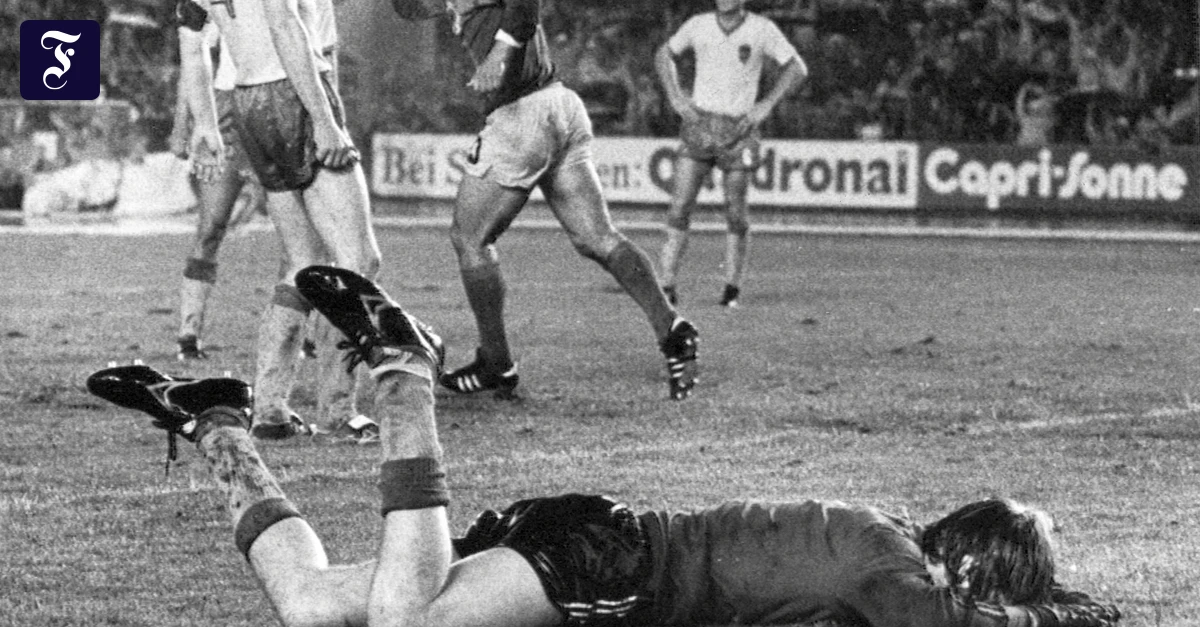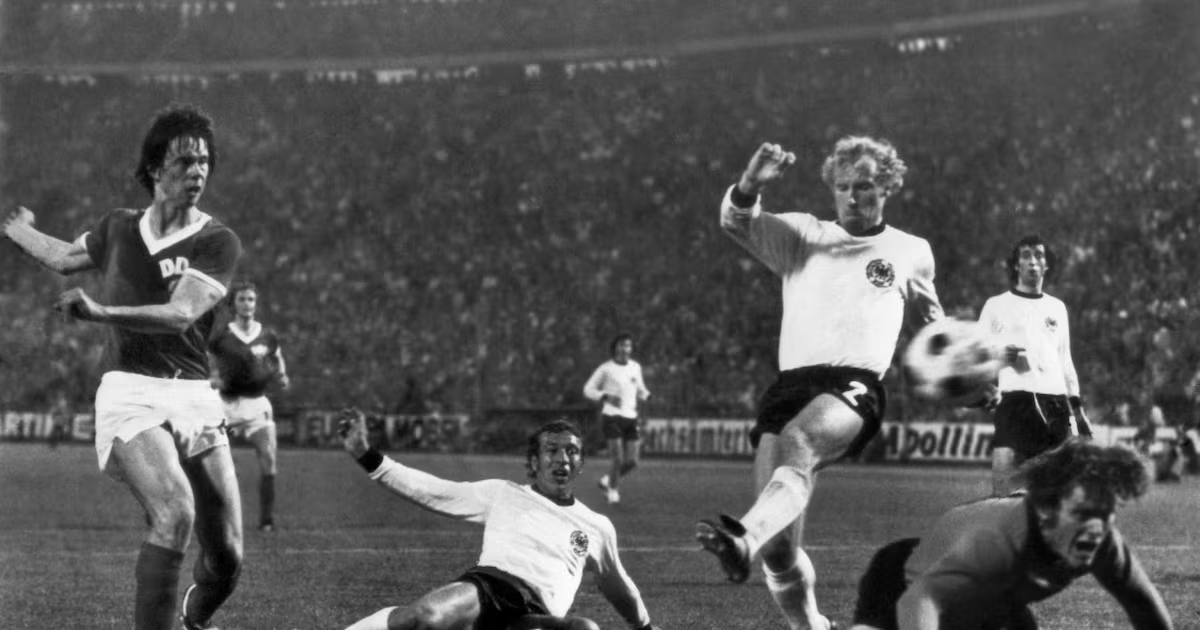
Half a century on from his moment of moments, Jürgen Sparwasser reflected: “If my gravestone only said ‘Hamburg 1974’, everyone would know who was buried underneath.” The clash of the two Germanies was the only time they ever met in international football, a self-enclosed tournament within a tournament.Amid suffocating security, East Germany’s anthem, Auferstanden aus Ruinen, was booed before kick-off. “Of course the fixture had a certain explosiveness, but that didn’t interest us players,” said Sparwasser. “I was just surprised that [West German chancellor] Helmut Schmidt was in the stadium. [Erich] Honecker and [Erich] Mielke probably didn’t get entry visas!” Especially as the sensational unmasking of East German leader Honecker’s planted spy Günter Guillaume had forced the resignation of Schmidt’s predecessor Willy Brandt weeks earlier.The East German state’s security measures for the tournament were entitled Akzion-Leder (Operation Leather), with Stasi men monitoring the players to ensure nobody defected, while the small travelling support had been vetted to ensure they were politically clean. At the Volksparkstadion, the home crowd chanted “Ulbricht-Schweine raus!”, mocking the late Walter Ulbricht, builder of the Berlin Wall. “It was all completely normal,” lied DDR goalkeeper Jürgen Croy.The West’s 4-3-3 soon ran aground against the East’s compact 4-4-1-1. “We were so in awe when we saw the likes of [Wolfgang] Overath and [Franz] Beckenbauer on the pitch next to us,” said defender Lothar Kurbjuweit, who marked Uli Hoeneß superbly throughout. “But the Western players were shouting at each other, comments unthinkable to us. A very strange atmosphere.”East Germany, probing carefully, spurned a sitter on 30 minutes. Reinhard Lauck’s low cross presented an open goal to Hans-Jürgen Kreische, who lifted it miserably over the bar. Minutes later, Lauck rolled a scoreable opportunity beyond the far post. From the home side, there was almost nothing at all.West Germany captain Franz Beckenbauer shakes hands with DDR captain Bernd Bransch in Hamburg on June 22nd, 1974. Photograph: Allsport/Hulton Archive/Getty Images Midway through a stodgy second half, West German manager Helmut Schön played what would once have been an unanswerable trump card. Günter Netzer’s class and poise had powered West Germany to glory at Euro 72 but now, at 29, he was already a man out of time. He and Overath, who were good friends, were simply too similar to play together: Netzer had the superior pedigree, but Overath was the man in form.“Schön said: ‘You’re going on,’” recalled Netzer. “But I didn’t want to. I saw the impossibility of making a difference in this messed-up match.” Warming up, he moved as far away from the dugout as possible, “in the hope that they wouldn’t find me”. When he finally came on, Beckenbauer pointedly didn’t pass to him once.Seven minutes later, the sky fell in on West Germany. Croy’s throw-out to Erich Hamann allowed the substitute to advance down the right before spotting Sparwasser. “I saw ‘Spari’ moving and I thought, ‘pass to him, then he won’t have run for nothing’,” Hamann recalled. The diagonal ball landed perfectly for Sparwasser, who fooled the three West Germans around him by controlling it with ... his nose. He nudged it past the stumbling Bernd Cullmann and shot high past goalkeeper Sepp Maier as Berti Vogts arrived too late.And that was that. In the final seconds, West Germany dithered so impotently outside the box that the crowd howled with disgust before Vogts eventually blazed miles wide. Afterwards, Croy and Gerd Kische celebrated with a nocturnal visit to Hamburg’s Reeperbahn, shadowed by plain-clothes police, though Sparwasser couldn’t join them because his goal meant he might be recognised. “We looked at the Reeperbahn’s sinful district, but we were good boys,” said Croy.1974 World Cup in Germany, first round, Hamburg - the scoreboard with the final result. Photograph: Herbert Kronfeld/ullstein bild via Getty Images West German embarrassment was reflected in the apoplectic press coverage. Bild am Sonntag exclaimed, “So nicht, Herr Schön!” – not like this, Mr Schön! – and Kicker declared, “Es muss etwas geschehen” – something has to be done. Stern‘s headline, above a photo of Sparwasser scoring, asked, “Die besseren Deutschen?” – the better Germans?After the tournament, Beckenbauer would say that “Sparwasser’s goal woke us up”, and jokingly called for him to be given “the 23rd gold medal”. But for now, West Germany’s prospects of victory looked minimal. That night, at their base in Malente, the broken Schön (already depressed due to the recent death of his dog) told his players: “I am extremely disappointed in you.” He then locked himself in his room and shunned all communication; the cover story was a stomach ailment.[ Has the World Cup arrived yet? In the US, it depends on who you askOpens in new window ]With its curfews and armed guards, Malente had already been an unhappy resting place. “You go crazy here,” Beckenbauer said, while Heinz Flohe complained of “the walls closing in on us” and Paul Breitner compared it to a barracks. Now, with Schön melting down, it was time for radical measures. The alpha male Beckenbauer promptly executed a palace coup in the hotel kitchen, giving rise to excitable talk of a “wilden Kaiser” (wild emperor).“It was a very long night,” he said. “A lot of beer. We washed down our anger. That’s when we grew together, into a team that could spit in the devil’s eye.” Hoeneß’s conspicuous idleness made him the whipping boy. “Franz attacked Uli, and others also really put him down,” said Maier. Hoeneß himself admitted: “I perhaps needed a warning shot. I had become a bit lazy.”Though he was now effectively in control of team matters, wielding a veto on tactics and line-up changes, Beckenbauer maintained the façade of Schön calling the shots. The duo sat together at subsequent press conferences, with Schön often concluding his remarks by saying: “Franz Beckenbauer agrees.” Could it somehow work?This is an edited extract from Glittering Prize: The Story of the FIFA World Cup 1930-2022, Vols 1-3, out now through Pitch Publishing
A tale of two Germanies: When East stunned West in a febrile 1974 World Cup clash
Franz Beckenbauer’s men lost out in a tense atmosphere amid a turbulent political backdrop, prompting a dressingroom coup by Der Kaiser
989 words~4 min read