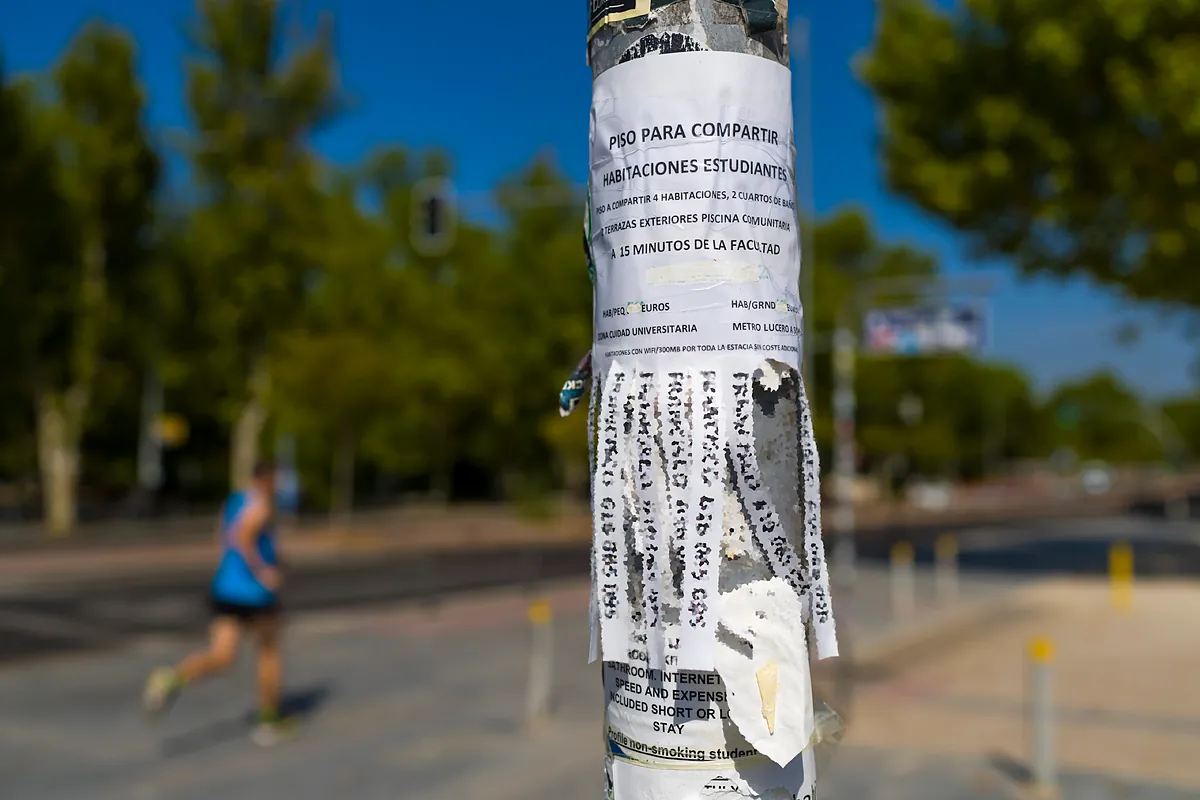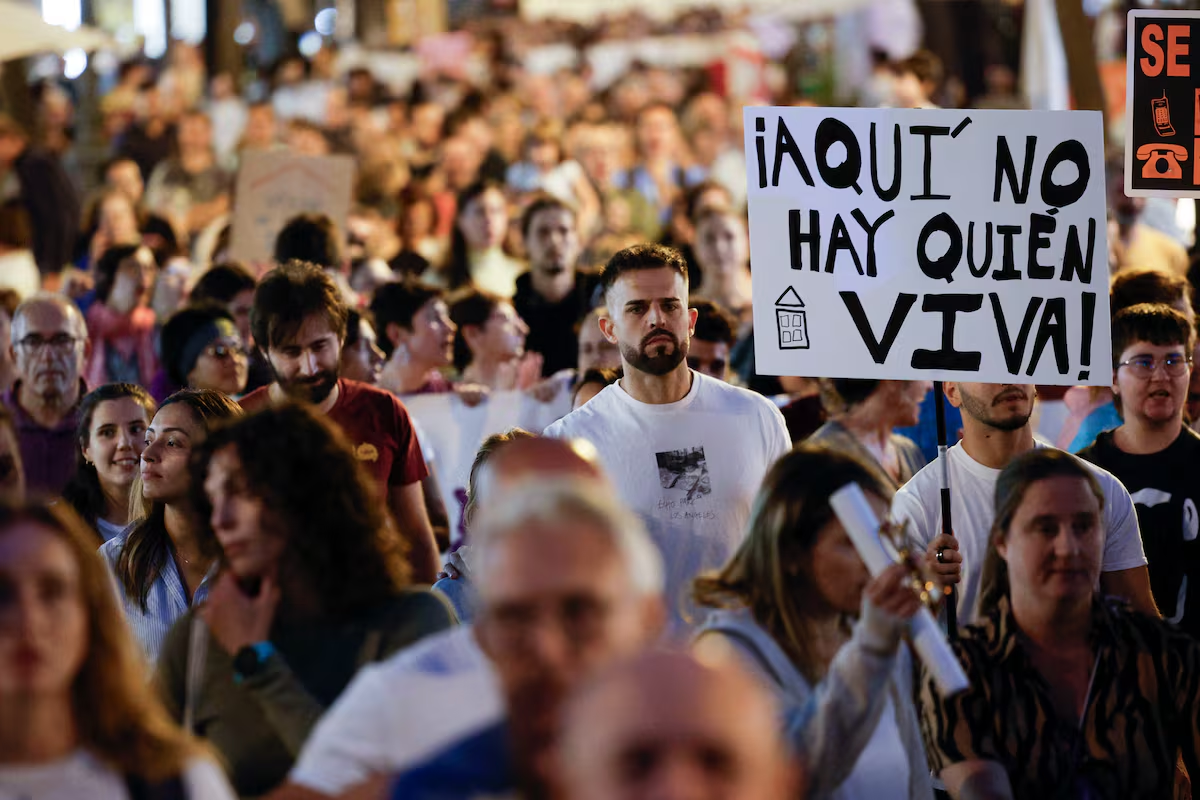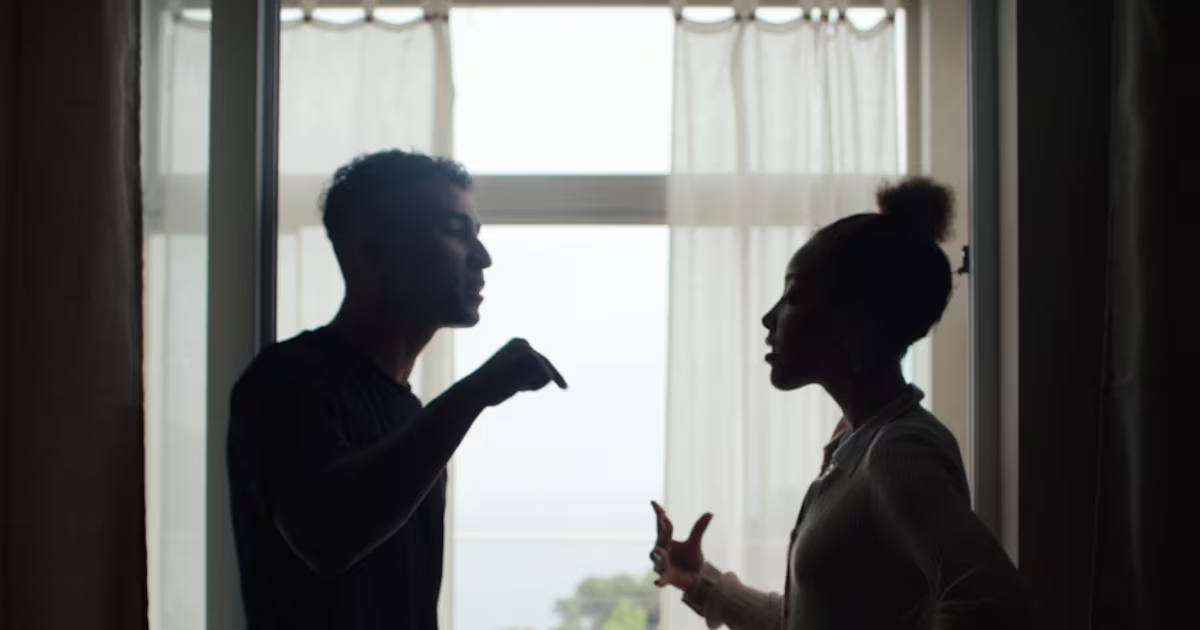
Maria* came to Ireland in 2023 to study English. She never expected to be living in cramped conditions or to be grabbed by her sub-landlord demanding sex in exchange for fixing a light.The Bolivian woman’s story is an example of how the housing crisis and the shortage of affordable accommodation is putting tenants including young foreign women such as Maria in vulnerable positions. “The house was really bad. Nothing was ever working. Even the light in our room was always breaking. It was just a really small room with a bunk bed and that was it,” she says. She describes her rental property as a “big house” that was home to about 20 people. “It was very uncomfortable. Even if you were making food, there would be other men who were living in the house looking at me in a very sinister way, staring at me,” she says.On her arrival in Ireland, Maria signed up with an English-language school for international students at a cost of €3,000, which included two weeks’ stay in a hostel. After that time elapsed, the then 32-year-old had to secure her own accommodation. She found a rental home in Rathmines, south Dublin, though it would not be available for a month. In the interim, she stayed with a friend, also from Bolivia, who was living in a large house in Clontarf on the northside of Dublin with about 20 other people. They were mostly other international students or immigrants. The two friends shared a bunk bed in a small room, costing them about €400 each per month. One evening Maria came home late to discover the light in their bedroom was broken. She and her friend called the man who was subletting out the house. “He came and let himself into the room with a key,” she says. “It was so bad that he didn’t even knock. He tried to fix it but was unable to and said: ‘Maybe tomorrow?’ We said: ‘Okay, but what can we do, we’re scared.” He replied: “I can stay here with you guys and then tomorrow can fix it.”“We said: ‘If you can, that would be good.’ I said he could sleep in my bed in the bottom bunk and I would stay in the top bunk with my friend.”Maria says she closed the door of the bedroom and went to climb up on to the top bunk when the sub-landlord, who had been lying on the bottom bunk bed, grabbed her arm, threw her on the bed and said: “I’m only going to stay with you guys and sort your problems if you sleep with me.” “I tried to get up from the bed, pushed his arm away, got up and started calling for my friend. I’m not sure if she thought it was a joke,” says Maria. These people who rent to students - they know we came alone, they know we don’t have the language, they know we don’t have any idea about the cost of living here in Ireland. So I think that’s why they take advantage of all that— 'Maria'“He then grabbed my arm, harder this time and threw me back on the bed. He said: ‘You can sleep with me or I’m not going to help you again.’ I told him to leave and he said: ‘You’re paying very cheap rent; we’re helping you so you have to help us.’“I got up from the bed again. I was crying; I was very scared, calling for my friend. He said: ‘Stop crying, it was a joke.’ We told him to leave and he did.” Maria says she left the house early the next morning and never returned. She stayed on a friend’s couch for the following two weeks until the rental property in Rathmines became available. “I cried a lot that day, but I think I didn’t realise how bad it was, how dangerous it was for me as a woman, in that house, in that situation,” she says. “I think I actually feel more scared now thinking about it than at the time, because back then I was so focused on a lot of other things; trying to learn the language, trying to find a house, sorting out documents for my visa.”Corrinne Hasson, executive director of the National Women’s Council: 'The ongoing housing crisis continues to make unhoused women more vulnerable to sexual violence and exploitation.' Photograph: Nick Bradshaw Maria, who now works in the beauty sector and rents in north Dublin, says although she enjoys living in Ireland, it is “not safe” for female student immigrants. “These people who rent to students – they know we came alone, they know we don’t have the language, they know we don’t have any idea about the cost of living here in Ireland. So I think that’s why they take advantage of all that,” she says. “When you come as a student, especially from another continent, it’s really hard and unsafe, because we can’t really go back home. It’s not an option, because we paid a lot of money to come. I don’t want any other woman to be in the same situation as I was and far away from home.” A survey of 512 international students representing 64 nationalities renting in Ireland found an “alarming” incidence of rooms being advertised in exchange for sex in 2024, according to a group representing international students. The survey from the Irish Council for International Students (Icos) found that 5 per cent of female respondents (14 women) had either received an offer to rent a room in Ireland in exchange for sex, or had seen a room that was being advertised in exchange for sex. A further eight men who replied to the survey also gave evidence of this.[ ‘Alarming’ incidence of ‘sex for rent’ advertisements, survey of international students findsOpens in new window ]The research was based on an anonymous online survey conducted between September 19th, 2024 and October 6th, 2024, with the survey shared across social media with higher-education institutions, English-language schools and groups working with international students.Brian Hearne, policy and communications manager for Icos, says Maria’s experience is a “snapshot of the situation” that many international students, migrants and women face in “this precarious housing market”. “It is really difficult for us to say the extent of the problem but we know through our research that it is going on underneath the radar ... It is quite shocking and is something that needs to be dealt with urgently,” he says. Hearne says that, alongside forthcoming legislation, social media platforms and other housing forums need be “held accountable for the content that is published on their websites”. “From our experience, a lot of the ads appear on social media or informal housing groups,” he says. “They do appear elsewhere, often on Daft.ie and other housing platforms, but are advertised and displayed in a way that is maybe subtle or sneaky. [ Sex for rent offers in Dublin: The landlord wanted me to share a bed with himOpens in new window ]“So it might be something like ‘willing to discuss alternative rent payment’ or ‘looking for someone who is willing to have a good time’ or language that, maybe for someone where English is not their first language, would pick up on.” Minister for Justice Jim O’Callaghan says he is “confident” of securing enactment of the Criminal Law and Civil Law (Miscellaneous Provisions) Bill before the Dáil’s summer recess in mid-July. The legislation will introduce two specific offences around sex for rent: offering accommodation in exchange for sexual activity and advertising accommodation in exchange for such activity. The offer or advertisement is being criminalised and there is “no requirement to prove that sexual activity occurred”, according to the Department of Justice. The proposed penalty for the offences is a fine of up to €5,000. “Any attempt by accommodation providers to exploit their position and prey on vulnerable individuals through these arrangements is completely unacceptable,” says a department spokesman. “It is a reprehensible abuse of power by unscrupulous people and it will not be tolerated under any circumstances.”A coalition of civil society organisations, including Icos, the National Women’s Council (NWC), Rape Crisis Ireland, AkiDwA – the Network of Migrant Women, and the Union of Students in Ireland have welcomed the legislation. Corrinne Hasson, executive director of the NWC, says the legislation must be accompanied by practical steps to make it enforceable and ensure its effectiveness, including a performance review.“The ongoing housing crisis continues to make unhoused women more vulnerable to sexual violence and exploitation,” she says. “Women fleeing domestic violence, women on low incomes, homeless women, as well as women simply trying to put a roof over their head in the rental market are all subject to the risk of encountering an offer of sex for rent exploitation. “It is a real threat to marginalised women all over the country, and the more vulnerable you are the greater the threat it is.”* Maria is not her real name, which was changed for this article to protect her identity.
Sex-for-rent demands in Ireland’s housing crisis: ‘You can sleep with me or I’m not going to help you’
Maria’s story is a snapshot of the situations many international students, migrants and women face in Ireland’s ‘precarious’ housing market
1,510 words~7 min read