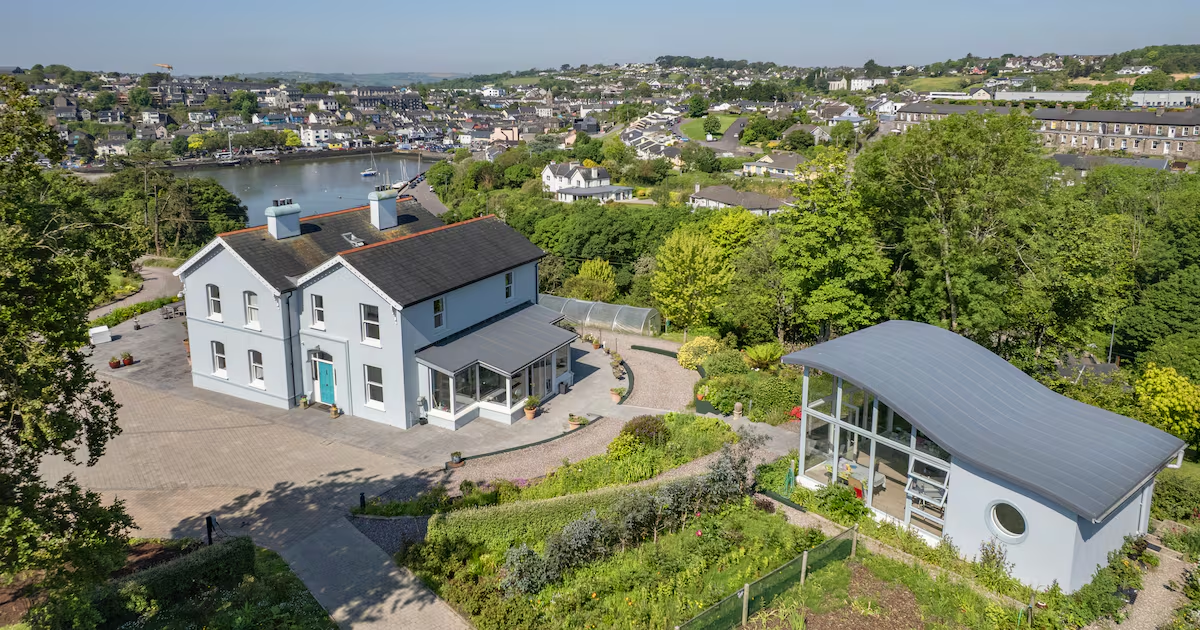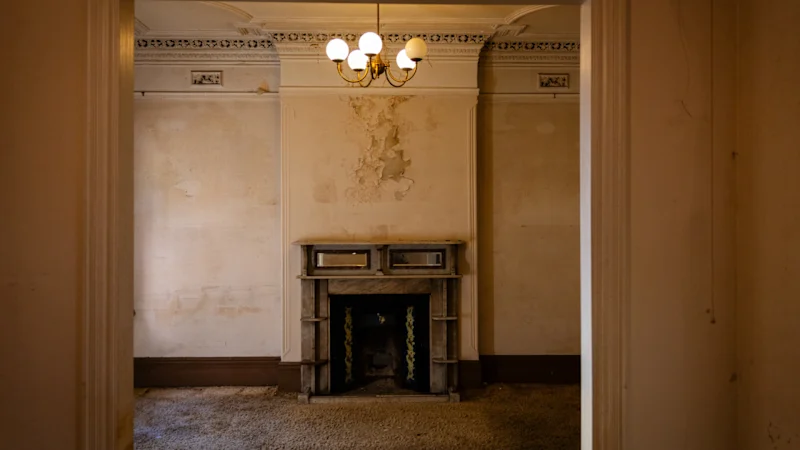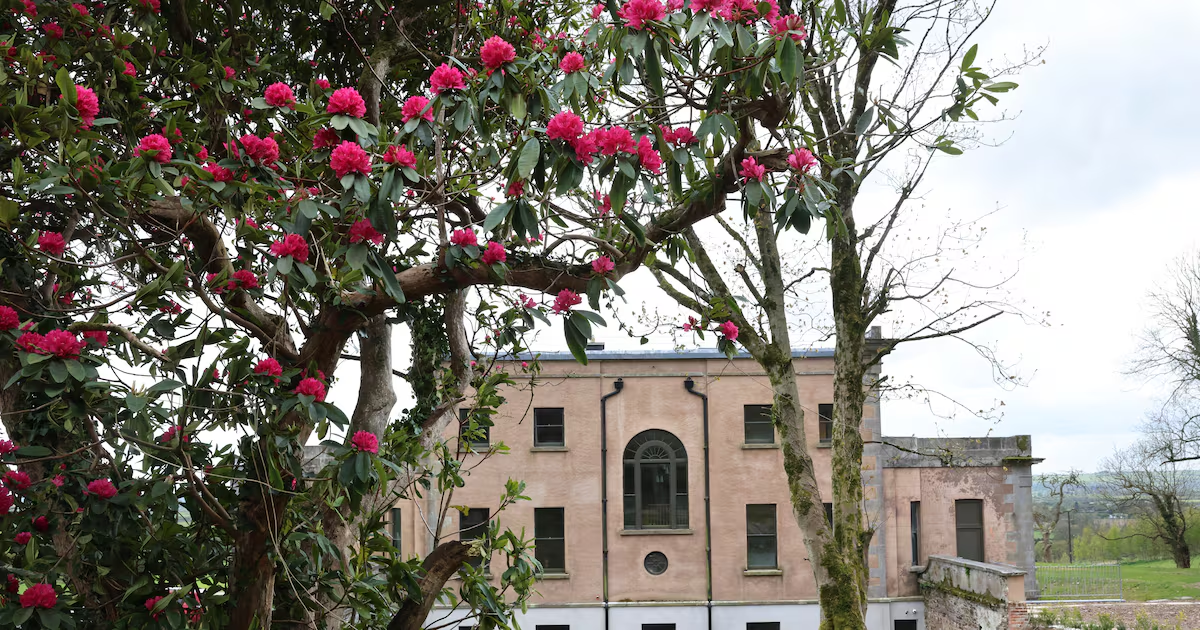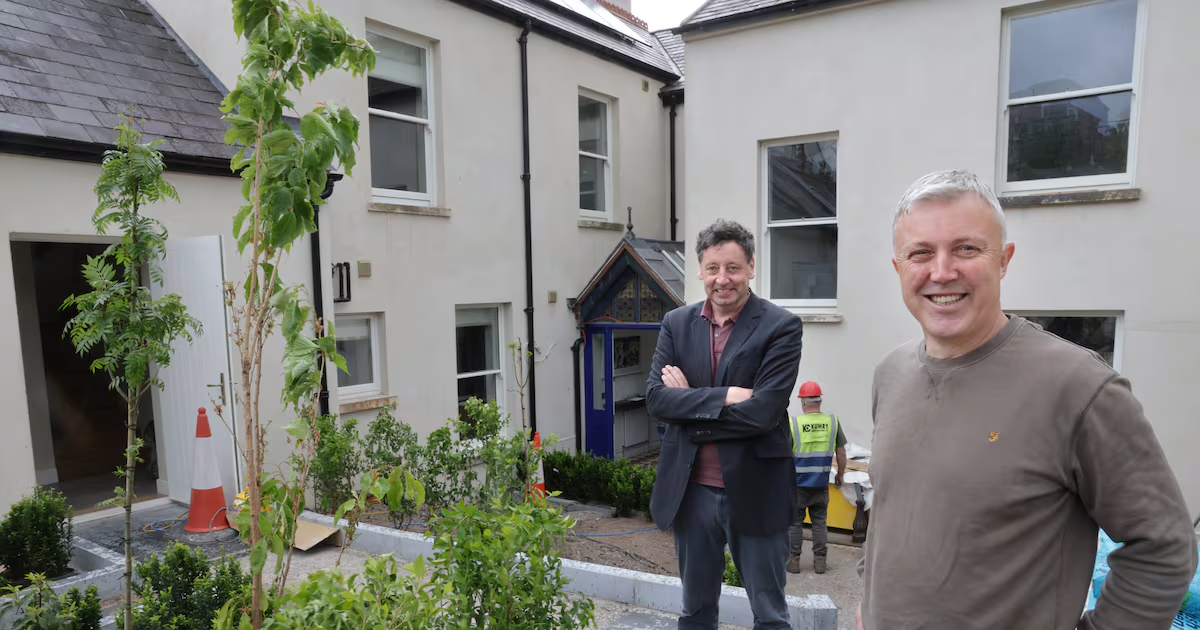
Sympathetic restoration of Annamount, off Summerhill North, is as a model that may bring people back to live in the city’s inner suburbsShane Clarke (right) at Annamount, Cork city, where he restored the historical property and converted it into three homes, with architect Gareth O'Callaghan (left). All photographs: Dara Mac Dónaill/The Irish Times Sun Jun 07 2026 - 05:00 • 5 MIN READ“A house of 4,500sq ft is probably too big for most people,” says Shane Clarke. It’s the reason why he has opted to split a Victorian home, Annamount, into three townhouses.And he now hopes that the sympathetic restoration of the property on Wellington Road, off Cork’s Summerhill North, could inspire others to bring life back to this historic part of the city.In 2016 Clarke and his wife, Deirdre de Barra, decided to return to Ireland after 25 in London. They opted for Cork, where Clarke was appointed as inaugural chief executive of Nano Nagle Place on Douglas Street, formerly the South Presentation Convent. By then the couple had already bought their house on Wellington Road. Next door was Annamount, an early 19th-century property, which had been let out in bedsit accommodation until a fire in 2020 made it unfit for habitation. The “imposing” listed multibay two-storey over basement house was built in about 1830 and, as described in the National Inventory of Architectural Heritage (NIAH) records, was later embellished with many features characteristic of Victorian Gothic. Its key historic features included some fine cast-iron work, polychrome tiles, a “delightful gable-fronted porch and high-quality leaded stained glass”.However, left vacant, Annamount seemed more Gothic by the month, and Clarke could imagine it remaining derelict for years to come. His London career of urban design and management, notably with Team London Bridge, is echoed in his Irish consultancy firm GardenCityCulture, and in his awareness of the need to manage and enhance the value of heritage properties. The potential of Annamount, he believes, might have been left unrealised.“It might not have been seen as an opportunity to add value not only to the building itself, but possibly to the area as a whole, and to get a modest return on the costs of the restoration.”So, in 2021, he bought Annamount for €400,000. However, the Covid-19 pandemic caused significant delay with the design and planning application that had been, prepared by JCA Architects led by Gareth O’Callaghan. Impressed by their work at Nano Nagle, which won the Council of Europe Museum Prize in 2022, Clarke retained JCA for his own house at Wellington Road, and subsequently at Annamount where, as at Nano Nagle, O’Callaghan worked with colleague Alan Macilwraith.“These period properties have a family resemblance among themselves,” says Clarke, “yet each individual one seems unique. And the way to make them survive into the 21st century is to make them fit for people to live in.” Entrance hall Kitchen and dining area Shane Clarke and architect Gareth O'Callaghan Qualities such as deep-set doors and timber sash windows, the architraves and alcoves, and the long, slanting gardens distinguish these hillside terraces, stretching from the three-lane MacCurtain Street up Summerhill North, to the hub of St Luke’s Cross, with its tollbooth recalling a turnpike road.At Annamount respect, inspiration and innovation marked the renovation of the property. “Everything that could be restored or replaced was done,” says Clarke. “All the fireplaces have been kept, along with the decorative coving. We were able to use about a third of the original tiled floors and copied what we couldn’t save. We took out the stained-glass window on the half-landing, restored it and framed it in a light-box to be used as a feature in the larger unit.” That three-bed unit of 150sq m is for Clarke’s mother, who will move to Cork from Sandycove in Dublin. The second dwelling of 120sq m will also be in the main house, sharing the renewed arched porch as a lobby. The third unit is the two-bed coach-house of over 70 sq m, and designed to a sleek contemporary mode. These two units will be rented. An eccentricity of many of these south-facing properties is that their main entrance is behind them on Wellington Road, within an Architectural Conservation Area. This back-to-front positioning hides the wicket entrances on Summerhill North behind high walls and railed or steel-sheeted gates. Several well-tended gardens can be glimpsed between the bars, but from this roadside the impression is of diminished grandeur, even though some marble nameplates remain under overgrown shrubbery or beside shrunken pediments.Although a walk from the toll booth down Wellington Road begins with a city council warning of a dereliction notice to the unknown proprietor of the former post office, O’Callaghan relishes a neighbourhood rich with architectural resonance. Here, gateways and railings express a tradition of decorative stone and ironwork; O’Callaghan explains that even the stepped and railed footpaths are typical of the terraced houses built for the upper military of nearby Victoria – now Collins – Barracks.One of the restored fireplaces Stairs Inside the converted Annamount Inside the converted Annamount Inside the converted Annamount Often built in groups, these houses reflected the city’s mercantile trade and the merchants who liked to live near it. The gateway to Montpelier Terrace has stone wheel-guards for its carriages, a porch is built to the Greek Ionic order, here and there are spoked fanlights, tiled passages, boot-scrapers, two different houses unite in a pediment. Roman cement-moulded details and limestone thresholds remain, entrances have marble inserts as nameplates on the piers, all suggesting a vibrant and continuing sense of place. Such elements occur chiefly on the southern edge of Wellington Road. On the opposite side, the sandstone buildings of two former convents, including a hospice known in earlier days as “t’incurable”, dominate a streetscape of shorter terraces. It is where Summerhill North descends to the riverside that the purposely grander villas were built, the merchants replacing the military with splendid architectural confidence in an introduction to the even grander villas of Montenotte.While O’Callaghan welcomes the authoritative coherence evident in a new consciousness of Summerhill North, Clarke would like to see a city council with greater financial autonomy when making planning decisions. His feeling is that the city authorities are not looking at the inner suburbs to find what can be carved from residential spaces. “We can see young people coming here, young Europeans, and saying what a terrific place to live,” he says. “And that’s what I want to bring back with Annamount. It’s not just my affection for the house. The intention is to restore some of that atmosphere, and wealth, to an eclectic and interesting community with a slightly Bohemian spirit.” Entrance gate Annamount, off Summerhill North in Cork Annamount, off Summerhill North in Cork IN THIS SECTION
Restoring a Victorian house in Cork city with space for three families
The sympathetic restoration of Annamount, off the city’s Summerhill North, into three new homes could be seen as a model to bring people back to live in the city’s inner suburbs
TL;DRAI
Questo articolo non è rilevante per Warptech Tech News — parla di restauro architettonico residenziale a Cork, non di tech, AI, business, startup, economia, o altri topic della testata. Segnala al team editoriale se è stato inviato per errore, altrimenti non ha senso includerlo nel flusso.
1,122 words~5 min read