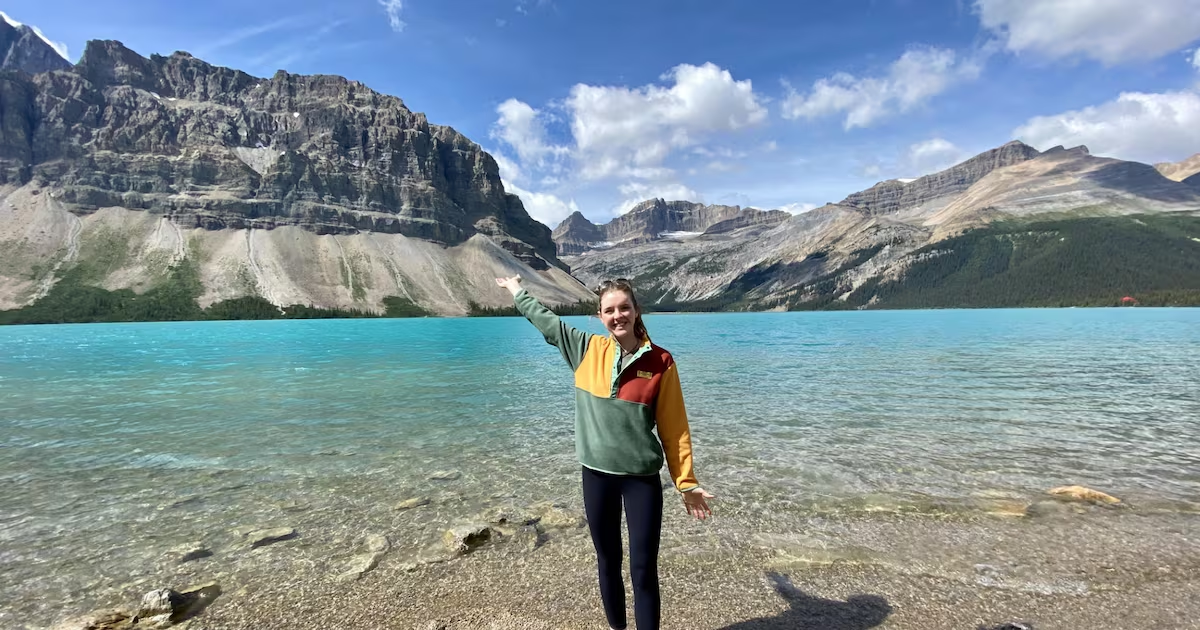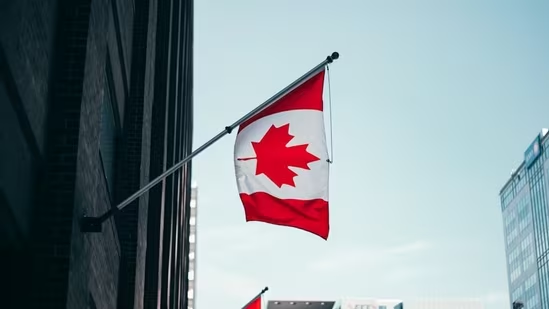
The number of Irish people emigrating to Canada has been rising steadily since Covid, almost equalling those going to the United States – its flashier, wealthier neighbour to the south – over the past three years.Estimates from the Central Statistics Office (CSO) show 15,600 people moved from the Republic to Canada between 2023 and 2025, with 16,000 going to the US. “They go to Australia to party and come here for professional development,” says Vancouver-based immigration lawyer Niall Carry. The Co Meath man and former social worker went ‘down under’ before moving to Canada 15 years ago and later became a citizen.The working holiday visa, allowing 18- to 35-year-olds to work for two years, is one of the key draws to this vast nation, with a land mass bigger than the US, but one eighth of the population. Canada is a steady option for Irish “seeking adventure or career growth” says Kerry man Ruairí Spillane, founder of immigrant information site Moving2Canada.com.When he started the website, “it was horror stories of Irish families leaving the keys of their house behind in negative equity situations”. But things have changed. “Now we’re at a point where emigration is optional and there are strong Irish communities from coast to coast for those that want to explore Canada.” For Doireann Ní Siochrú, moving to Canada in July 2024 on a working holiday visa “wasn’t just about changing location, it was about personal growth”. “Vancouver in particular offered the perfect mix of opportunity, lifestyle and adventure,” she says of the city on the west coast, which has become the most popular choice for recent Irish emigrants. “Leaving home and moving here on my own was a big step, but I wanted to challenge myself and understand what I’m capable of achieving,” the Dubliner says, describing the move as “transformative”.However, the number of working holiday visas available to Irish people has been dropping in recent years, says Spillane. “In 2023, we had 10,000 two-year work permits issued, 2024 saw 6,500, 2025 has around 3,800, so Ireland’s quota for 2026 is 3,800,” he says. “We don’t have the 10,000 we saw in 2015 but there are still a lot coming here,” says Cathy Murphy, head of the Irish Canadian Immigration Centre, set up in 2012 to assist new Irish arrivals. High demand is evidenced in the applications. More than 4,000 Irish people have been “invited to apply” for a working holiday visa so far this year. The unique automatic two-year open work visa gives people time to build a life, with many staying, or trying to stay, long term. “Previously, Irish couples were returning to have kids but now they seem increasingly confident that they have a strong enough support network through each other,” says Spillane. While he feels the population of young Irish has “peaked”, he says “the number of Irish staying on longer term is likely increasing”. The Canadian census shows evidence of more families with children moving, with 4,445 children with Irish citizenship arriving in 2021. Many people don’t realise it’s possible for their families to come with them on a working holiday visa, says Niall Carry. One of those who moved for “just two years” with family, and stayed, is Katríona Masters. The Co Down woman and her Scottish husband Colin decided to take a chance on Vancouver, arriving with their three children a decade ago. Brexit had left the economy in the North, where Masters ran a cafe, in an uncertain place, while Donald Trump’s first election scuppered plans for a new life in Connecticut. Colin, about to turn 36 that year, just made the working holiday visa age cut-off.“When I first came I’d meet people who then went home after two years to have children,” says Masters. It took a while to settle in, with surprises such as the prevalence of bears – “nobody prepared me for bears”. However, her husband got on the permanent residency track early through the Provincial Nominee Program. The quality of life in Canada is “really good” overall, she says, with “clean living” and “everything outdoors”, “lots of activities [such as] skiing and hiking”. “We’ve a great circle of friends and a great way of living. It’s very peaceful.” Those on working holiday visas should start thinking about their long-term plans and consider applying for permanent residency when they arrive, says Carry. Many people only fully appreciate Canada after a year and if they don’t take action until 18 months into their stay, it’s too late, says Ruairí Spillane. “Two years goes quickly, but there’s not always an obvious path to stay longer,” says Cathy Murphy. People can become “terribly disappointed when they can’t stay”, she says. One of the main attractions of staying are the career opportunities in its strongly growing economy, despite what Canadian prime minister and ex-Irish passport holder Mark Carney described as the “rupture” of the “rules-based international order” to its south. Job opportunities are good, and the Irish have “an excellent reputation in Canada and are highly desired by employers”, says Spillane.“Lots of Canadian construction companies contact me seeking Irish with data centre construction,” says Spillane, who also founded Outpost Recruitment.Construction is “still the big one” for Irish immigrant jobs in building and infrastructure projects. “The Irish construction workers are highly sought after due to their excellent work ethic and communication skills,” he says.People will find once they “get their foot in the door” they move “faster and higher” than they would have in Ireland, where they might have got stuck at a certain level, says Murphy.But new arrivals are often surprised at the slow pace of job applications, Niall Carry says. “It could be two or three months and you don’t hear anything [about an application], then all of a sudden you will have a slew of interviews.”Landing a “career role” can take several months, and even then people should expect this will be a “slight step back” from where they were back home, says Murphy. New arrivals should consider getting a “joe job”, such as a barista or a barback (bartender support) to tide them over while they look for a career role, Murphy advises. “You have to take a job to get Canadian experience on your resume,” and if people have very particular professional experience “it will take time”, says Carry. He recalls an Irish lawyer who took an ice cream van job, which gave her Canadian experience for her CV, and eventually got legal work. “There will be frustration ... but there are a lot of really good jobs.”The need to network can come as a shock to Irish workers, and arrivals should use Irish contacts, says Carry. He urges people not to be “humble” or “sell yourself short”. For engineer Doireann Ní Siochrú, who took two to three months to get a job, LinkedIn was a key tool. “The process itself was quite involved, I went through four rounds of interviews before receiving an offer.” Ní Siochrú loves the lifestyle that working in Vancouver offers. The small, diverse west coast port city nestled between the Pacific Ocean and the Rocky Mountains has become the destination of choice for many recent Irish arrivals. “I love that you can finish work in the city and be hiking a mountain, snowboarding, swimming in the ocean, or bike camping under the stars all in the same day. It still doesn’t feel real sometimes,” she says. Patterns of emigration from Ireland have focused on the three most populous English-speaking provinces. Almost half of Irish-born emigrants (49 per cent) live in east coast Ontario, including Toronto, with a quarter in west coast British Columbia (BC), including Vancouver, and 14 per cent in landlocked western province Alberta (Edmondton and Calgary). Just 2 per cent have settled in French-speaking Québec. However, since 2010 more Irish are settling in BC than Ontario (of 6,355 arrivals 2016-2021, 38 per cent live in BC and 35 per cent in Ontario). The high cost of living means many are leaving Vancouver and other bigger cities and instead choosing smaller and more affordable cities, says Cathy Murphy. “I suspect there are more Irish in Vancouver now than Toronto. While lots of Irish stayed in locations like Calgary, Edmonton, Regina and Saskatoon, there are emerging Irish communities in smaller regional locations like Ottawa, Kelowna, Victoria,” says Ruairí Spillane.The cost of living is “not much better than Ireland”, says Murphy. “We do have a housing crisis but not as acute as in Ireland.” It’s still hard to afford an apartment on a single wage in a big city, but manageable if you have a decent job, she says. Rents fell last year across Canada but are highest in Vancouver and Toronto, at $2,550-$2,700 (€1,500-€1,700) a month. While the average monthly salary is roughly €600 lower in Canada than in Ireland, stark differences in rent mean people may still have more purchasing power. Masters recently bought a condo with her family in Port Moody near Vancouver. Moving to BC was expensive and anyone thinking of going should “bring cash”, she says. Rent is “very high” and buying a house took a while, she says. “What they don’t tell you is that to get a house you have to go through an interview, show them pictures of the family, you need a credit check and bank statements. With a lot of the houses you don’t have the whole house, you’ve a family in the basement underneath you – that blew my mind.”But for Masters, one of the biggest challenges of moving over was not the cost, but making friends, finding the Canadians more guarded. But she met an Irish teacher from Limerick on Facebook (now her best friend) and later set up a mothers’ group. “We built up a community out of that.”For Doireann Ní Siochrú, moving alone “definitely takes courage”. “It pushed me to really put myself out there and fully embrace meeting new people.”She met her partner in a community centre sauna two months after arriving. “I just made a silly joke to start a conversation, and it went from there. That’s honestly been a big part of my experience, just being open, curious, and just going for it.“There’s such a sense of possibility. People are open, active, always trying new things. “I love the balanced lifestyle of adventure and calm. It feels like you’re constantly living, not going through the motions.”
The lure of Canada: ‘There’s such a sense of possibility’
The country is a steady option for Irish seeking opportunity, adventure, career growth and a balanced lifestyle
1,730 words~8 min read