(Image credit: Shutterstock)
TVs are complicated. As a result, the TV business sometimes seems at odds with itself. Brands are eager to impress with their latest technological innovations, but the competitive nature of the industry often fosters misinformation.I’ve been covering TVs for over 10 years, reviewing everything from budget models to the best TVs in the world. Throughout this time, I can’t help but have noticed a handful of myths that haven’t gone away.Some of these misconceptions could end up costing you money. Others might land you a less-capable TV. Let’s bust these myths.1. TV brightness matters more than anything else
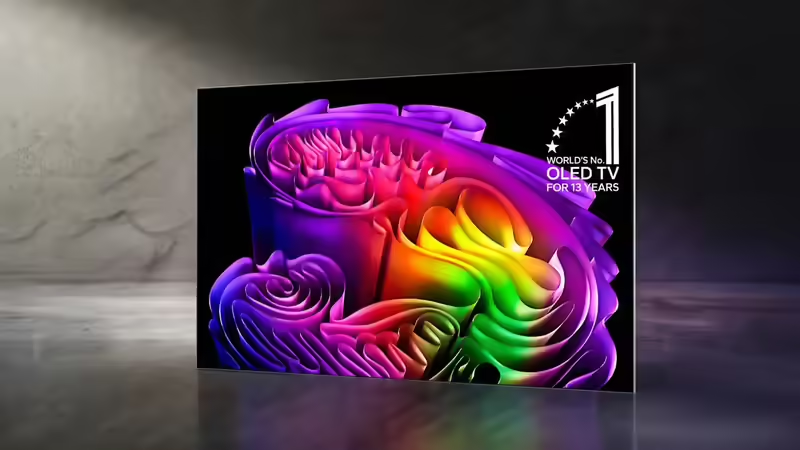
(Image credit: LG Display)In the world of TVs, few metrics are weighed as heavily as brightness. It’s easy to measure, easy to boast about with numbers, and most importantly, easy for people to understand. But while certainly important, brightness isn’t the be-all, end-all yardstick for picture quality.Brightness matters as it relates to your ability to see the picture. Naturally, if your living room gets a ton of sunlight, buying a bright-enough TV is important. The TV needs to compete with ambient light in order for the picture to pop.However, when we use the word “pop,” what we’re really talking about is contrast. Contrast describes the difference between the darkest parts of the picture and the brightest.Contrast — not brightness alone — is the main ingredient in a visually appealing picture.A high-contrast picture offers more depth, making it appear more real to our eyes. This is why contrast — not brightness alone — is the main ingredient in a visually appealing picture.Get instant access to breaking news, the hottest reviews, great deals and helpful tips.A TV that gets extremely bright has a distinct advantage over a dimmer model, since its picture will hold up better during the day and have a head start with the lights off. But many TVs — especially the best OLED TVs — deliver better contrast (and a better overall picture) than rival sets that achieve higher brightness.It’s all relative. Since the pixels on an OLED TV are self-lit, they’re capable of producing perfect black levels and controlling the brightness on a pixel-by-pixel basis. As a result, the brighter parts of the picture look even brighter. OLED TVs, in other words, don’t have to get as bright as LED TVs in order for our eyes to perceive them as being brighter.OLED TVs don’t have to get as bright as LED TVs in order for our eyes to perceive them as being brighter.Another way to look at this is that 1,000 nits of highlight brightness on an OLED TV looks much brighter than 1,000-nit highlights on an LED TV, and it’s all thanks to OLED’s ability to get consistently darker.This is one of the reasons we often recommend entry-level OLED TVs over their similarly priced, LED-based rivals. The LG B5, for instance, offers modest brightness compared to most mid-range LED TVs, but its OLED-driven picture allows for better overall contrast than most of those LED-based sets.I’ve seen searingly bright TVs that look worse than models half as luminous. I’ve also seen equally bright TVs that look drastically different thanks to matters of color, picture processing and more.When shopping for a TV, it’s worth researching brightness and having a good handle on how a TV might hold up in whatever room you’re putting it in. But it’s also worth avoiding the mindset that brighter equals better.2. Because of burn-in, OLED TVs don’t last as long as LED TVs