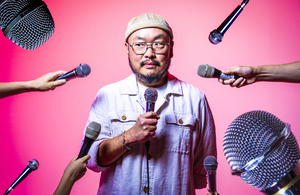
Stand-up comedian Kim Dong-ha tests whether K-comedy can travel as far as K-pop Comedian Kim Dong-ha poses for a photo before an interview with The Korea Herald at its office in Seoul on May 28. (Yoon Chang-bin/The Korea Herald) Korean culture has expanded far beyond its borders over the past decade: K-pop is a global phenomenon, while Korean films, television, food, fashion and beauty products continue to attract growing international audiences.Comedian Kim Dong-ha hopes Korean comedy can follow.Kim recently completed the first North American stand-up tour by a Korean comedian, performing in Washington, Toronto and Vancouver under the banner "Made in Korea." The shows were performed entirely in Korean and drew largely overseas Koreans and Korean diaspora audiences.For Kim, however, the tour was only a starting point."The most important thing is studying each country's culture and language," Kim said during an interview with The Korea Herald on May 28. "If you rely only on translation, there are limitations. For example, if you're making jokes about famous people, Americans won't know Korean celebrities. You need to know American celebrities instead."The determination to bring Korean comedy overseas reflects Kim's own unlikely journey.Many of South Korea's household-name comedians entered the industry through broadcaster recruitment programs, but Kim built his career entirely outside the mainstream. From a small theater troupe in rural North Gyeongsang Province to Seoul's emerging stand-up comedy scene, he spent years performing on the margins before becoming one of South Korea's biggest ticket-selling comedians.Born in Masan, South Gyeongsang Province, Kim never imagined comedy could become a realistic career."People on TV felt like completely different kinds of people," he said. "For someone from a provincial city, it felt like a world that had nothing to do with me."Instead, Kim entered a teachers' college, studying education and Korean language instruction. He even worked briefly as a temporary teacher after graduation.At the time, it had seemed like the safest path."The most successful-looking people around me were teachers," he recalled. "I liked reading, so I thought becoming a Korean language teacher would suit me." Comedian Kim Dong-ha poses for a photo before an interview with The Korea Herald at its office in Seoul on May 28. (Yoon Chang-bin/The Korea Herald) Yet making people laugh remained his greatest source of happiness.While serving in the military in his early 20s, Kim spent much of his time reading. It was there that he came to a realization that would change his life."I realized that the people on television had once been ordinary people too," he said. "They became who they are because they challenged themselves."After leaving teaching behind, Kim joined legendary comedian Jeon Yu-sung's Cheolgabang Theater troupe in Cheongdo, North Gyeongsang Province, in 2013.The decision placed him on one of the hardest paths available in Korean comedy.At the time, broadcaster recruitment programs dominated the industry. Most successful comedians debuted through major television networks. Kim did not.Instead, he spent years learning comedy in small theaters while repeatedly failing broadcaster auditions."I was always eliminated in the final rounds," he said.When the theater eventually closed, Kim found himself without a company, television contract or even a clear plan.Still, he was unwilling to give up."I just thought, 'Let's go to Seoul. Maybe something will be there.'"Shortly after arriving in Seoul, he discovered “Comedy Haven,” one of Korea's first clubs dedicated entirely to stand-up comedy.The experience immediately captivated him."What I had learned before was sketch comedy," he said. "The lights go out, the set changes, actors come on stage. That was comedy to me."Stand-up felt radically different."There was just one microphone," he said. "A comedian would walk on stage and make people laugh using only words. I thought, 'This is something I can do.'"Kim soon became part of a small group of comedians who would help build Korea's modern stand-up scene from the ground up.Among them were performers such as Danny Cho, members who would later form Psick University, and other comedians who spent years performing before stand-up gained wider popularity. Comedian Kim Dong-ha poses for a photo before an interview with The Korea Herald at its office in Seoul on May 28. (Yoon Chang-bin/The Korea Herald) There was little money and even less recognition."We had maybe 10 or 15 people," Kim said. "We monitored each other's performances, held meetings and talked about comedy all the time. After shows, we'd gather at convenience stores because we couldn't afford anything else."As their short-form videos from the comedy show uploaded on social media began going viral online, public awareness gradually followed."A lot of people think stand-up became popular first and then we benefited from it," he said. "I think it's the opposite. We kept doing it consistently, and because of that, more people learned what stand-up comedy was."Today, Kim regularly fills large venues across Korea. But despite his success at home, one experience during his North American tour reminded him how difficult comedy can be.While visiting New York early this year, Kim decided to test himself at a local comedy club.Stand-up comedy originated in the US, and he wanted to know whether his material could work outside Korea.He translated some of his jokes into English, showed club staff videos of his Korean performances and was unexpectedly offered a chance to perform.The result was far from the triumphant international breakthrough he had imagined."Of course it didn't go the way it does in Korea," he said with a laugh.The audience did not respond as strongly as Korean crowds. The cultural references landed differently. The rhythm was different. The language barrier was real.Instead of discouraging him, however, the experience left him hungry to improve."It made me realize how much I still need to learn," he said. "Next time, I want to study English properly and understand local culture much better."Ultimately, Kim's ambitions extend beyond personal success.Just as Korean music, films and television have found audiences around the world, he hopes Korean comedy can one day travel as well.Asked about his ultimate goal as a comedian, Kim gave an answer that sounded both sincere and perfectly suited to a stand-up comic."I want to tell one more joke right before I die," he said. "To me, that means I've lived as a comedian until the very end. It means I'm still thinking, still creating and still making people laugh."Then he paused and delivered one final punchline."Actually, that was a joke too." Comedian Kim Dong-ha poses for a photo before an interview with The Korea Herald at its office in Seoul on May 28. (Yoon Chang-bin/The Korea Herald)
Making America laugh is no joke
Korean culture has expanded far beyond its borders over the past decade: K-pop is a global phenomenon, while Korean films, television, food, fashion and beauty
1,078 words~5 min read