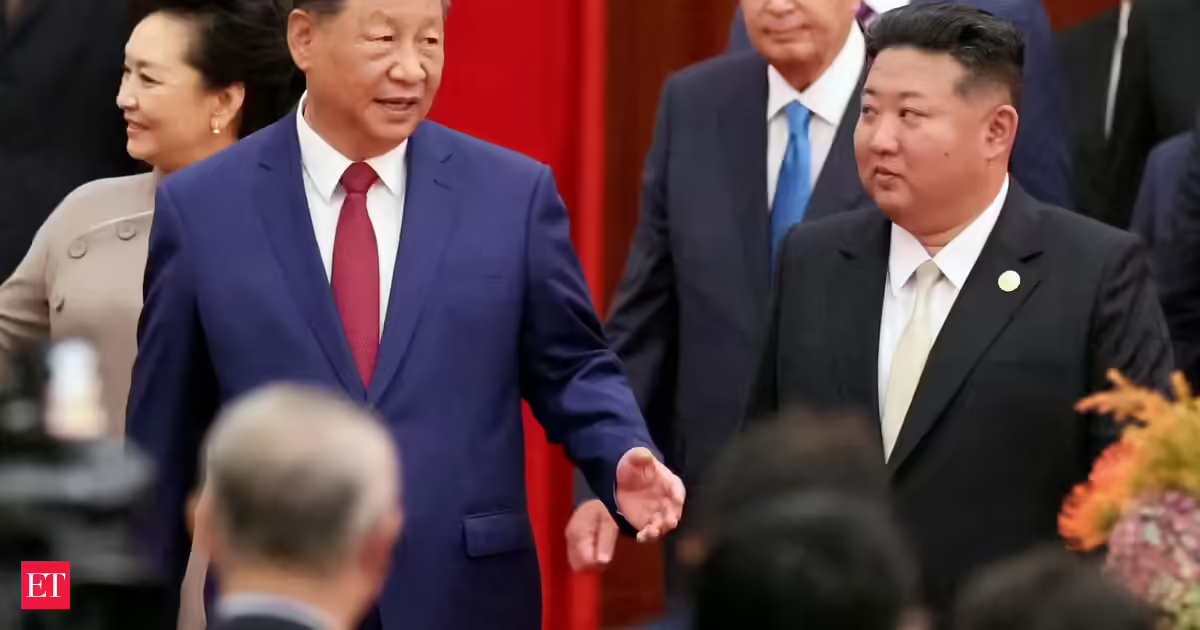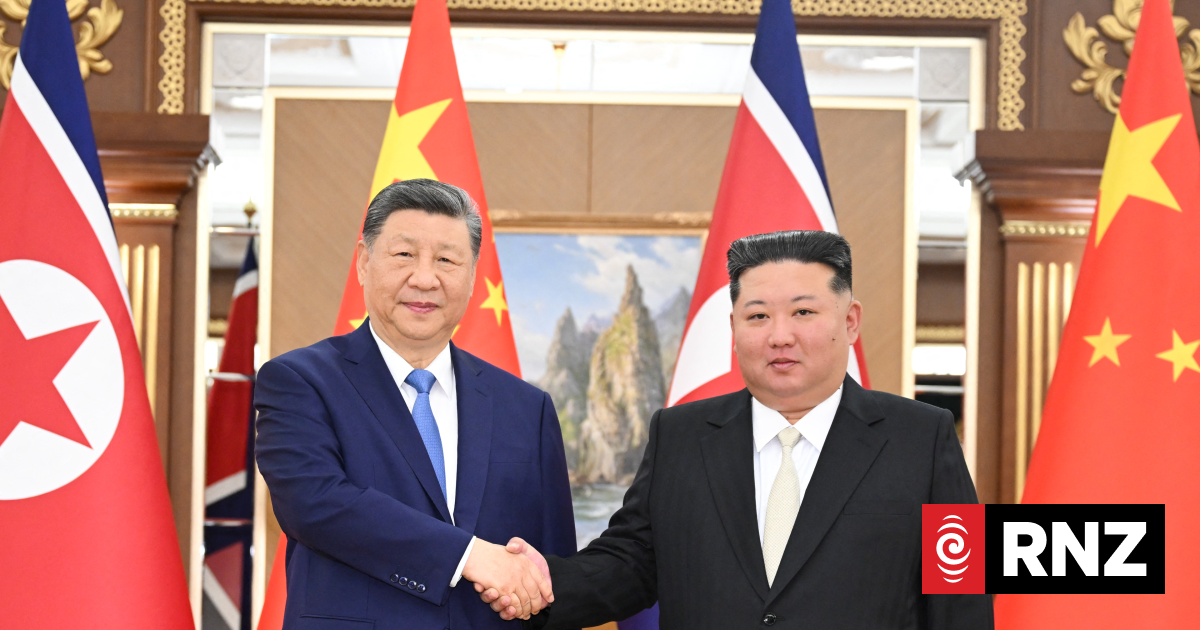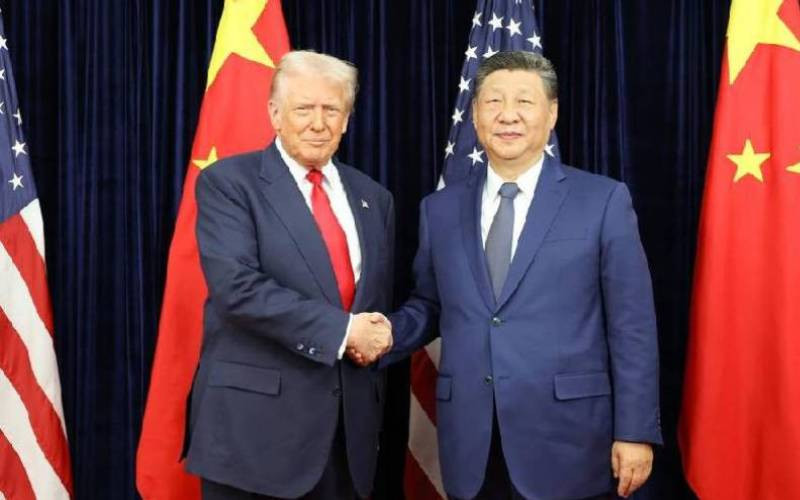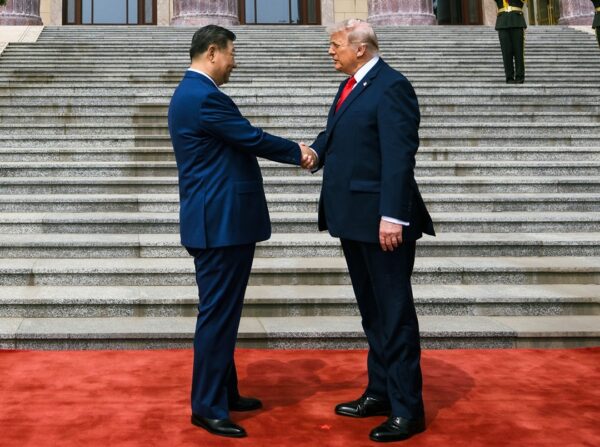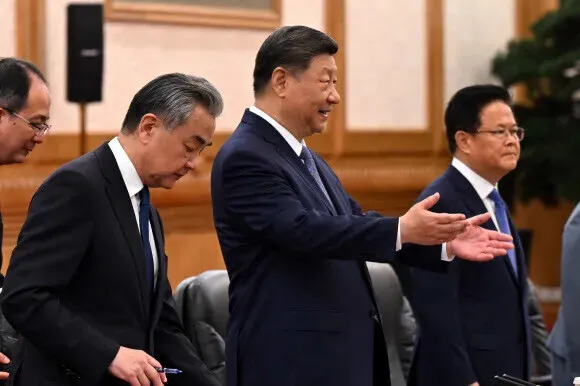
President Xi Jinping of China greets Australian Prime Minister Anthony Albanese for a summit during the latter’s visit to Beijing on July 15, 2025. (EPA/Yonhap)
To fully grasp how South Koreans view China in 2025, we must first consider the context in which rumors of President Xi Jinping’s supposedly waning power have spread like wildfire in the country.Conjecture about Xi’s fall from grace began circulating in 2024 among anti-China, anti-Chinese Communist Party YouTube channels outside of Korea. This year, these rumors rapidly spread among Korean YouTubers, and more recently, even major news outlets in Korea have reported on the issue as the latest development in Chinese politics. In brief, these rumors suggest that Zhang Youxia, the second-in-command of the People’s Liberation Army and the current vice chairman of the Central Military Commission, has conducted a coup to wrest control of the PLA from Xi. Meanwhile, heavyweights within the CCP, including former President Hu Jintao and former Premier Wen Jiabao, are said to have seized political power in the party, turning Xi into a mere figurehead. There are also claims that a covert expanded meeting of the CCP’s Political Bureau, with even retired PLA leaders in attendance, was held in May; participants are suspected to have decided to officially oust Xi from presidency at a plenary session of the CCP scheduled for Aug. 27-30.The inner workings of China’s top leadership remain an enigma to outsiders. Rumors of Xi’s downfall, in contrast, portray a clear-cut, dramatic narrative of power struggles within China, piquing public curiosity and raking in clicks. However, many experts have pointed out that the contents of such rumors are unfounded, saying that those who proliferate them are exaggerating and tailoring a few incidents to create a particular narrative. Among these experts is Cho Young-nam, a professor of Chinese politics at the Seoul National University Graduate School of International Studies. Cho writes in the July 2025 edition of the SNU Institute of International Affairs’ Pacific Report that Xi maintains a firm grip as a leader, as he oversees the CCP’s powerful rectification campaign and directs development of China’s 15th Five-Year Plan. In addition, he has been negotiating with US President Donald Trump on tariffs and advanced technology through direct telephone conversations, and has visited Southeast and Central Asia for summits.Chinese political commentator Deng Yuwen also pointed out in a commentary for the Chinese-language edition of the Deutsche Welle published July 7 that if Xi had been pushed out of power, significant changes would have been made in the CCP’s official propaganda, of which there are no signs. Furthermore, he states that the incidents offered as evidence of Xi’s fading power are not persuasive. For one, the presence of Xi Mingze, Xi Jinping’s daughter, at a family dinner the Chinese president held for the visiting Belarusian President Aleksandr Lukashenko in early June has been interpreted as Xi’s attempt to ask Lukashenko to care for his daughter in the future. But there is no reason for Xi to entrust the safety of his daughter to Lukashenko rather than Russian President Vladimir Putin. Another piece of news often cited as evidence of Xi’s supposedly fading power is the name of Guanzhong Revolutionary Memorial Hall, a museum which opened in late May to commemorate Xi’s father. The absence of Xi’s father’s name, Xi Zhongxun, in the hall’s name was said to indicate Xi’s loss of power. However, Deng states that this conclusion is far-fetched, as the memorial hall was built next to Xi Zhongxun’s grave on the 23rd anniversary of his death.Conspiracy theories continue to multiply as ambiguous incidents are interpreted as pieces of definitive evidence of Xi’s supposed downfall. The fact that Miao Hua, the head of the Political Work Department of the Central Military Commission, and He Weidong, vice chairman of the Central Military Commission, who were appointed by Xi, have been removed from their positions is cited as the most important evidence for the theory that Xi’s power is waning. Miao and He’s dismissal has left three of the seven seats of the Central Military Commission vacant. However, this could also be interpreted as a sign of Xi Jinping’s firm resolve to eradicate corruption and factionalism within the military in order to create a powerful army — one capable of defeating the United States. Personnel-related decisions made at the Central Military Commission at the CCP plenary meeting next month should be watched closely for this reason.The CCP Political Bureau’s review of new policy-making rules at the Central Committee in a meeting at the end of June led many to conclude that the new rules will enable senior statesmen to take part in policy-making.