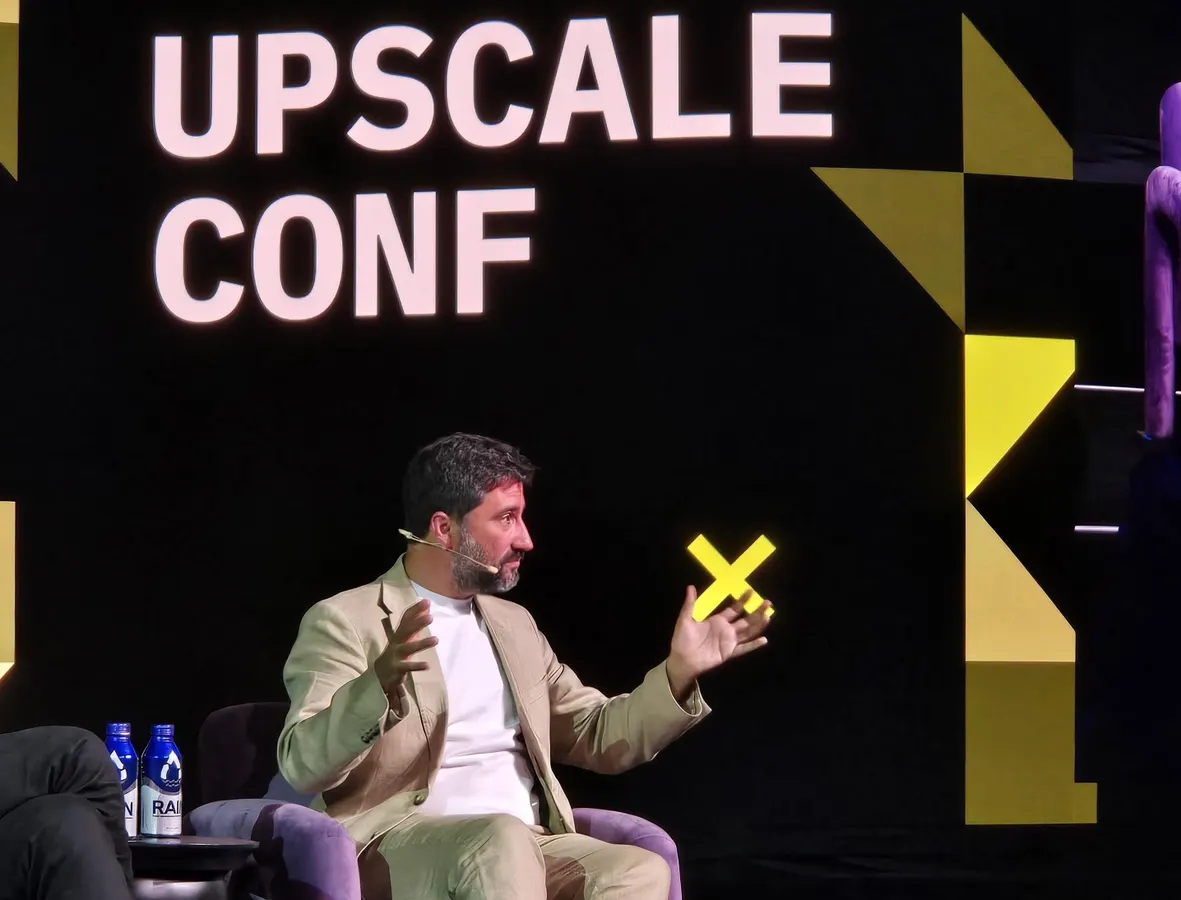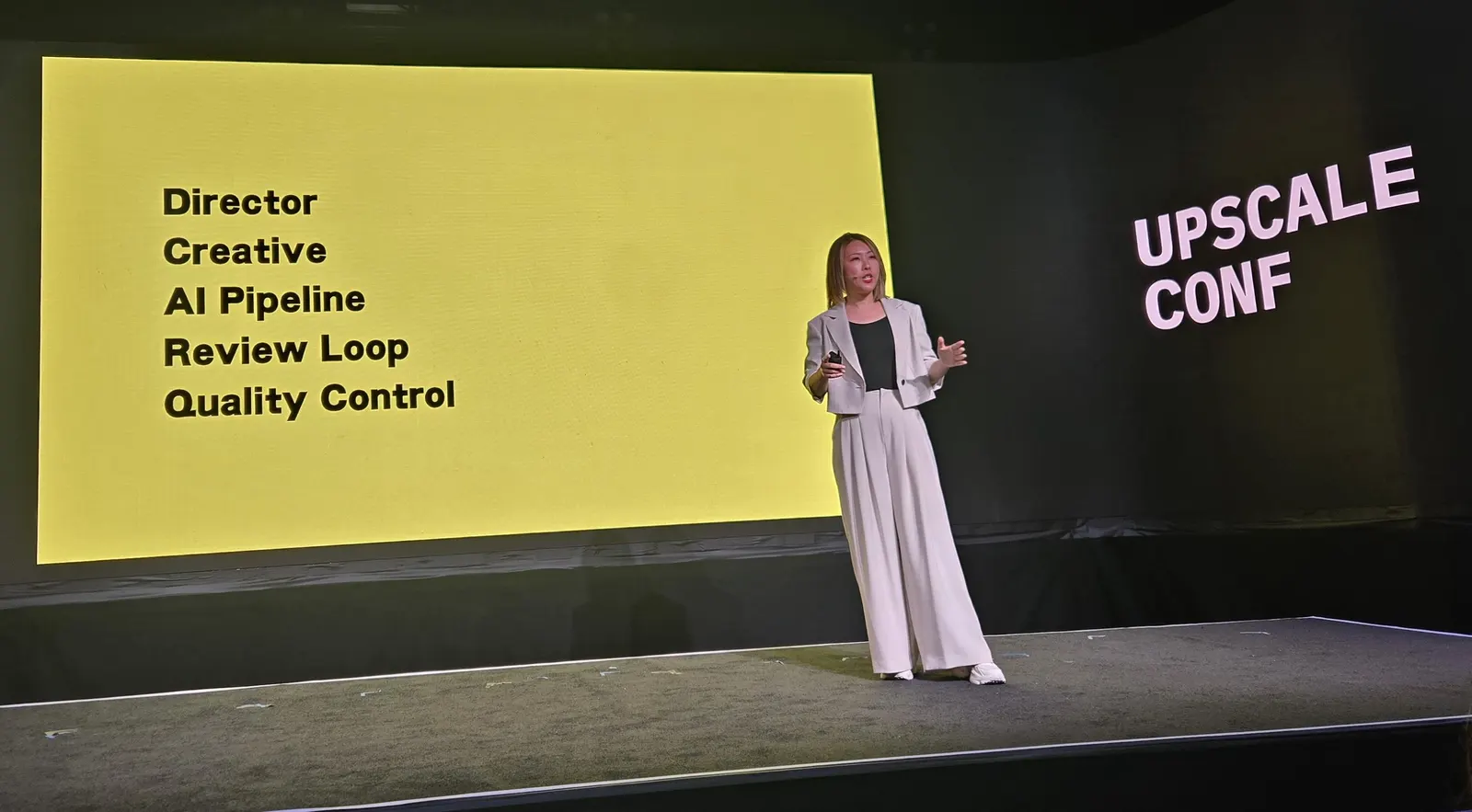
Momo Wang, Founder of Bunny Galaxy and creator of iconic rabbit graphic Tuzki shares where humans fit into the AI production pipelineRon SchmelzerSo much of the story of AI in creation is centered around what you get out of the AI black box when you put in a prompt. But innovators are showing that there’s more to the story than AI generating text, video, and images. At Upscale Conference SF 2026, three artists made the same point from different corners of culture. Curt Cameruci, better known as Flosstradamus, framed AI as a new sampler. Noah Wagner, a writer, director and head of AI innovation at Echobend, treated it as a production problem solver. Momo Wang, founder of Bunny Galaxy and creator of iconic rabbit graphic Tuzki, talked about AI as an animation pipeline, a franchise engine and, more than anything, a test of human taste. The first wave of generative AI was focused on outputs, but the next one asks who can direct it, scale it, own it and make audiences care.Goldman Sachs has projected that the creator economy could approach $480 billion by 2027, up from roughly $250 billion when it published its research in 2023. That number used to describe influencers, brand deals, ad revenue, subscriptions and fan commerce. It now has to stretch to include AI creators that now can operate like a small studio.The Creator As StudioWagner, a film director, creative director and executive producer whose credits include Westworld, Silicon Valley, Ballers, and Game Of Thrones, made it clear that while AI might be changing the tools creators use, nothing has changed in terms of the role and power that creatives have in their own futures “You and your collaborators can be a studio,” Wagner said, after comparing the AI moment to earlier breaks in film history, including New Hollywood, YouTube, TikTok and the DSLR boom. He shared that while the tools are faster and more capable, the timelines are compressed and the access is wider. At the same time, Wagner argued that craft, story, collaboration and taste still govern the work, regardless of medium.That idea marks a break from what is widely considered to be “AI slop”, the use of AI to quickly, and tastelessly, generate text, image, video and other outputs with little effort. The Upscale Conference hosted by creative tech platform Magnific made the repeated claim that what separates AI slop from true creative works that use AI is intentionality and effort. MORE FOR YOUNoah Wagner at Upscale Conference SF 2026Ron SchmelzerWagner showed a variety of works where AI was used in the creation process, but it wasn’t a simple click-to-generate that separated the creator from the creative outputs. In one project involving a dog named Lord Queso, the production could not get the animal to run up to an actor on set. The team used AI to create the missing action and blend it into the edit. “The live action at the center, AI around the edges,” he said, describing a practical ratio rather than an ideology. Every story decides what it needs.That is where the creator economy is now maturing. AI is no longer a magic vending machine. It becomes glue, mortar, sketchpad, stunt coordinator, localization layer, pitch deck, asset factory, rough cut assistant and, at times, final-frame tool.Tools from companies like Adobe, Magnific and Higgsfield have all been pushing in that direction. The tools expand beyond text-to-video, image-to-video, and video-to-video prompts to include more of the concept generation, iteration and curation parts of the process that are often much more tedious. Remixing Becomes A Business ModelCameruci, known popularly as Flosstradamus, began his talk showing a sampler he got at 15. An injury kept him inside, but the simple looping machine opened a door. “All of us creators, we’re all remixers,” he said. “We take a few elements of the past, all of these elements of culture, we remix them up and put them together and make something new.”Curt Cameruci, "Flosstradamus" shares insights on AI as a remix toolRon Schmelzer at Upscale Conference in SF 2026For musicians, that claim is very well supported by both musical and technological history. Musicians such as Elvis borrowed heavily from Chuck Berry and other artists, and artists today frequently combine, remix and enhance the works of others as part of the creative craft. The Roland 808, 909 and 303 music machines were not built to invent hip-hop, house and acid house, but creators misused them brilliantly. Cameruci drew the line from those machines to AI. Tools marketed for one purpose often find their real power after artists abuse them, reroute them and push them into cultural weather they were never designed to survive.Cameruci sees this as a sharper way to view generative AI than the tired “replacement” frame in which AI replaces a designer, editor, illustrator or producer. He sees the real opportunities in new genres appear when millions of creators can explore the space between existing forms. Cameruci called that territory the latent space. His own career in EDM trap came from fusing high-energy dance synths with hip-hop drums. In AI terms, he argued, the interesting terrain sits between nodes: dance and hip-hop, 1960s soul and 2000s rap, visual models and music models, inherited culture and synthetic variation. “That’s where new genres get birthed,” he said.The commercial angle is not theoretical. AI voice, dubbing and localization tools are turning remix logic into market access. Cameruci described work that used voice cloning and multilingual singers to reimagine songs for new audiences, with humans involved at each step. “We put humans in the loop of every little step of this,” he said of one localization experiment.ElevenLabs has built a public-facing version of that same thesis, marketing AI dubbing for creators, marketers, studios and broadcasters that want to translate content for foreign audiences while preserving voice qualities. In 2025, Matthew McConaughey said he was using ElevenLabs to bring his newsletter to Spanish-language audiences, part of a broader wave of licensed AI voice use by public figures. Likewise, AI music company Suno has leaned hard into remixing and enhanced studio capabilities that give more creative control to the user and make AI less of a blackbox vending machine. Even Spotify has recently gotten into the AI music remix business testing the ability for users to remix music from artists that have given their permission.Animation Moves Into Production ModeWang’s talk carried the most pointed insights for anyone who thinks AI makes creative work easy. Her career began with scarcity. She described growing up in a 240-square-foot home, borrowing brushes and giving up oil painting because the materials were too expensive. Years later, AI helped bring her back to painting and into large-scale AI filmmaking. “When the tools are easy and cheap to access, nobody has to give up your dream anymore,” she said.That sentence could serve as the moral argument for AI in the creator economy. Wang said the conversation has changed. “In the past few years, we are still talking like, ‘Oh, what, the AI can make something?’” Now, she said, the questions are about creating at scale and developing quality. “This year, it’s definitely everybody in the production mode.”Production mode is ugly in the best way. This means review systems with color-coded approvals that people can understand. Handling character consistency and motion logic to ensure that creative intent isn’t marred by technology inconsistencies. The creative iterative process also means style tests, storyboards, layered shots, and human supervision every step of the way to make sure that the creator’s intent makes its way into what people see and hear.Wang said a traditional 3D production path for one project could have taken five to six years. With an AI workflow, the team finished in about one year. That made directing denser, rather than easier. “You have to make the same amount of the creative decision as before,” she said, “but at the same time have to be five times faster.”That is the hidden labor behind AI content. Today’s consumers see video clips from low-effort outputs and assume that AI will replace well-crafted art with generic, shallow slop. But the reality is that intention hasn’t ever gone away, and with careful use, AI can help bring more of that intention to the market instead of replacing it with generics. Wang joked that when AI struggles with a unique one-eyed character, comedy animation can start to feel like a horror film. AI lowers the cost of attempts, but it raises the premium on judgment. In a world where everyone can make images, the scarce asset becomes decision-making.Hollywood Is Learning The Same LessonThe same shift is playing out above the individual creator level. In 2024, Lionsgate announced a partnership with Runway to create and train a new AI model customized on Lionsgate’s proprietary film and television library. The stated focus support for creators and filmmakers in pre-production and post-production including clips for use.That deal reflected an industry’s view of the Upscale storyline in which AI extends beyond the tool and provides a layer between development, visualization, editing, localization, marketing and franchise management. The creator economy once borrowed from Hollywood. Now Hollywood is borrowing from creators with smaller teams, faster tests, rougher prototypes, closer feedback loops.The AI creator economy is starting to resemble music after the sampler, film after the DSLR, publishing after the blog and video after TikTok. More people can enter with tools that give more creative ability to those who couldn’t master the older tools. This means more work gets made. No doubt, much of it will be mediocre, but some of it will be magical, impactful, or strange enough to matter.At this conference for AI creatives, the story “AI will replace creators” argument misses what is actually happening in the industry. AI may replace certain tasks and it may flood markets with low-grade content. It may crush parts of the freelance stack and force painful renegotiations around consent, credit and pay. But the Upscale talks pointed toward a more complex future in which creators who master AI will take on jobs that once required companies, studios or years of waiting.Wang closed with the clearest answer to what stays scarce when the tools become cheap. “People don’t invest in technology. People invest in the world they believe in. Your life, your perspective, your story,” she said. “That’s something no tools can generate and no prompts can replace.”
Innovative AI Creators Are Moving Past AI’s One-Trick Pony Era
AI creative innovators are showing that craft, story, collaboration and taste still rule, breaking from “AI slop”, the use of AI to quickly, and tastelessly, generate outputs with little effort.
1,727 words~8 min read