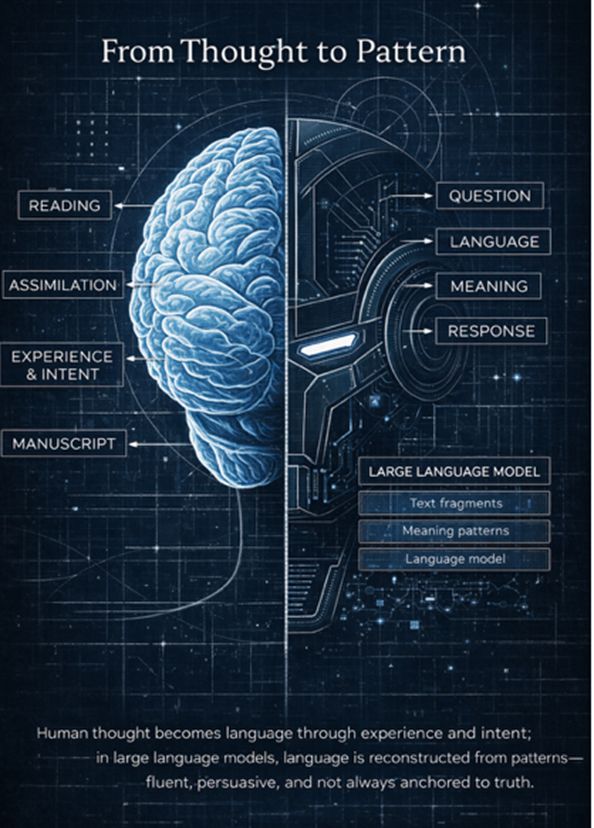
The world speaks AI. Not metaphorically, but literally. Scroll through social media, scan a company’s website, or read the latest press release, and chances are it was not written by a person but generated by artificial intelligence. What began as a tool for assistance has morphed into a dominant voice, one that threatens to flatten creativity, compromise authenticity, and weaken trust.From communication and marketing to content writing and journalism, AI is rapidly replacing the human touch. The shift is not subtle. The tone is templated. The phrasing is polished but soulless. A growing number of LinkedIn posts, op-eds, newsletters, and corporate reports now echo a synthetic fluency, linguistically perfect but void of nuance, emotion, or original thought. The language may sound professional, but it rarely says anything personal or meaningful.This shift is now visible even in the most formal layers of communication. Corporate messaging, from shareholder letters to earnings calls and official statements, is increasingly shaped by AI-assisted writing. A certain style is quietly spreading. Structured, repetitive, and overly polished. Phrases that sound clever at first glance but begin to repeat across industries, across companies, and across voices. One common pattern that analysts have started to notice is the familiar construction that reframes ideas in a formulaic way, presenting one concept only to replace it with another more amplified version. It does not prove AI use, but it signals something deeper. A growing reliance on automation that standardizes how institutions sound.The consequences of this shift go beyond aesthetics. As Professor Michael Wooldridge warned, “We are heading into a world where basically within a decade, pretty much everything we read and see on social media and the internet is going to be AI generated, and we're not going to know what's real and what isn't... There are many, many risks associated with that that society just fragments because there is no common core of beliefs anymore.”This is not a distant dystopia. We are already seeing the cracks. Marketing campaigns are being built without creative directors. Brand identity is outsourced to algorithms. Writers are now called “prompt engineers,” a title that suggests writing no longer begins with a thought or a voice, but with a command. Even individuals, often unknowingly, publish AI-written posts under their own names, gradually diluting their identity in the process.There is a deeper risk beyond how things read. AI does not just write for you, it begins to think for you. The more we rely on it to generate, refine, and express ideas, the less we sharpen those abilities ourselves. When AI starts completing your thoughts and drafting your words, it becomes easy to forget how to express your own voice. Over time, especially for writers and communicators, there is a real risk of creative detachment.If you meet someone in real life, without the screen or the prompt in between, would you still know how to explain your idea, defend your position, or engage in a meaningful debate? The ability to think clearly and communicate effectively is not automatic. It is built through constant use. When that process is outsourced, the skill begins to fade.At the same time, AI is quietly reshaping how talent is perceived. When everyone uses the same tools to produce polished content, it becomes harder to distinguish between those who truly have creative capability and those who rely entirely on machines. The surface looks the same. The depth does not. But in a fast-moving environment, that difference is becoming harder to detect. This creates a new challenge for organizations and audiences alike, not only in recognizing excellence, but also in identifying limitations that would otherwise be obvious.And yet, this is where the conversation needs balance. AI should not be rejected. In fact, everyone should leverage it. Used properly, it raises efficiency, improves productivity, reduces costs, and saves time at a scale no human team can match. It can accelerate workflows, support research, and remove repetitive tasks that slow down creative work.But efficiency should not come at the expense of identity. Productivity should not replace thinking. Speed should not erase depth.The real risk is not using AI. The real risk is depending on it to the point where it replaces the human role entirely.Soon, perhaps as early as next year, we may begin to see a new trend. Guidelines for writers, journalists, and marketers on how not to sound like AI. The style is already recognizable. Clean but cold. Structured but predictable. Perfect but forgettable. And audiences are starting to notice. In response, the ability to write with a human voice, with imperfection, personality, and originality, may become the most valuable skill again.In a world where everything speaks AI, the value of human expression becomes more precious. The authentic voice, the unscripted thought, the imperfect sentence that carries real meaning, might soon be the only thing that stands out.We must ask ourselves: are we trading originality for efficiency? And if so, is the cost too high?AI is not the enemy. It is a tool. But if we allow it to become the only voice we use, we may eventually lose our own.The solution lies in redefining the relationship. Let AI support the process, not replace it. Let it assist with speed and structure, but let the thinking, the perspective, and the final word remain human.Because as the world speaks AI, it becomes more important than ever to make sure someone is still thinking.
The world speaks AI
As AI-generated content floods journalism, marketing, and social media, are we sacrificing creativity, critical thinking, and authentic human expression for efficiency? An opinion on the growing influence of AI on communication and trust.
898 words~4 min read