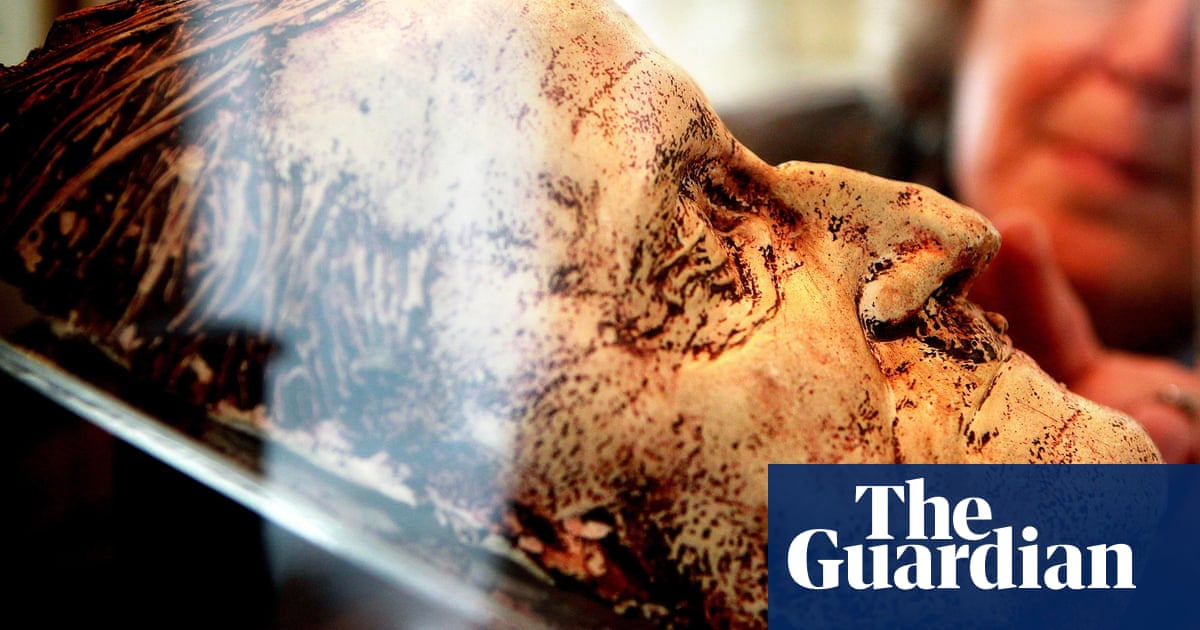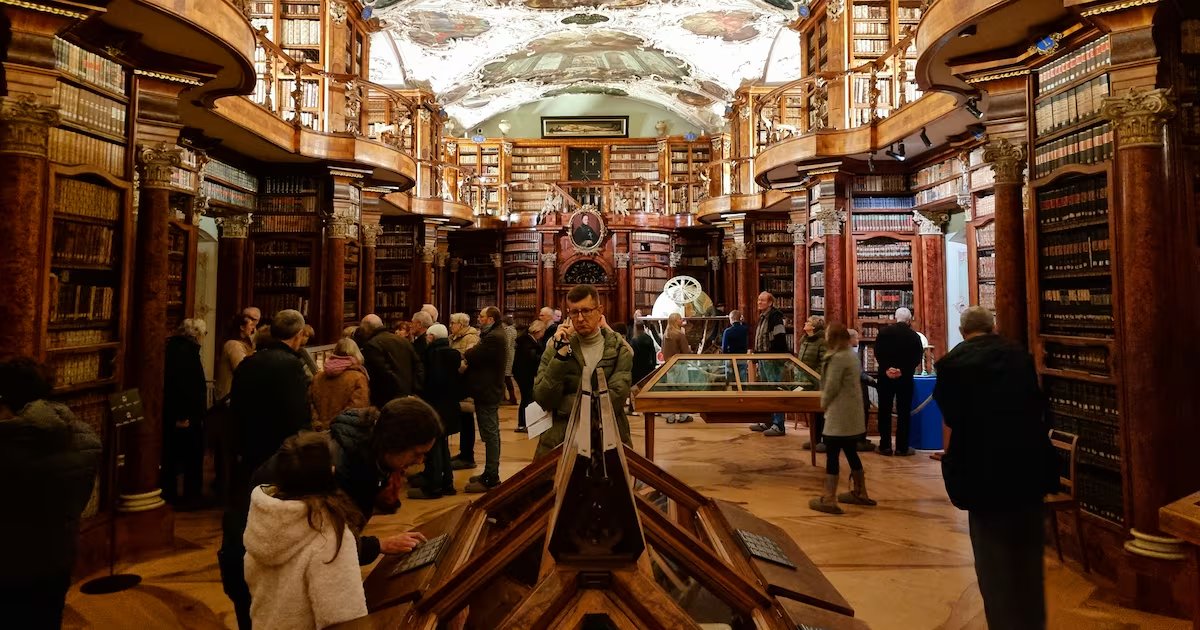
Before entering the Abbey Library of St Gall, you must first put on a pair of slippers from the collection provided outside the door. The slippers are all the same size – extra-large – so they easily fit over your shoes. The trick is to keep them there. I stepped out of mine at the first attempt, before realising you can’t really walk in them: you must glide instead. This feels a little weird, as does the effect of watching others do so. It looks like slow-motion skating.The slippers are designed to protect the fir-wood floor from stains or scratches, although the unwitting work of tourists must save on polishing too.This is one of the world’s oldest libraries, founded in the eighth century as part of the great abbey that grew up around the site of a hermitage erected by Irish missionary St Gall circa AD 612. But the staggeringly beautiful room that now houses the collection is more recent, dating from the years 1758 to 1767. Hence the extravagant baroque style that extends from floor to ceiling. A smaller but much more ornate version of Trinity College Dublin’s Long Room, it takes your breath away at first viewing.The sign in Greek over the entrance translates as “sanctuary of the soul”, echoing an inscription from the oldest known library of all, the one of Pharaoh Ramses II, from 3,000 years earlier. And I hope the soul of an Egyptian woman named Shepenese appreciates the Swiss version, because amid all the books, her mummified remains are also on display. The daughter of a priest, she died circa 600 BC but was brought to St Gallen in 1820. Her small but perfectly formed head is visible in the sarcophagus. Photographs are discouraged.Among the library’s thousands of volumes, meanwhile, are several hundred from Ireland, brought by the monks who followed Gall. The most important of these include a ninth century copy of an older work, the “Priscian Glosses”. Priscian was a grammarian born in what is now Algeria in the fifth century, whose work was used to teach Latin in Ireland. The copy of his dictionary in St Gallen dates from about 845 and includes many translations in Old Irish.It has translations of Ogham too, and as such is the oldest source of Ogham writing in a manuscript. But some of the definitions still have surprising contemporary resonance, as with the one for the Old Irish word “latheirt”.According to Damien McManus in A Guide to Ogham (1991), the gloss for that “shows the basic meaning to be ‘excessive ale-consumption’ with the logical extensions ‘excessive drunkenness’ and ‘large hangover’, the last probably the meaning intended in the Priscian Oghams.”The book is further notable for being the only known source of two Old Irish poems, in one of which a monk eulogises the birdlife in his outdoor office, as translated:“A hedge of trees surrounds me: a blackbird’s lay sings to me – praise which I will not hide ... In a grey mantle the cuckoo’s beautiful chant sings to me from the tops of bushes: may the Lord be kind to me! I wrote well under the greenwood.” As noted here earlier in the week, however, in my tale from a St Gallen biker bar (Diary June 3rd), the city’s most important animal is not a bird but a bear. [ A piece of Switzerland that is forever IrishOpens in new window ]Elsewhere in the Unesco-listed Abbey, a woodcut depicts the founding legend of Gall taming a wild bear, resulting in a mutual arrangement whereby the animal brought him firewood every day and received food in return.The story may have been inspired by ancient traditions of bear worship. If so, the writer Robertson Davies further updated it, with help from Swiss psychotherapist Carl Jung, in his 1972 novel The Manticore. That has its protagonist suffering a mental breakdown and seeking help from a specialist in Zurich, who invokes the wisdom of the bear worshippers and the seventh-century saint. His advice to the patient is to make peace with his inner grizzly: “Cherish your bear, and your bear will feed your fire.”A bear is still the official emblem of St Gallen. It’s also the mascot of the local football club, which the week before I visited won the Swiss Cup for the first time since 1969. Celebrations were wild, I gather. Some in the biker bar were still suffering from what seventh-century monks called a latheirt.I didn’t have enough time there, alas, to visit another great abbey in the general neighbourhood: Reichenau, just across the German border.That too is synonymous with an animal, Pangur Bán, immortalised by the poem of an Irish monk working in the scriptorium, who likened his pet cat’s endless hunt for mice to his own search for meaning. As the last verse sums up (in Robin Flower’s translation): “Practice every day has made/Pangur perfect in his trade;/I get wisdom day and night/Turning darkness into light.” Not that I’d have seen the original in Reichenau. The book that contains it is now held at yet another abbey, in Austria.
Soul sanctuary: Frank McNally on ‘staggeringly beautiful’ library of St Gall
There are several hundred medieval Irish volumes, including a dictionary that has definitions with a surprising contemporary resonance
846 words~4 min read