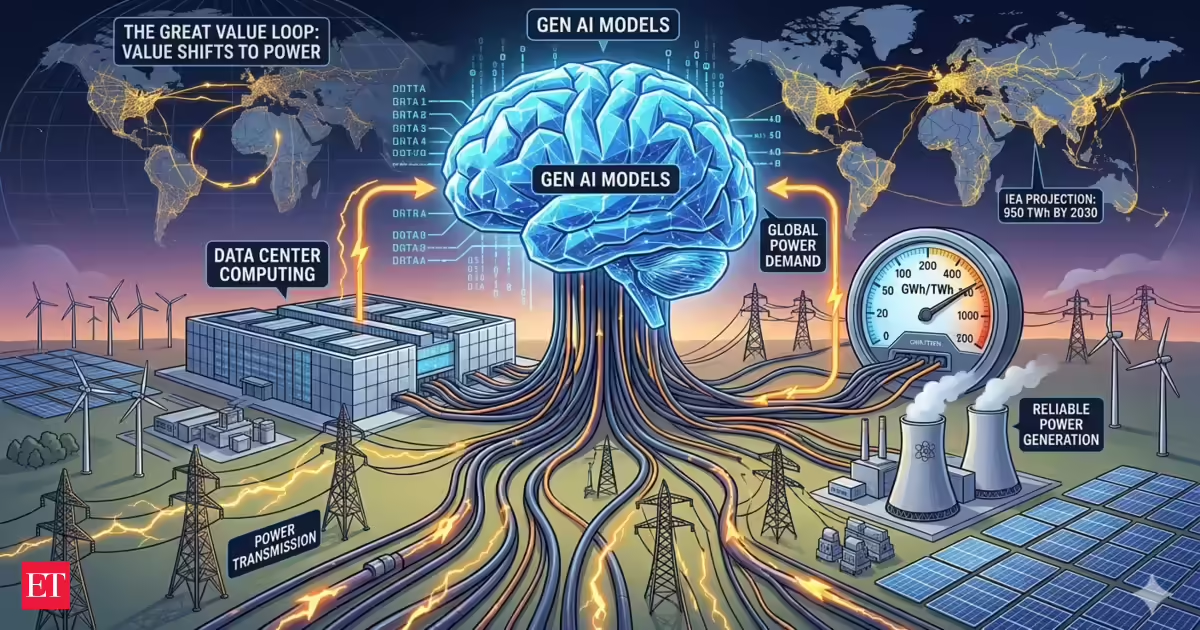
AI data center power shortage: It’s easy to think of AI as something purely digital, models in the cloud, APIs in the background, software that scales instantly. But the reality behind it is starting to look very different.Each wave of the gen AI boom has had its own scarce resource. First, it was access to frontier models like GPT-4, Claude, and Gemini. Then it shifted to GPUs, cloud capacity, and data centre space. Now, a more fundamental constraint is coming into focus: electricity.AI Is No Longer Just SoftwareWhat looks like software on the surface is increasingly an industrial system underneath.A modern AI model depends on chips, cooling systems, land, interconnection rights, and long-term power contracts. It is not just code, it is physical infrastructure that must run continuously at scale.The scale is expanding quickly. The International Energy Agency projects global data center electricity use will grow from about 485 terawatt-hours in 2025 to around 950 terawatt-hours by 2030, as per an HBR report. AI-focused data centers are expected to triple their electricity use over the same period. CBRE has also highlighted a global power shortage that is already limiting data centre growth.You Might Also Like:The New Question for LeadersFor the last few years, the strategic focus was straightforward: which AI model to use, and how to secure enough compute.Now the question is more grounded: can we secure reliable, affordable, permitted electricity where and when our compute needs to run?This shift matters because energy is not as flexible as software or cloud contracts. It depends on physical grids, permitting timelines, transmission capacity, and long-term infrastructure planning.The result is a growing gap between AI ambition and energy availability.You Might Also Like:A Pattern Seen Before: The Great Value LoopThis transition fits into a broader pattern described as the Great Value Loop, as per the HBR report.When a new technology emerges, value first concentrates in whatever is scarce, models, chips, cloud access, or distribution. Investment floods in, supply expands, and what was once rare becomes more standardized.But the cycle doesn’t stop there. As one bottleneck is solved, pressure moves downward to the next constraint. Value shifts to whatever still cannot be easily scaled or copied.AI appears to be entering that next stage. The industry has already moved from models to compute. Now it is moving from compute to power.You Might Also Like:The Industry Is Moving Into a Power-Constrained EraEarlier phases of technology revolved around different constraints. Connectivity defined the infrastructure era. Attention defined the discovery era. Intelligence defined the compute era. Now, the constraint is shifting again, toward electricity, cooling, land, and grid access.This change is already visible in how AI demand is measured. It is no longer just about tokens or model size, but about megawatts and power availability.The IEA estimates that data centers used about 415 terawatt-hours of electricity in 2024 and will exceed 950 terawatt-hours by 2030, as per the HBR report. The fastest growth is expected in AI-focused facilities.But the challenge is not just total demand, it is location. Data centers are concentrated in areas where grids face constraints in transmission, interconnection, and permitting. That makes electricity not just a cost factor, but a limiting condition.How Companies Are RespondingLarge technology companies are already adjusting.Meta has issued requests for gigawatts of new nuclear generation capacity. Microsoft has signed long-term power agreements linked to restarting nuclear facilities, as per the HBR report. Other firms are securing long-duration energy contracts, building infrastructure near power sources, and reshaping where compute is located.At the same time, efficiency gains in AI are changing demand patterns rather than reducing them. As models become cheaper to run, usage expands, increasing total demand for energy-intensive computing.What This Means for Business StrategyThe implication is not that every company needs to become an energy producer. Instead, energy awareness is becoming part of AI strategy.That starts with making energy use visible. Companies are beginning to track electricity consumption per AI workflow, alongside cost and performance metrics, using tools from major cloud providers.It also means reducing unnecessary demand, using smaller models where appropriate, batching workloads, caching repeated queries, and shifting non-urgent processing to more efficient conditions, as per the HBR report.Another shift is in contracting. Long-term power agreements and flexible cloud arrangements are becoming tools for managing uncertainty around energy availability and pricing.Even cloud-region selection is changing. It is no longer just about latency or compliance, but about access to reliable and unconstrained power.Finally, organizations are beginning to formalize governance around this issue, bringing together technology, finance, procurement, and operations to evaluate AI deployments through both performance and energy impact, as per the HBR report.FAQsWhy is electricity becoming important for AI?Because AI systems rely on large data centers that consume huge amounts of power to run models, cooling systems, and infrastructure.How fast is AI electricity use growing?The IEA projects data-center electricity use will nearly double from about 485 TWh in 2025 to about 950 TWh by 2030.
The hidden shortage threatening the AI boom - how to prepare for what comes next
AI data center power shortage: As AI technology surges, a pressing electricity shortage looms over the industry, significantly impacting data center operations and strategy. Discover how companies are adapting to secure reliable power for their AI needs.
814 words~4 min read