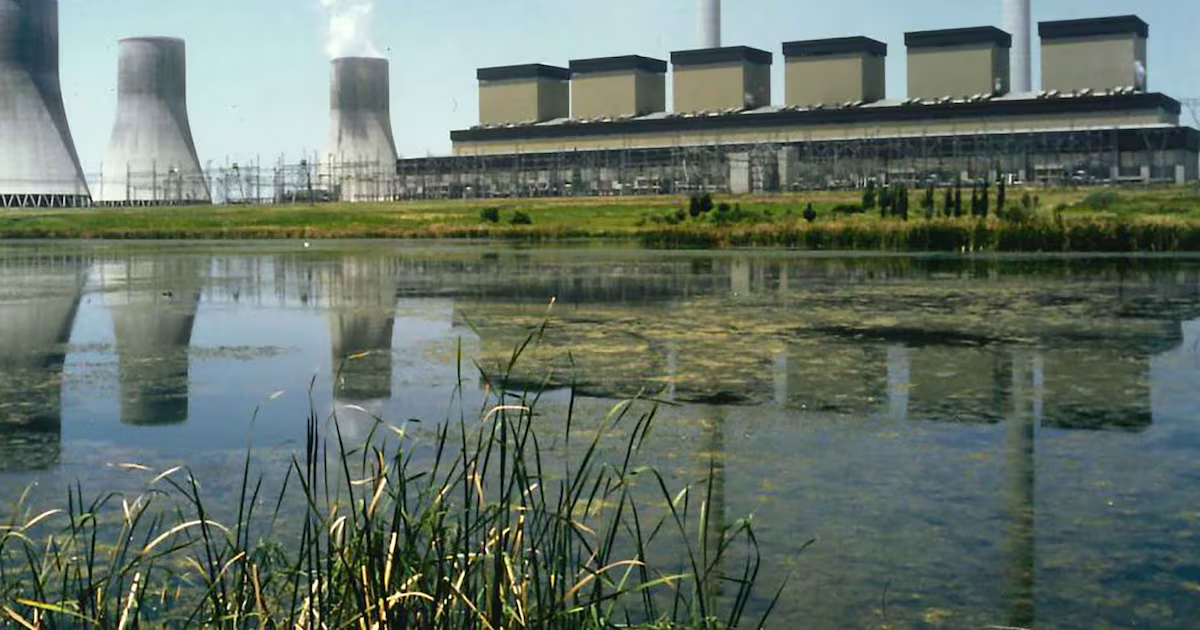
Electricity generation declined 9% year on year in April, marking the 11th consecutive month of annual contraction, as weakening demand continued to weigh on South Africa’s power sector.Stats SA data released on Thursday shows power output fell 1.7% from March, while electricity distributed across the country dropped 5.5% compared with April 2025, with seven of the nine provinces recording declines.Stats SA’s electricity production figures do not fully capture self-generated renewable energy used by households and businesses, such as rooftop solar installations, said Nicolai Claassen, director of industry statistics at Stats SA.“The IPPs [independent power producers] that generate electricity for distribution to Eskom on their grid are included in our statistics. We do have statistics on off-grid activity, but we do not cover that very well at the moment,” he said.IPPs now contribute 10%-15% of electricity to the national grid after the launch of the Renewable Energy Independent Power Producer Procurement Programme (REIPPP) in 2011.But the country still receives most of its electricity — most of it coal-fired — from power utility Eskom, which also accounts for about 20% of the power generated on the continent.Eskom is planning to build a solar photovoltaic (PV) panel manufacturing facility with the capacity to produce at least 1 gigawatt at one of its sites in Mpumalanga — enough to supply the electricity needs of at least 750,000 homes — as part of a strategy to support localisation of the renewable energy value chain.South Africa also imports electricity through the Southern African Power Pool, most of it from Mozambique, specifically from the Cahora Bassa hydroelectric dam.In April, electricity inflows into the country rose by 14.5% year on year, while outflows decreased by 54.3%, Stats SA said.Domestic electricity consumption fell 5% year on year in April and was down 1.3% compared with March. Seasonally adjusted electricity demand also declined by 0.8% in the three months ended April compared with the previous quarter.“From what we can ascertain from our internal research, it could be reduced industrial demand that is causing the decline in electricity consumption,” Claassen said.He cited the widely reported threat of closure for several of the country’s smelters under the weight of heavy energy costs.The ferrochrome industry endured one of its most challenging years in recent memory in 2025, partly due to sharp increases in the price of electricity, the largest single input cost in production.
Electricity output slumps 9% as demand softens despite energy stability
SA electricity output and demand fall despite reduced load-shedding pressure
391 words~2 min read