Staff writer, with CNA
The rapid growth of artificial intelligence (AI) is transforming the role of server manufacturers, forcing them to expand globally and take on increasingly complex integration work that extends far beyond traditional hardware assembly, Wistron Corp (緯創) chief technology officer David Shen (沈慶堯) said yesterday.As AI infrastructure projects are becoming increasingly complex, one of the biggest changes brought about by the technology is what Shen described as “super integration.”Server makers are now required to integrate technologies spanning computing, networking, storage, cooling systems, power distribution and advanced semiconductor packaging, Shen said at news conference held by the Taiwan Stock Exchange at the Computex expo in Taipei.
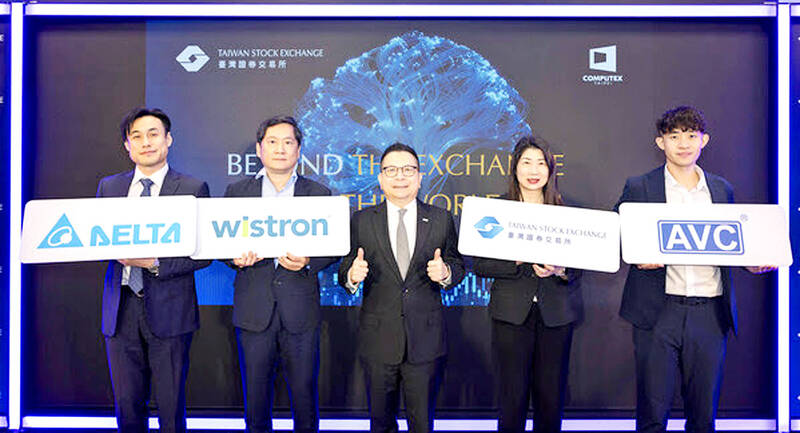
From left, Delta Electronics Inc senior manager Johnny Shih, Wistron Corp chief technology officer David Shen, Taiwan Stock Exchange (TWSE) chairman Sherman Lin, TWSE senior vice president Brenda Hu and Asia Vital Components Co finance manager Chen Yen-liang hold placards at a news conference at the Computex Taipei expo yesterday.
Photo courtesy of the Taiwan Stock Exchange
As AI clusters grow larger and more powerful, manufacturers must work closely with suppliers throughout the supply chain, including semiconductor companies, to optimize system performance, thermal management and power efficiency, he said.Wistron’s revenue grew from NT$1.049 trillion (US$33.26 billion) in 2024 to NT$2.186 trillion last year. AI infrastructure accounted for 46 percent of its total revenue in 2024, rising to 71 percent last year and 79 percent in the first quarter of this year, company data showed.