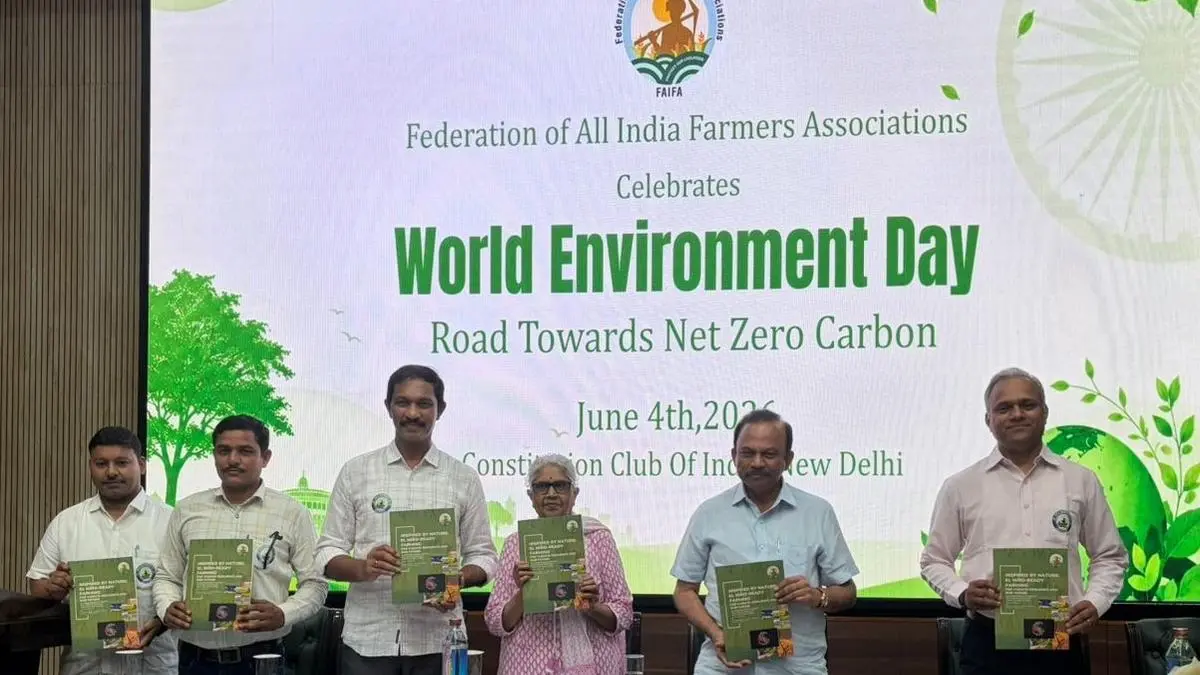
Federation of All India Farmer Associations (FAIFA) launches report to mark World Environment Day.
A report by the Federation of All India Farmer Associations (FAIFA) has warned that climate resilience must become a national agricultural priority amid rising climate risks, extreme weather and El Niño concerns.The report titled ‘Inspired by nature: El Niño-ready farming for climate resilience and our future’ called for an urgent transition towards climate-resilient farming systems capable of safeguarding food security, farmer livelihoods and long-term agricultural sustainability.Released by Magunta Sreenivasulu Reddy, Member of Parliament from Ongole in Delhi on Thursday, the report presents a comprehensive roadmap for addressing some of the most pressing challenges confronting Indian agriculture today. It examines the growing impact of extreme heat, erratic rainfall, soil degradation, groundwater stress and resource-intensive farming practices, while outlining practical pathways for building a more resilient agricultural ecosystem.El Nino impactA central theme of the report is the growing strategic importance of El Niño and its implications for Indian agriculture. The report notes that El Niño events have historically been associated with weaker monsoons, moisture deficits and increased vulnerability during the kharif season. Against this backdrop, FAIFA argues that agricultural planning must increasingly focus on preparedness, adaptation and risk management rather than reactive responses to climate-related disruptions.It advocates a dual transition -- ecological and technological -- to strengthen resilience across agricultural systems. It calls for restoring soil health, reducing excessive dependence on chemical inputs, improving water-use efficiency, promoting crop diversification and encouraging nature-inspired farming practices that enhance long-term sustainability.On the intensifying climate risks, the report notes that India experienced extreme weather events on 331 out of 334 days between January and November 2025, affecting more than 17 million hectares of cropped area. It highlights alarming trends in soil degradation, citing evidence that 97 per cent of tested soil samples were deficient in nitrogen, while 85 per cent lacked adequate organic carbon, underscoring the urgent need for restorative and sustainable agricultural practices.Lauds Govt effortsFAIFA’s report acknowledges that recent government efforts have increasingly focused on strengthening farmers’ resilience through technology adoption, natural farming, improved risk management, women-led rural entrepreneurship and climate-smart agricultural practices. These initiatives have created a robust foundation for long-term agricultural transformation and provide a strong platform for accelerating India’s transition towards a more resilient and sustainable farming ecosystem.Tech integrationHighlighting the transformative potential of emerging technologies in agriculture, the report identifies digital public infrastructure, AgriStack, Bharat-VISTAAR, artificial intelligence, satellite monitoring, precision irrigation, remote sensing and weather-based advisory systems as critical tools for improving farm-level decision-making and reducing climate-related risks.According to the report, the future of resilient agriculture will depend on the effective integration of technology with local knowledge and farmer-centric extension systems.The report concludes that India possesses a unique opportunity to build one of the world’s most resilient agricultural systems by leveraging its traditional agricultural knowledge, scientific institutions, digital infrastructure and policy ecosystem. It calls for coordinated action among governments, research institutions, industry stakeholders and farming communities to accelerate the transition towards a climate-resilient agricultural future.Speaking on the occasion, PS Murali Babu, FAIFA President, said Indian agriculture stands at a defining moment. Climate change is no longer a future challenge but a present reality affecting farmers across the country.The findings of this report clearly demonstrate that resilience must become the organising principle of future agricultural development. By combining traditional ecological wisdom, scientific innovation, digital technologies and farmer-centric policies, India has the opportunity to build an agricultural system that is productive, sustainable and prepared for future climate shocks, Babu said.Published on June 4, 2026