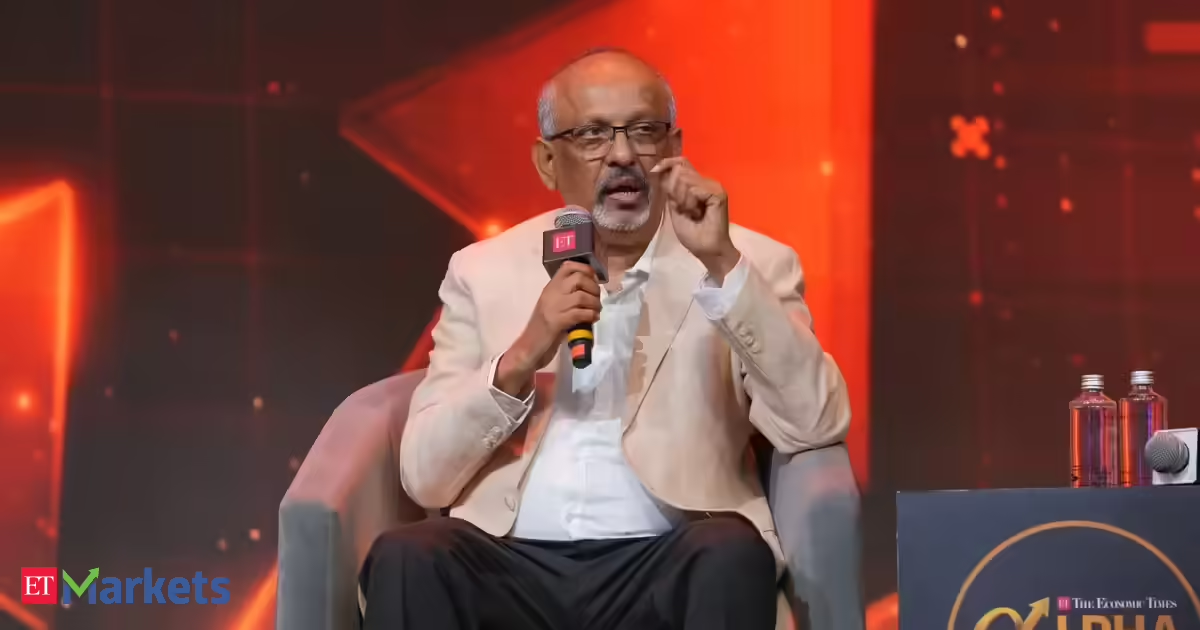
India's recent market underperformance has triggered a wave of pessimism among investors, with concerns ranging from artificial intelligence (AI) and foreign investor selling to high valuations and macroeconomic challenges. However, Samir Arora, founder and fund manager at Helios Capital, believes many of these explanations are exaggerated and reflect what he calls a "negative halo effect" rather than a fundamental deterioration in India's investment case.Speaking at ET Alpha Wealth Summit IT playbook, Arora drew parallels with the concept explained in the book The Halo Effect by Phil Rosenzweig. According to him, when a company or market performs well, investors tend to attribute every positive quality to it. Conversely, when performance weakens, every perceived weakness is used to justify the decline. He believes India is currently experiencing the latter phenomenon.One of the most common explanations for India's recent underperformance is that global investors are increasingly focused on AI-related opportunities, particularly in the US technology and semiconductor sectors.Also Read | ET Alpha Wealth Summit: Future alpha may emerge from neglected markets and asset classes, says Kalpen Parekh Arora acknowledged that AI has become a powerful investment theme and has driven substantial gains in several global stocks. However, he questioned whether investors are pushing the trade too far. He pointed out that semiconductor and AI-related companies have witnessed extraordinary rallies, leading to stretched expectations and increasing competition among players.According to him, investors should not assume that AI alone can explain all market movements. While AI remains an important trend, portfolios cannot be entirely concentrated in a handful of technology names. Large institutional investors continue to require diversified allocations across sectors and geographies, leaving room for markets such as India."We don't need to be the best investment in a portfolio. We only need to be better than the last investment in that portfolio," Arora argued. Another concern often raised by investors is that AI could significantly disrupt India's IT services industry.Arora said the weakness in listed IT companies cannot be attributed solely to AI. He highlighted the rapid growth of Global Capability Centres (GCCs) in India, which are increasingly hiring employees directly rather than outsourcing work to traditional IT service providers.According to him, GCCs now employ roughly 2.5 million people and are growing much faster than traditional IT services firms. In many cases, these employees earn significantly higher salaries, which benefits the broader economy. Therefore, weak stock performance in IT services companies should not automatically be interpreted as a sign of economic weakness.Arora also challenged the popular argument that foreign institutional investors (FIIs) are exiting India due to expensive valuations.He noted that India has traded at a premium to many emerging markets for decades. If valuations were the sole reason for selling, foreign investors would not have continued investing in high-valuation Indian companies.Citing market data, Arora pointed out that while foreign investors have reduced holdings in several traditional large-cap stocks over the last few years, they have simultaneously increased exposure to a range of newer companies and sectors. Many of these purchases have been made at relatively high valuation multiples, suggesting that investment decisions are driven by growth opportunities rather than simple valuation comparisons.Arora believes another misconception is that global investors are indiscriminately pulling money out of India.According to data he cited, foreign investors have been reducing exposure across several Asian markets, including Korea and Taiwan, not just India. The broader trend reflects portfolio reallocations rather than a specific negative view on India.He argued that while net outflows from India have attracted attention, foreign investors have also deployed substantial capital into other Indian stocks and sectors over the same period. This suggests that investors are selectively repositioning rather than exiting the market altogether.Also Read | ET Alpha Wealth Summit: India could unlock a $5 trillion export opportunity through FTAs, says Saurabh Mukherjea Despite concerns around growth, AI disruption, foreign selling and valuations, Arora remains optimistic on the long-term outlook.He expects India to continue delivering healthy earnings growth, even if expectations have moderated slightly due to geopolitical uncertainties. He noted that recent corporate earnings have remained relatively strong, particularly in the mid-cap segment. More importantly, he believes investors should avoid becoming overly influenced by pessimistic narratives."The markets are best played by optimists," Arora said, arguing that investors often focus excessively on macro concerns while overlooking the resilience of businesses and earnings growth.For investors worried about whether now is the right time to invest, Arora offered a simple signal: both his domestic mutual fund and offshore fund remain almost fully invested, reflecting his confidence that India's long-term growth story remains intact despite the current bout of negativity.(Disclaimer: Recommendations, suggestions, views and opinions given by the experts are their own. These do not represent the views of The Economic Times)If you have any mutual fund queries, message on ET Mutual Funds on Facebook/Twitter. We will get it answered by our panel of experts. Do share your questions on ETMFqueries@timesinternet.in alongwith your age, risk profile, and Twitter handle.
ET Alpha Wealth Summit: Markets are best played by optimists, says Samir Arora on India's investment outlook
Helios Capital founder Samir Arora believes investor pessimism toward India is driven more by a “negative halo effect” than weakening fundamentals. Speaking at the ET Alpha Wealth Summit, he argued that concerns around AI, valuations and FII selling are overstated, while Indias long-term earnings and growth story remains intact.
819 words~4 min read