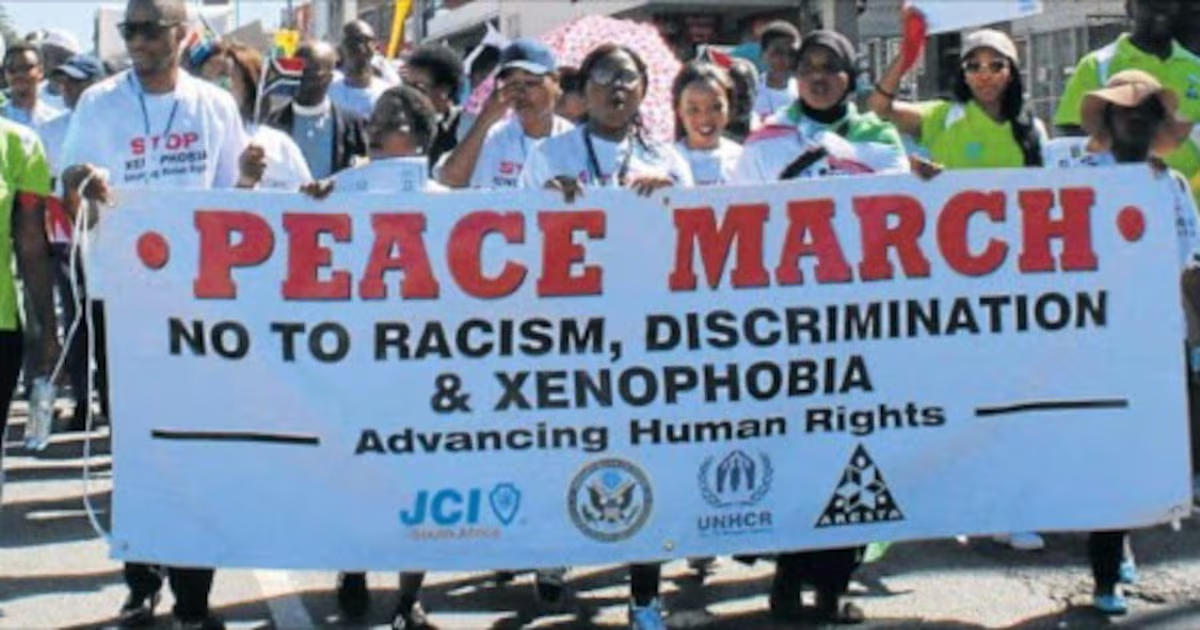
Politics is a game of perceptions. Governments do not govern through policy alone. They also govern through messaging, influence and public trust. Communication is therefore not a luxury in politics. It is power.A government that communicates well shapes public opinion and national culture. A government that fails to communicate loses control of the national conversation. In today’s digital age, where everyone lives on their phone, silence creates a vacuum. That vacuum is quickly filled by misinformation and propaganda, fear, anger and political opportunists.This is why communicators are among the most important assets in politics, and virtually any organisation for that matter. There is almost no such thing as too much communication. The more government communicates, the more it keeps its hands on the levers of public perception. And that is important.With South Africa seeing growing protests and marches against illegal immigration, communication should be at its highest. That’s because other than the rising social tensions there is an element of bad PR against the country, with many parts of the continent quick to label South Africa xenophobic. This often happens without proper acknowledgement of the pressures caused by illegal migration, unemployment, stretched public services and weak border control, a long-time Achilles heel of democratic South Africa. These conceptions and misconceptions will continue because our communication machinery seems to have ground to a halt.Where are the regular updates? Where are the public campaigns? Where are the visible efforts to counter misinformation and explain what the government is doing? Instead, silence has become the loudest message.President Cyril Ramaphosa has occasionally tried to push back against the idea that South Africa is xenophobic. Yet he often sounds like a lone voice. The broader communication machinery of government appears absent.The large number of migrants living in South Africa should in itself challenge the claim that the country is universally anti-foreigner. But because the government has failed to communicate clearly and consistently, negative narratives continue to spread locally and internationally.To make matters worse, some political leaders have made poorly judged remarks that have inflamed tensions further. Instead of calming the situation, such comments have created more division and confusion. This is not their fault — they are not communicators. But it raises an important question: What exactly is causing the paralysis in government communication? Is it fear? Is it incompetence? Is it political or conflicting views? Or is it a government that is simply reluctant to publicly engage on difficult issues?Let’s assume sensitive diplomatic work is happening quietly behind the scenes. That may well be true. But in a democracy governance cannot happen in silence. Citizens need to hear, see and understand what their government is doing.That creates the impression that things are under control and someone is in charge. Say what you want about US President Donald Trump, he communicates. There is never any doubt who is in charge, whether you agree with his worldview or the decisions he makes or not. But when the government says little, as in our case, speculation grows. People begin to assume the country is not being steered or that something is hidden. Conspiracy theories gain traction. Trust in institutions weakens. Public frustration grows louder.Modern politics is no longer fought only in parliament or during elections. It is fought daily on social media, in communities, and in the battle for public perception.The government should understand this by now. A state that does not tell its own story will eventually have its story told by others. Once negative perceptions become entrenched, reversing them becomes far more difficult.Malope is a communications practitioner.
TSHWANE MALOPE | SA’s silent government is losing the battle of perception
Failure to communicate leaves state vulnerable to negative narratives
592 words~3 min read