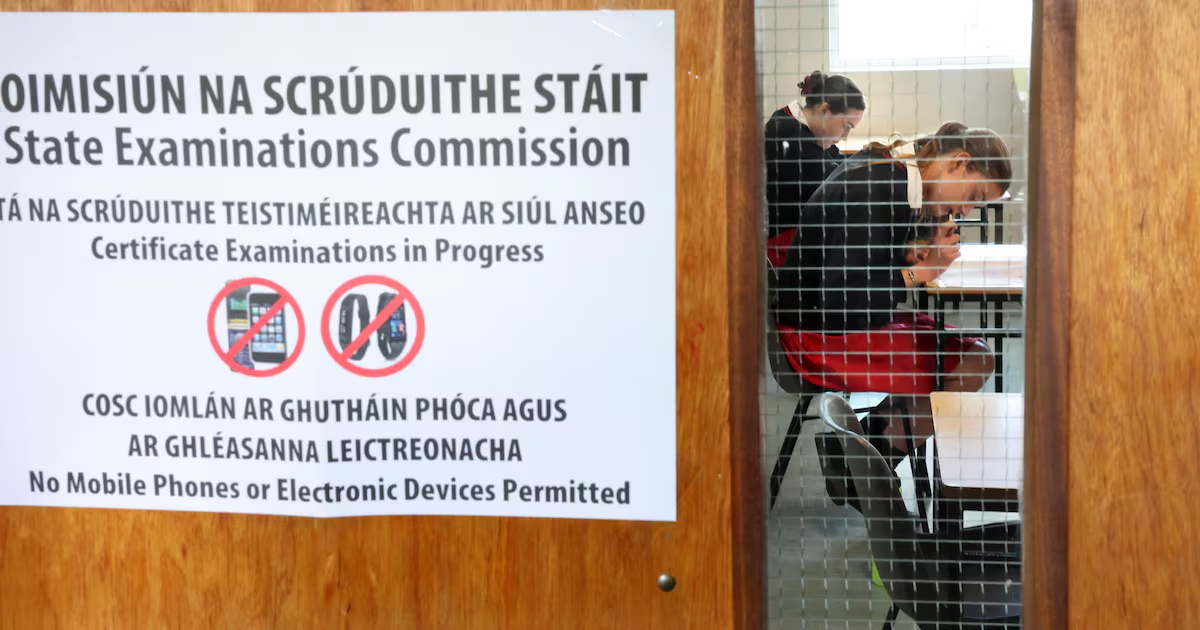
Like all adults with a job and dealing with the regular banalities of life – bills, forgotten dentist appointments, missed flights – I still find Leaving Certificate season anxiety inducing. Because columnists are show-offs by nature, I like exams more than most. And yet, there was something that felt peculiarly malign about those two weeks in June 13 years ago: the timetable was dense, the stakes vertiginous and the weather taunting. There was also rather a lot to memorise. It is a cliche to complain of exam dreams, following you around years after the fact. Nevertheless, there it is: Maths, paper two, something to do with triangles . . . before I am bolt upright in the middle of the night, slowly remembering I write about food and culture and politics for a living. My grasp of triangles might be remedial but that cannot hurt me now – I don’t think. If someone tells you they no longer suffer the occasional exam dream, they are telling you a lie. With all that said, I remain full of praise for the Leaving Cert system – believing it to be of considerably greater value than its UK counterpart, the A-levels. At this time of year, I see all the hand-wringing articles and letters about all the teenagers struggling with the pressures and breadth and scope of this particular exam. And yes, I am sympathetic. But my greatest criticism of the Leaving Cert? Perhaps it is not robust, rigorous or difficult enough. But first, the merits. I am a believer in the power of the generalist. Expertise carries a kind of bourgeois prestige at this particular moment in time – a ballast to populism, evidence of a good and serious education, proof that one is a noble contributor to society (who hates the person dedicated to a narrow corner of cancer research?). But generalists have access to a far greater range of human experience – literature, science, philosophy and the understanding that at some points, all these disciplines converge into one. I suspect, though lacking hard evidence (that’s just the generalist in me), that generalists are, by and large, more affable in nature because of this. The Leaving Cert understands and cherishes the value of the generalist with its seven, maybe eight subjects spanning disciplinary abilities. In the UK, by the time a student is 16 years old they are studying perhaps just three subjects with no mandatory English, Irish (well, duh) or maths. Esotericism is well and good but enforced at such a young age, it is limiting. Why deny ourselves the ability to recall a line of a Shakespeare sonnet, a few friendly words of Irish, a rudimentary understanding of calculus and the ability to locate Tirana on a world map? Life is long and there will be time to specialise later. I hear the common complaint already: it is not fair to push students on disciplines for which they have no aptitude. Well, newsflash: you will spend the vast majority of your adult life having to perform tasks you are ill-suited to (for some, that is driving; for me, that is communicating with my accountant). What harm is there in getting used to that now? And besides – exams are definitionally unfair. They are not an exercise in levelling the playing field but stratifying academic accomplishment. The whole point is for a student to prove their abilities, not for the system to be calibrated toward the lowest common denominator in the room. Next, a note on rote learning. I don’t want to sound like a dinner-party bore, but artificial intelligence continues to reshape the world in ways we will never be able to fully predict. In the meantime, we are watching students and professionals alike outsourcing their daily thinking to the machine. They are relying entirely on chat bots and search engines for facts, data, reference points and basic information about the world we inhabit. The ancient practice of memorising information ourselves? I suspect that will soon come to be a prestige ability, much like reading literature. Students complain about the endless reams of Shakespeare quotes they must commit to memory, the amount of poetry they need to marshal in their brains and the long list of dates they must recall. This is good: knowing concrete information about the world is the only starting point for understanding the world. Outsourcing this cognitive foundation stone to ChatGPT, because it is convenient and fast and easy, is self-destructive. Exams – the more information-based the better – remind us of this fact. “We should focus more on critical thinking skills” is just shorthand for “I am too lazy to learn my vocabulary”. But more than anything, intellectual ambition is both a social and a moral good. The Leaving Cert is difficult – but Ireland, if it wants to maintain its global stature as a serious country with an attractive workforce, then it should not cede any ground on educational standards. And on the level of the individual? In the necessary pursuit of becoming a well-rounded individual, two tricky weeks in June is a worthwhile sacrifice.
Finn McRedmond: The Leaving Cert is dense, demanding and far superior to the UK’s A levels
With its seven, maybe eight subjects, the Leaving Cert cherishes the value of the generalist. In the UK, a 16-year-old may be studying just three
852 words~4 min read