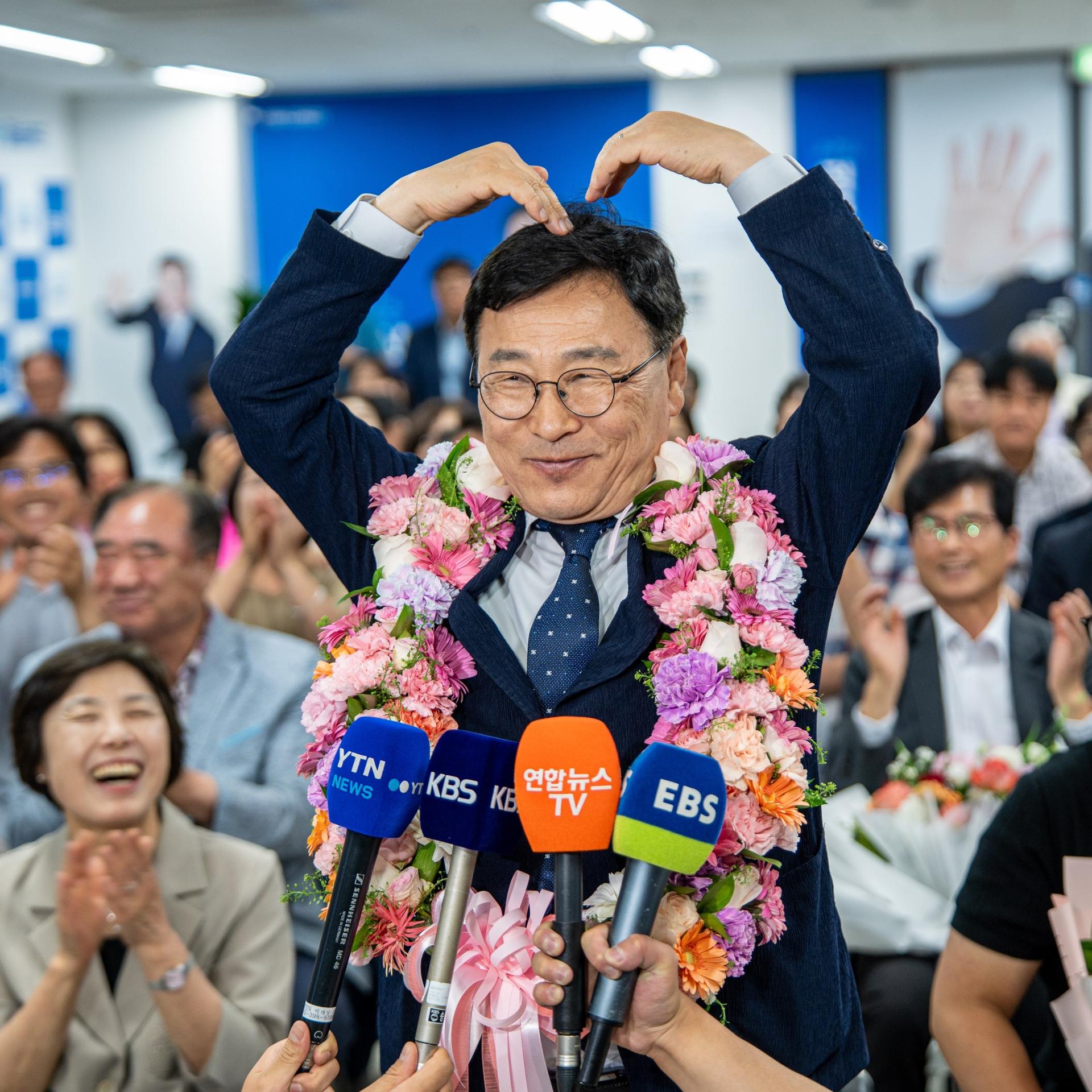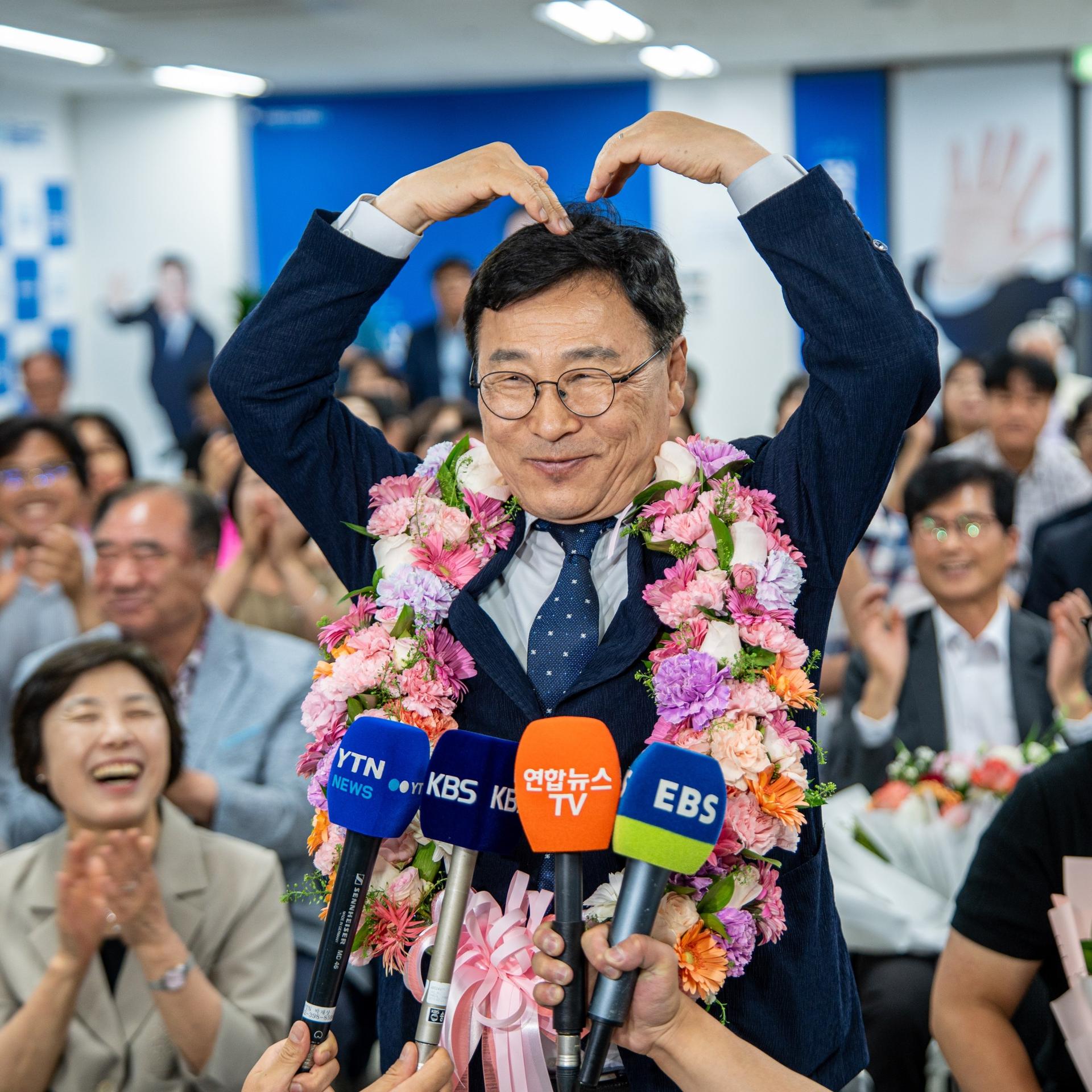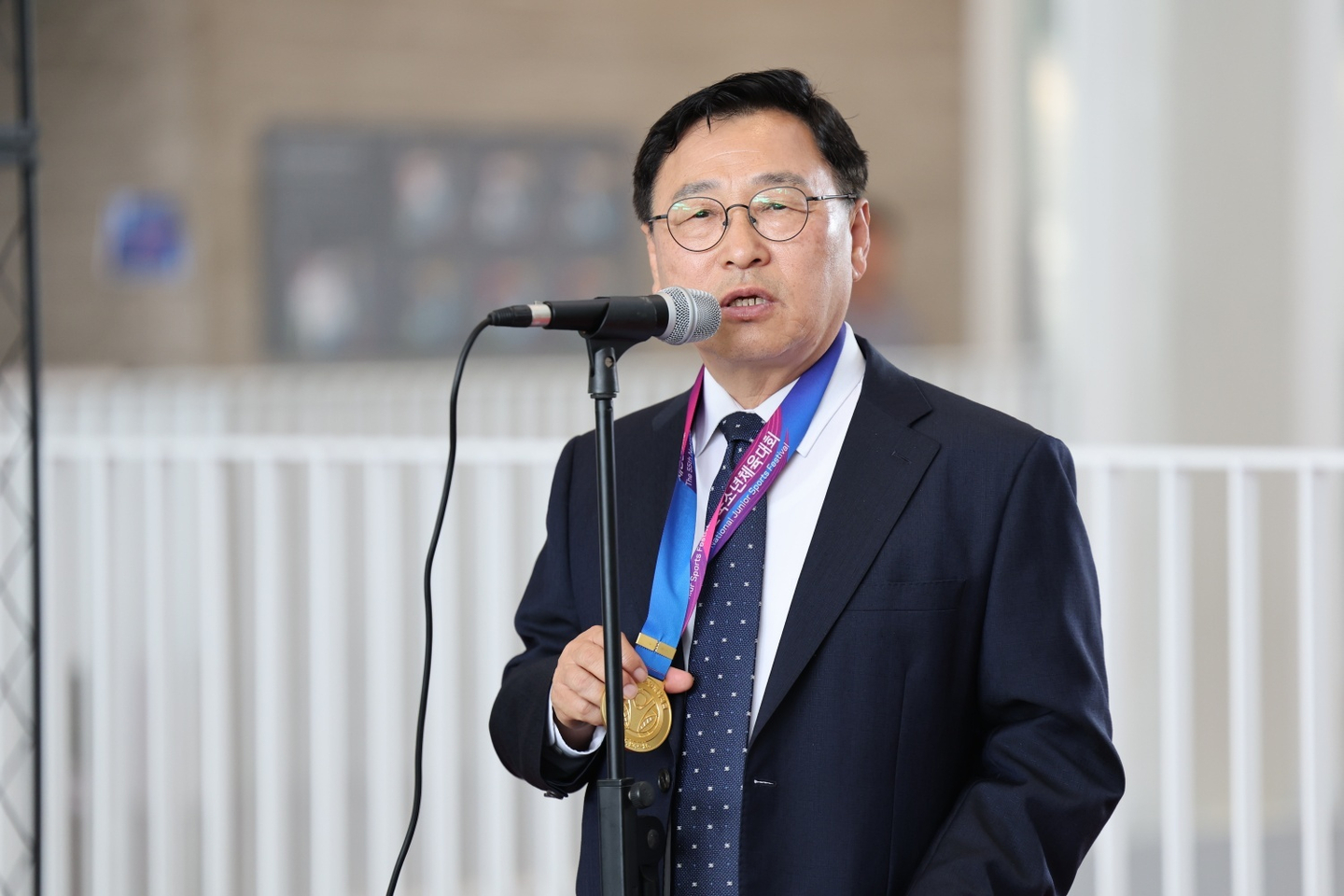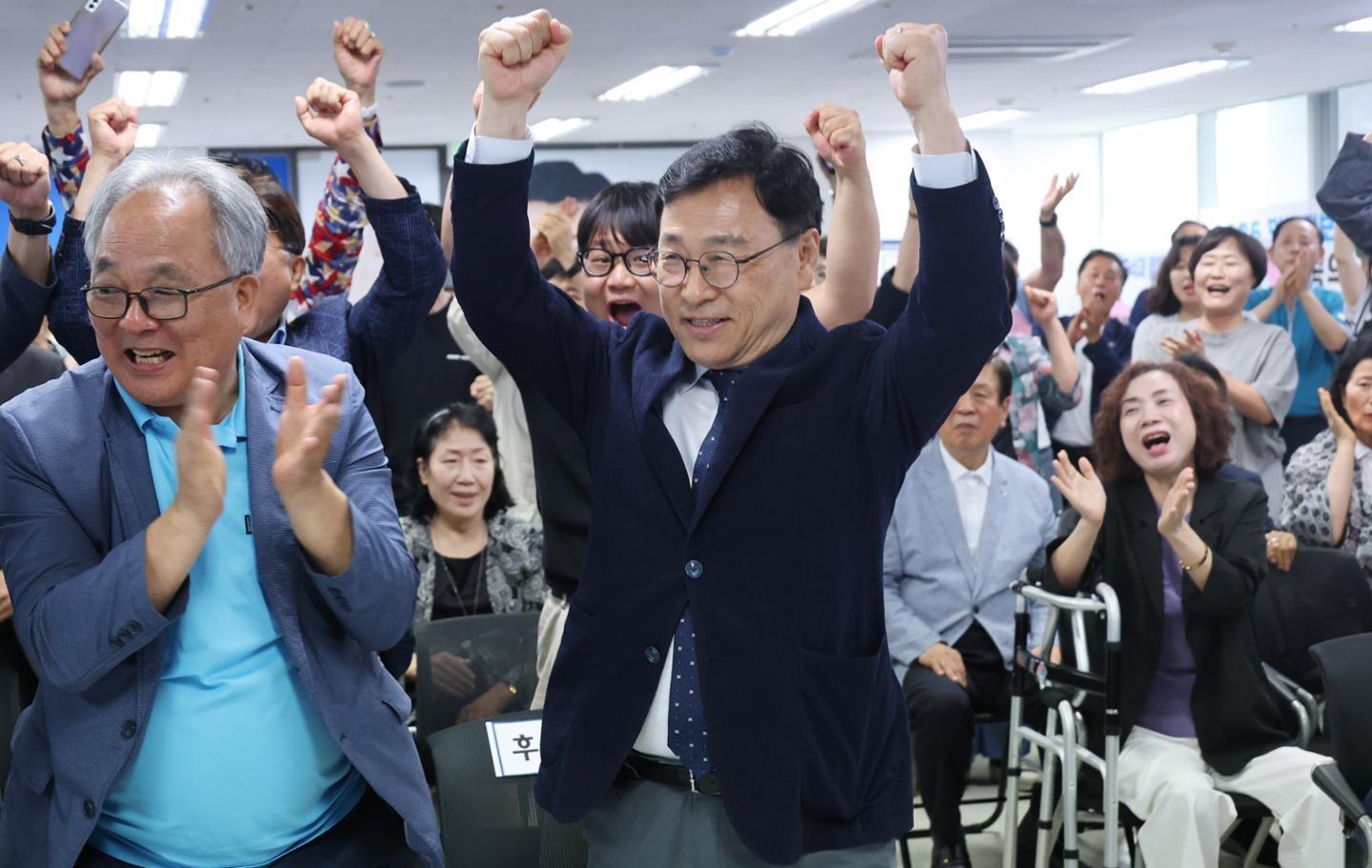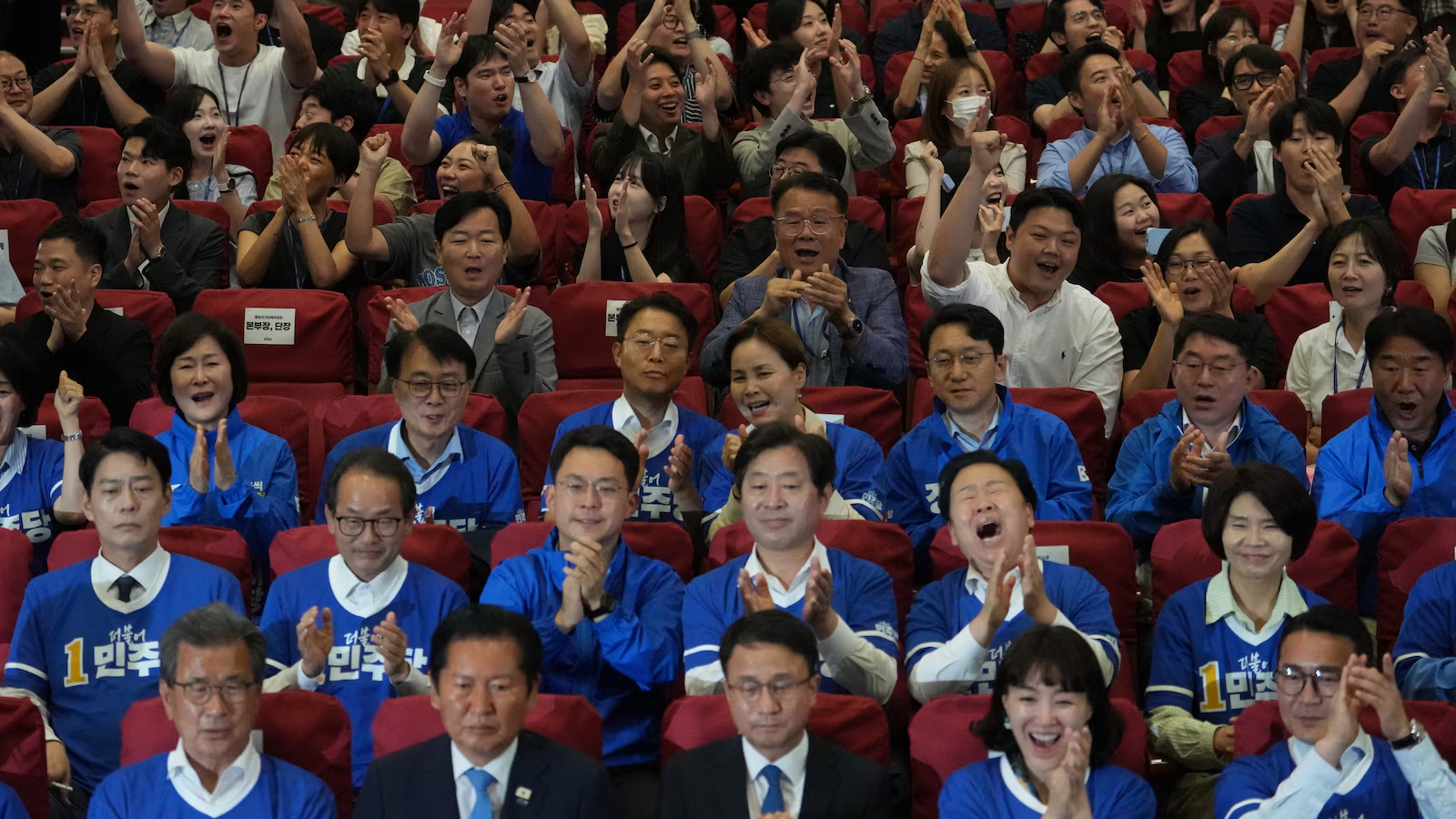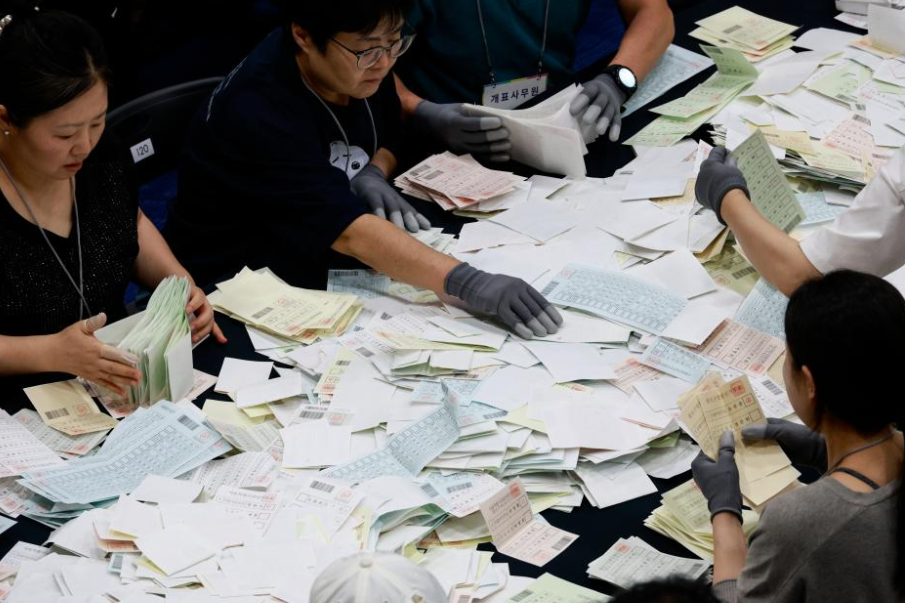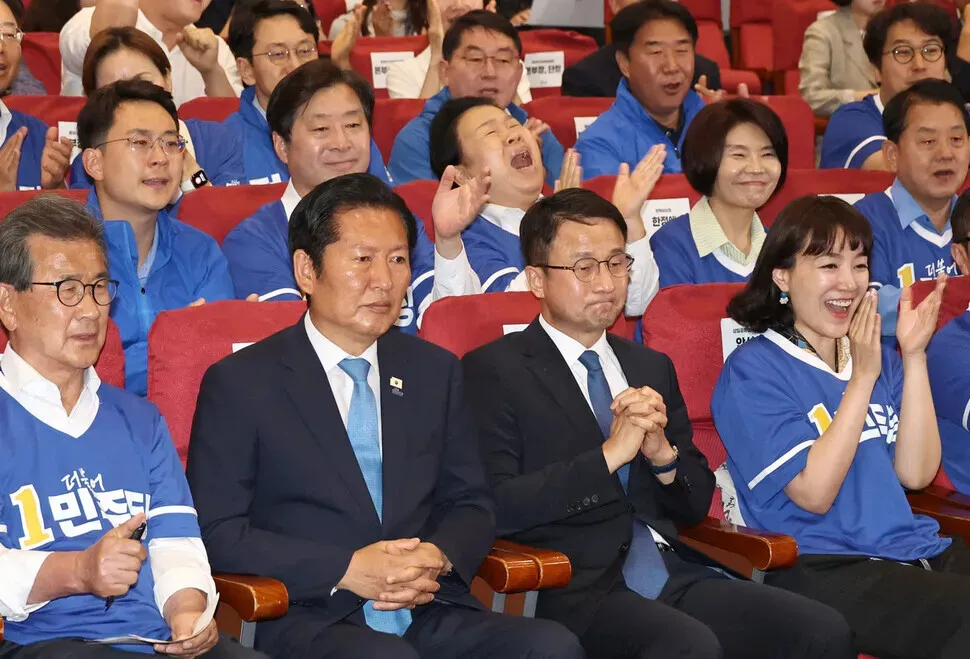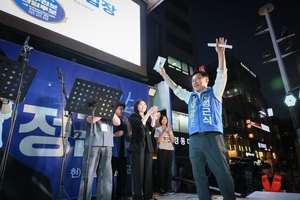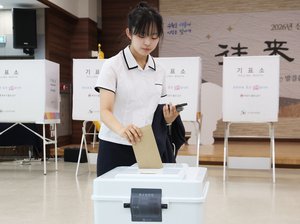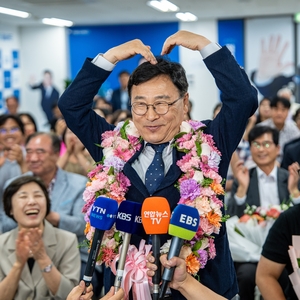
Liberal education policies expected to gain momentum as progressive candidates win 11 of 16 regional superintendent posts Seoul Metropolitan Education Superintendent Jung Geun-sik makes a heart over his head early morning on Thrusday at his campaign office in Jongno-gu, Seoul, as he is declared the winner in the city's election for education chief. (Yonhap) With progressive candidates increasing their number of education superintendents across the country, the balance of power in education policy is set to shift further toward the progressive bloc.The number of progressive superintendents, which stood at nine after the previous elections four years ago, rose to 11 in Wednesday’s election.Incumbent Seoul Metropolitan Education Superintendent Jung Geun-sik was declared the winner at around 8:40 a.m. Thursday, securing a second term after earning 30.56 percent of the vote. He outpaced conservative runner-up Cho Chun-hyuk, who received 23.22 percent.Another conservative candidate, Yoon Ho-sang, came in third with 14.47 percent, fueling criticism that the conservative bloc’s failure to field a unified candidate may have cost it the race.“I think the choice made by Seoul citizens today shows that they want Seoul education to continue without wavering,” Jung said in his victory speech Thursday. “I believe it reflects citizens’ hopes for schools where every student is respected and can grow together, beyond competition and anxiety.”A progressive resurgence Jeju Provincial Education Superintendent-elect Ko Eui-sook (center) receives flowers late on Wednesday as it becomes clear she will emerge victorious in the island's election for education chief. (Yonhap) Wednesday’s election is set to be recorded as a dramatic comeback for progressive superintendent candidates after they lost ground for the first time in the previous elections in 2022.Six progressive candidates were elected in 2010, when direct voting for the posts was introduced nationwide, and the figure rose to 14 in 2018. Conservatives made gains in 2022, when only nine progressive candidates were elected. This year, however, progressive candidates expanded their presence again, despite the merger of two traditionally progressive constituencies into one.“The high approval rating for the Lee Jae Myung administration appears to have had a trickle-down effect on the superintendent elections, drawing more votes toward progressive candidates aligned with the ruling bloc,” an educator told local daily Chosun Ilbo.Only five regions, Daegu, Sejong, Daejeon, North Gyeongsang Province and South Gyeongsang Province, elected conservative education chiefs.Kang Mi-ae, Sejong’s conservative superintendent-elect, became the city’s first female education chief.Progressive candidates won in three regions, Gyeonggi Province, Gangwon Province and Jeju, that had elected conservative superintendents in the previous election.In Gyeonggi Province, Ahn Min-seok defeated incumbent Superintendent Yim Tae-hee, while in Gangwon Province, Kang Sam-young unseated incumbent Shin Kyung-ho.In Jeju, Ko Eui-sook, a former member of the Korean Teachers and Education Workers Union, also defeated incumbent Superintendent Kim Kwang-soo.The defeats were seen as notable because incumbent superintendents have traditionally enjoyed an advantage in elections, where voter interest is relatively low and sitting officeholders have more opportunities to build name recognition.This time, however, three conservative incumbents appeared to lose their reelection bids.Liberal incumbent Kim Seok-joon won in Busan, securing a fourth term.Liberal policies to gain momentum Seoul Superintendent Jung Geun-sik (center) greets Seoul Metropolitan Office of Education employees on Thursday. (SMOE) With progressive superintendents taking control of a large majority of metropolitan and provincial education offices for the first time in four years, progressive education policies are expected to regain momentum.These include strengthening student rights ordinances, phasing out autonomous private high schools and expanding democratic citizenship education.Nationwide policies spearheaded by the Education Ministry, such as Suneung reform, could also gain traction.On May 15, 15 progressive superintendent candidates, including Jung, Ahn and Ko, announced a set of common pledges, including converting autonomous private and foreign-language high schools into regular high schools and guaranteeing teachers’ basic political rights.The progressive winners are also expected to step up coordination through the National Council of Governors of Education, which represents regional education chiefs and plays a role in shaping local education policy and coordinating with the Education Ministry.
Progressives increase hold on education policy
With progressive candidates increasing their number of education superintendents across the country, the balance of power in education policy is set to shift fu
654 words~3 min read