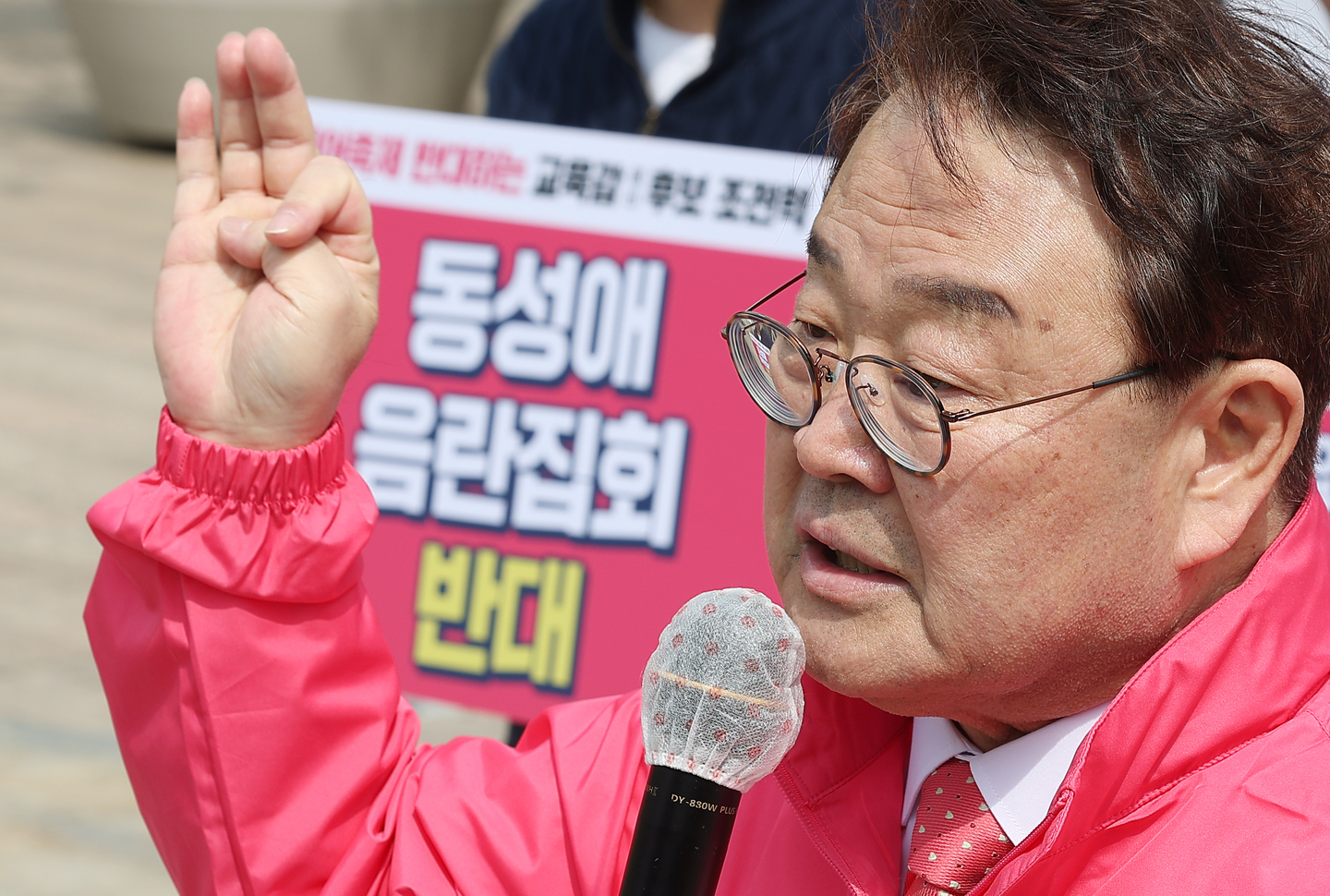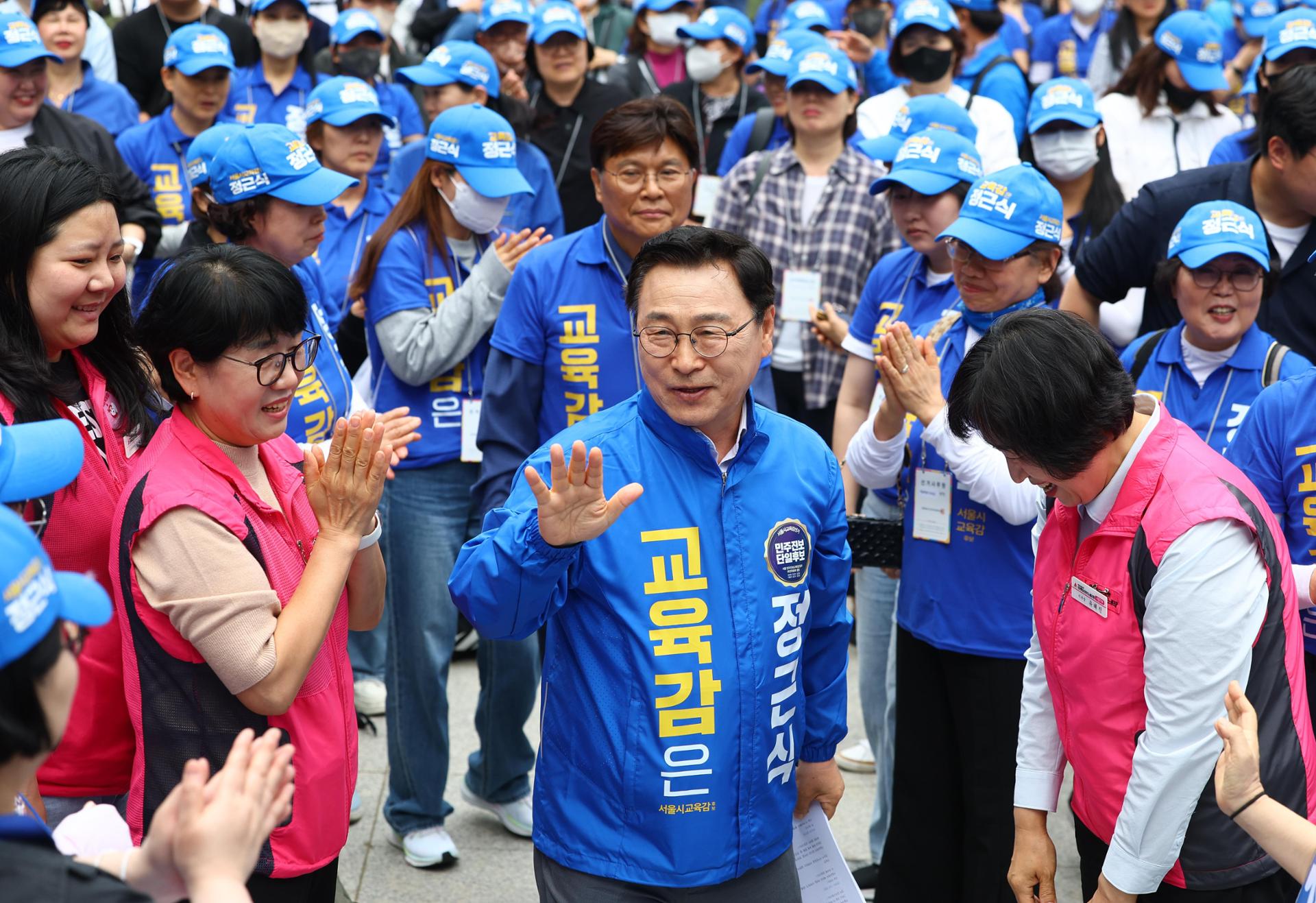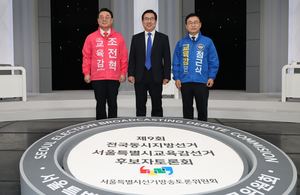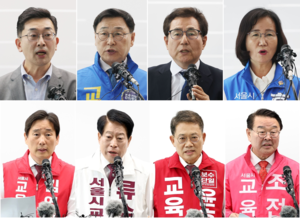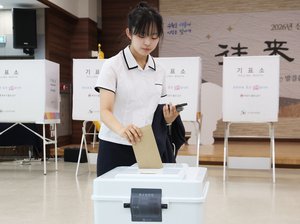
Direct vote aimed for neutrality, but critics say it fuels ideological campaigns Liberal Seoul Metropolitan Education Superintendent candidate Jung Geun-sik holds a rally on Tuesday in front of Deoksugung in Jung-gu, central Seoul. (Jung Geun-sik's campaign office) Seoul’s crowded education superintendent race laid bare growing doubts over whether the current direct-election system helps voters choose education leaders based on policy.In the capital, both conservative and liberal blocs failed to field unified candidates, leaving eight contenders on the ballot for Wednesday's local elections in the most crowded superintendent race in the city’s history.Although education superintendent candidates do not run under party banners, they are widely grouped by ideological leanings. This year’s campaign has been marked less by policy debate than by candidate unification disputes, ideological attacks and legal complaints.Many voters appeared indifferent or confused. Some said they did not know enough about the candidates to make an informed choice.“There are so many candidates that I don’t even know who belongs to which political side or what policy pledges each of them has made,” said a 26-year-old voter surnamed Choe. “Honestly, I don’t even know who I am going to pick.”Jang Seung-hyeok, spokesperson for the Korean Federation of Teachers’ Associations, said the current superintendent election system needs reform.“The current education superintendent election is not structured around policy pledges, but around candidate unification and rivalry between political camps,” Jang said.“Reform is necessary to preserve the original purpose of introducing direct superintendent elections.” Gyeonggi Provincial Education Superintendent candidates Ahn Min-seok (left) and Yim Tae-hee pose for a photo during a televised policy debate on May 26. (Yonhap) Few clear differences in pledgesThe lack of clear policy distinctions has added to voter confusion.A review by the JoongAng Ilbo of 290 major policy pledges submitted to the National Election Commission by 58 regional superintendent candidates found that many candidates offered similar proposals — artificial intelligence use, protection of teachers’ rights, education-related stipends — regardless of ideology or region.Terms such as “AI” and “digital education” appeared most frequently among the pledges, with 81 percent of candidates promising to incorporate AI into education.There was also little difference in how candidates said they would use AI. Many pledged to use the technology to improve basic academic skills, reduce educational disparities or support career and college admissions counseling.For example, Ulsan’s liberal superintendent candidate Koo Kwang-ryeol, Gwangju’s liberal candidate Lee Jeong-seon and Seoul’s conservative candidate Cho Chun-hyuk all promised to introduce AI-based consulting services for students’ career planning and college admissions.Other policy areas showed similar patterns. All 58 candidates mentioned improving basic academic performance, while more than 93 percent outlined measures to protect teachers’ rights.In many cases, similar policies were repackaged under different names by candidates across the political spectrum. Ahn Min-seok, the liberal candidate in Gyeonggi Province, promised to create a “Teachers’ Rights 119 Center” to respond to malicious complaints from parents. Shin Kyoung-ho, the conservative candidate in Gangwon Province, vowed to establish a “One-Stop Teachers’ Rights Rapid Action Task Force” for similar cases.The review also showed that only 10 percent of the pledges were tailored to local conditions. More than 77 percent of candidates had no region-specific pledges. Conservative Seoul Metropolitan Education Superintedent candidate Cho Chun-hyuk rips apart a paper marked "Notice of Withdrawal of Prosecution" in front of Cheongwadae, on Monday, pledging to teach students "why it is wrong for the prosecution to drop charges against President Lee Jae Myung." (Cho Chun-hyuk's campaign office) Mudslinging, ideological framing fatigue votersIn Seoul, after efforts to produce unified candidates in both ideological blocs failed, several candidates began calling themselves the “sole candidate” representing their respective side.On Monday, conservative candidate Yoon Ho-sang held a press conference calling on fellow conservative candidate Cho Chun-hyuk to step down.Yoon accused Cho of committing school violence when he was a high school senior and alleged that Cho had portrayed himself as a “conservative hero fighting against teachers’ unions,” despite having made no concrete efforts.Cho’s camp condemned Yoon’s remarks and vowed to hold him legally accountable even after the election.Cho, meanwhile, has shifted much of the conservative discourse in the superintendent race away from education policy and toward ideological issues, especially debates surrounding LGBTQ-related education.He also staged a one-person protest in front of the presidential office, saying schools should teach students that prosecutors’ decision to drop charges against President Lee Jae Myung was wrong.Liberal candidates have also leaned into national political issues. Some have invoked former President Yoon Suk Yeol’s martial law declaration, promising to teach students about the “insurrection” in schools.“We will further strengthen education on overcoming insurrection and constitutional values,” liberal Seoul superintendent candidate Jung Geun-sik said.The liberal bloc has also been caught up in legal disputes, with progressive candidates Jung and Han Man-jung filing complaints against each other and questioning each other’s legitimacy as the sole progressive candidate.Why do superintendent elections turn political? A high school student casts a ballot in Suwon, Gyeonggi Province, on Friday, the first day of early voting. (Yonhap) South Korea introduced direct elections for local education superintendents in 2007 to promote political neutrality in education.But critics said the direct vote system has instead pushed candidates to rely heavily on ideology and populist rhetoric to appeal to voters.“As meaningful policy differences between political camps disappear, it becomes more important for candidates to signal which camp they belong to,” Kim Yong-il, an education policy professor at Korea Maritime and Ocean University, told the Kyunghyang Shinmun.“In an uneducational election, where political and ideological messages are emphasized more than policy, it inevitably becomes harder for voters to make informed decisions.”Experts also note that superintendent elections tend to draw relatively low levels of voter attention. In the 2022 local elections, invalid ballots accounted for 4.9 percent of votes in superintendent races, far higher than the overall invalid vote rate of 0.9 percent.In elections with low voter interest, candidates are also more likely to produce generic pledges and rely on popular keywords such as AI, rather than offering detailed, locally tailored education policies, experts say.That has raised questions over whether direct superintendent elections are working as intended.
Superintendent races leave voters with few clear choices as policy takes a back seat
Seoul’s crowded education superintendent race laid bare growing doubts over whether the current direct-election system helps voters choose education leaders bas
1,003 words~5 min read