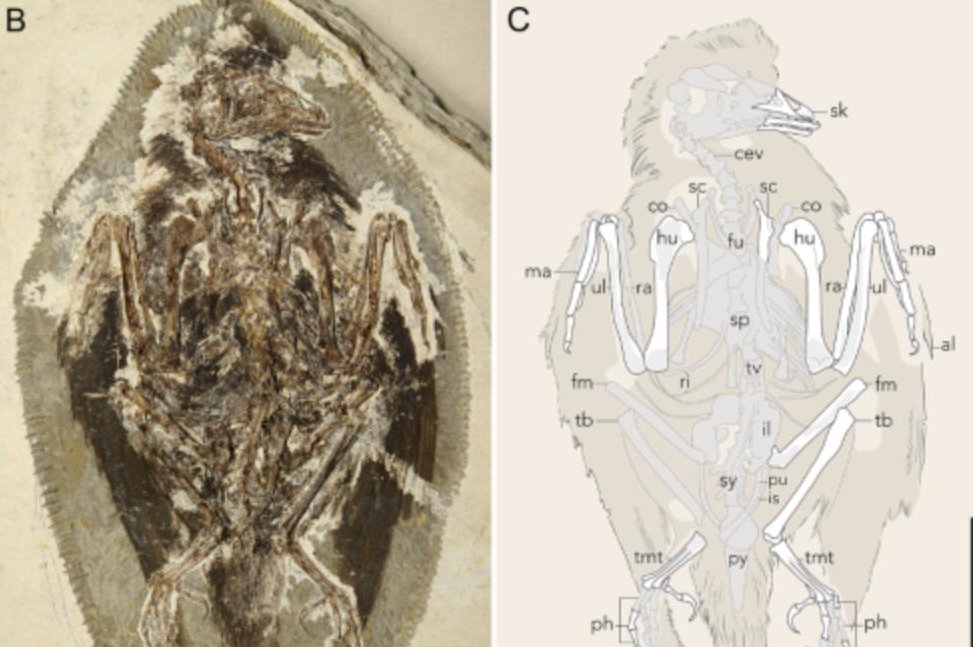
(A) The holotype specimen of Plumadraco, (B) a closer view of the body and, (C) a line drawing of the same portion of the body shown in B. Image courtesy Clark et al./PLoS One
Scientists have identified a 121-million-year-old fossil as a new prehistoric bird species. A recent study described the extinct bird as about the size of a robin, with tail feathers twice the length of its body.
The bird, Plumadraco bankoorum, was a member of the enantiornithines, the most diverse group of birds during the Cretaceous period. According to experts, the species' tail feathers are the proportionally longest tail feathers recorded from any enantiornithine bird.
Due to the bird's unusually large tail feathers, referred to as rachis-dominated feathers, researchers believe it likely used them as visual displays to attract a mate or communicate, rather than to fly. The feathers also end in racket-shaped tips, which contrast in shape from the background vegetation, causing the bird to stand out.
The experts believe this specific specimen was a male bird whose feathers served a similar purpose. However, they also note that additional information on tail musculature and nesting strategies is needed to further corroborate their interpretation.