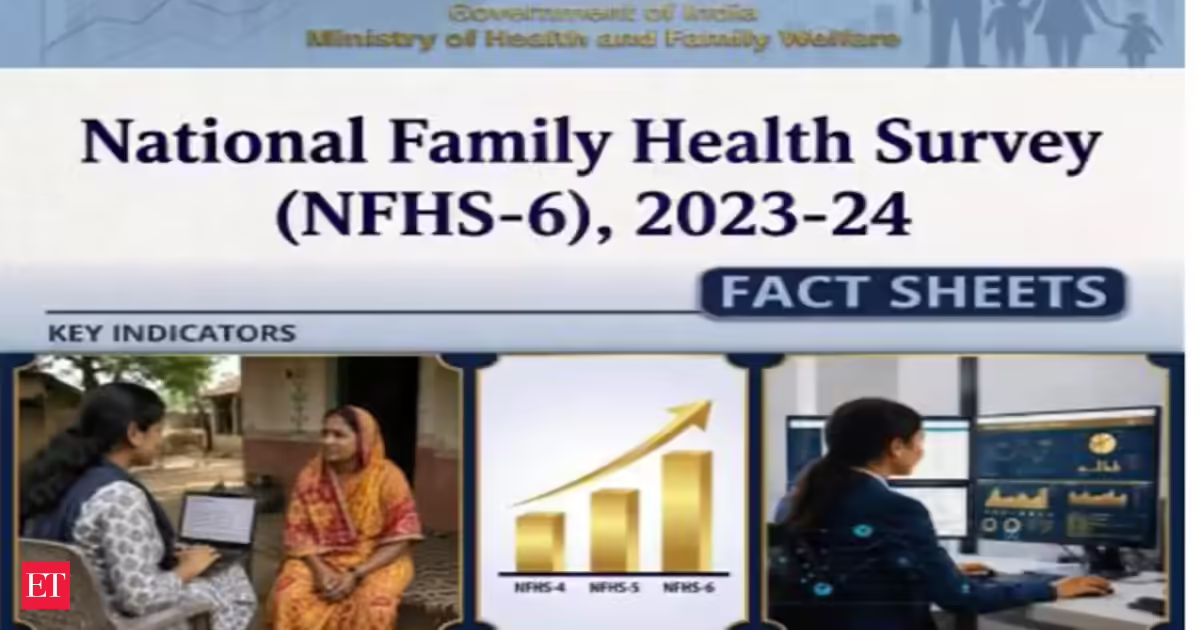
Health insurance coverage in India has expanded sharply over the past two decades, with the share of households having at least one member covered under a health insurance or financing scheme rising from just 4.8 per cent in 2005-06 to 60.2 per cent in 2023-24, according to the National Family Health Survey.The pace of expansion accelerated after 2015-16, when coverage stood at 28.7 per cent, rising to 41 per cent in 2019-21. “The rise in coverage is largely the result of sustained government intervention through schemes such as Rashtriya Swasthya Bima Yojana (RSBY) and later Ayushman Bharat PM-JAY, along with growing awareness of healthcare costs and improved enrolment systems,” said Nochiketa Dixit, Managing Director - Corporate Solutions & Retail, EDME Insurance Broker.The rise in coverage has, however, not been uniform across States. Haryana recorded the largest increase among the States analysed, with household coverage rising from 25.7 per cent in 2019-21 to 68.3 per cent in 2023-24, a jump of nearly 166 per cent. West Bengal also saw coverage more than double, increasing from 33.7 per cent to 88.2 per cent during the same period.In contrast, Tamil Nadu and Kerala were the only States to record declines in coverage, with insurance penetration falling 8.1 per cent and 1.2 per cent, respectively.According to Ramkumar Subramanian, Partner, Grant Thornton Bharat, these differences partly reflect varying timelines in adoption and penetration. “That’s because of late adoption by States such as Haryana and West Bengal compared to Tamil Nadu and Kerala. Tamil Nadu and Kerala have better public healthcare systems compared to the other two States, making West Bengal and Haryana reliant on health insurance coverage,” he said.Rural coverageGovernment-backed schemes have played a significant role in expanding coverage, particularly in rural India. The share of rural residents covered under any health insurance or financing scheme increased from 14.1 per cent in 2017-18 to 47.4 per cent in 2025. Coverage under government-sponsored schemes alone rose from 12.9 per cent to 45.5 per cent over the same period.Arun Ramamurthy, Co-Founder, Staywell.health, noted that the expansion of government-sponsored coverage in rural areas represents an important step towards reducing financial barriers to healthcare, especially for low-income households.As of August 2024, more than 34.7 crore Ayushman cards had been issued under AB-PMJAY. The scheme has authorised 7.37 crore hospital admissions worth over ₹1 lakh crore and covers 1,949 healthcare procedures through more than 29,000 empanelled hospitals.However, experts noted that coverage remains weak among middle-income households, many of whom are ineligible for government schemes but cannot afford comprehensive private insurance, leaving them reliant on savings or group insurance for coverage.Published on June 3, 2026
Health insurance coverage crosses 60% of households, NFHS
Health insurance coverage in India has surged to over 60%, driven by government schemes and increased awareness, particularly in rural areas.
434 words~2 min read