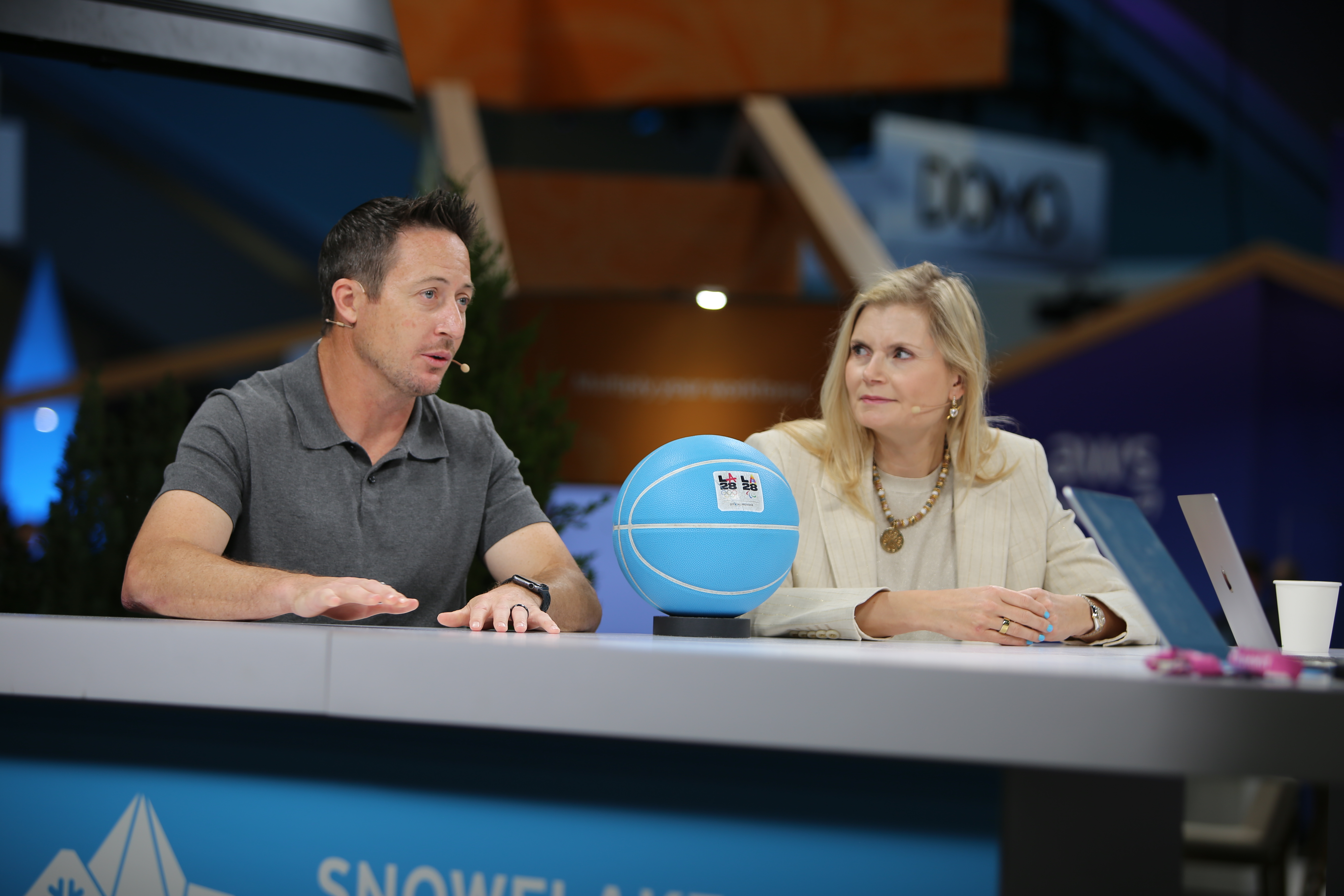
athlete with artificial robotic legs running fastgettyAI is getting lots of applications in the sports world, and in the world of entertainment. In sports, for example, you have real-time spatial data, on players through harnesses, in facilities with lidar, and so forth. In entertainment, there are new ways to render a person’s likeness, or a cartoon character, or a setting, through the amazing visual capabilities of today’s LLMs.I found this from a group-authored academic/analytical paper on AI in sports and beyond, posted on ScienceDirect:“Artificial intelligence (AI) has demonstrated remarkable power in transforming various industries. It is clear that AI has shown promising results in enhancing athletic performance, competition management, and viewer experience for sports.”As for entertainment, big budget studios and producers are embracing what LLMs can do in this realm, too. Check out this roster from IMDb for more on where AI is coming into play.Thoughts from Imagination in ActionI help run events called Imagination in Action or IIA conferences in Boston, at Davos, and elsewhere. In April, at MIT, we had a panel discuss these sectors and what AI is doing. Wall Street Journal Technology and Media Editor Sarah Krouse interviewed George Barrios of Isos Capital Management, Sumair Khan of Catch 12, Brian Walker of DraftKings and Lauren Selig of Shake and Bake productions, about all of this and the roles that AI now plays.MORE FOR YOUWhere’s the Disruption?The first question from Krouse centered around where panelists have seen disruption in their fields. Interestingly, three out of four of them said they don’t perceive AI to be working that way, exactly.“Large, successful businesses dabble in the first phase,” Barrios said, adding that he has not seen “disruption” per se, to this point. “They have to do something, so they begin doing things … I would say the disruption hasn't come yet.”“Athletes are very distrusting generally across the board,” Khan added, noting a lack of disruption in his experience as well. “They’re very slow for the adoption of new technologies, there's just a lot of fear, generally. So I think one of the reasons for us being here is just that: to learn, and so we can educate them on AI, not only as an investment, but how it can be utilized.”But in some cases, he added, explaining anecdotal developments, the investment is made, and the athletes are happy.“I wouldn't classify it as disruptive in nature,” Walker said. “It's opportunistic. It really puts us in the power position to be able to get ahead in a super-competitive market.”He explained further.“We invest specifically in the core pillars of the business, engineering, marketing, customer support, operations,” Walker said. “Those are the pillars of the company in terms of how we run; each of those has their own unique scale profile leveraging AI tools.”Quick scaling, he suggested, is another gain for the enterprise.“I think that the major disruptor, for me, is just in terms of a shortened period of time between fantasy now becoming reality,” Selig said of the movie-making world.Her company, she explained, has worked on films like Lone Survivor, Hacksaw Ridge, American Made, and Top Gun: Mission Impossible.“Those are big tentpole movies that have a lot of things in them that are just quite frankly impossible,” she said. “And now we're investing in the technologies that make those things possible. We now have the opportunity to use our creativity and our imagination in bigger, wider, better ways. And we have the tools to be able to do that. Not everybody has an agent. Not everybody uses AI. Not everybody knows how to edit. But if we all sort of can, you know, mash up our unique abilities together using tools we want, that's awesome. I love that.”More Market and Operational NotesAs the panel went further into what business looks like for sports and entertainment firms, Barrios mentioned the vast amount of video generated now, and the “fragmentation” of video in various fields. Selig talked about a “big swing in marketing” and how that changes the equation in Hollywood and beyond.Barrios had some thoughts about what he called “cohort analysis.”“What's the messaging to a certain cohort?” he asked. “What's the pricing to win them back to prevent churn? All of that.”“We want to control our merchandising,” Khan said of his firm’s experience. “We want to control our content. So a big part of our business is creating and producing content, whether it's long form or short form content.”He explained the use of video editing tools to make athletes look present when they actually are not, which fed into a discussion on IP a little later.Walker added a sort of analogy.“The general metaphor to think about is: the pipes for everything we do are getting bigger now, right?” he said. “Whether it's producing more product, or content, and it allows us to actually meet the customers where they are - so today in the modern sporting environment, customers are really passionate about their teams and the ability to meet them, especially as we're in a highly regulated space, but the regulation is rather patchwork right now, particularly when you looked at legalized sports betting versus prediction markets and so forth. We're able to move quickly and meet the customers. We're able to respond and pivot a lot quicker to build a richer experience with a customer such that they can really identify with the team that they love.”Protecting Intellectual PropertyThen there was that discussion of how to make sure that players aren’t taken advantage of in contracts.“We structure a lot of those contracts with the buyers, like Netflix and Amazon,” Khan said, “and their interest is to take all rights. They want the ability to exploit, you know, name, age, likeness, rights, and apply it to some of their own AI tools. And there's always the question of, are we going to get paid? Are you going to use that input, you know, to teach the AI? And then what is the output? Who owns it? These are real issues.”He mentioned a lack of case law around this.Barrios suggested the use of blockchain to protect video IP.Selig referred to the process as “a lawyers’ game.”“Blockchain might be able to help, might not,” she said. “I don't know.”Khan gave the example of a World Cup commercial with just faces, where the players themselves were able to get paid without showing up anywhere, but again, he noted the complexity of this issue.“It will change,” he said.“We have strong relationships with the leagues, with the players, associations, that sort of thing,” Walker added. “So we really lean in hard. We're, you know, partners with so many government agencies, regulators. So for us, the relationship side, the trust side is really, really important.”He added that the company has to “guard IP with sacredness” and pay a lot of money, but that ultimately, it’s worth it.I thought that issue was a good one to end on, and spend time on, because it really is central for a lot of people. Figures like Will.i.am, appearing at our conferences, have stressed the need for data ownership on a personal human level. Will we maintain that, in the face of the change that is all around us? We’ll see.
Considering AI In Sports And Entertainment
AI enhances sports and entertainment, accelerating innovation while raising concerns over intellectual property rights.
1,198 words~5 min read