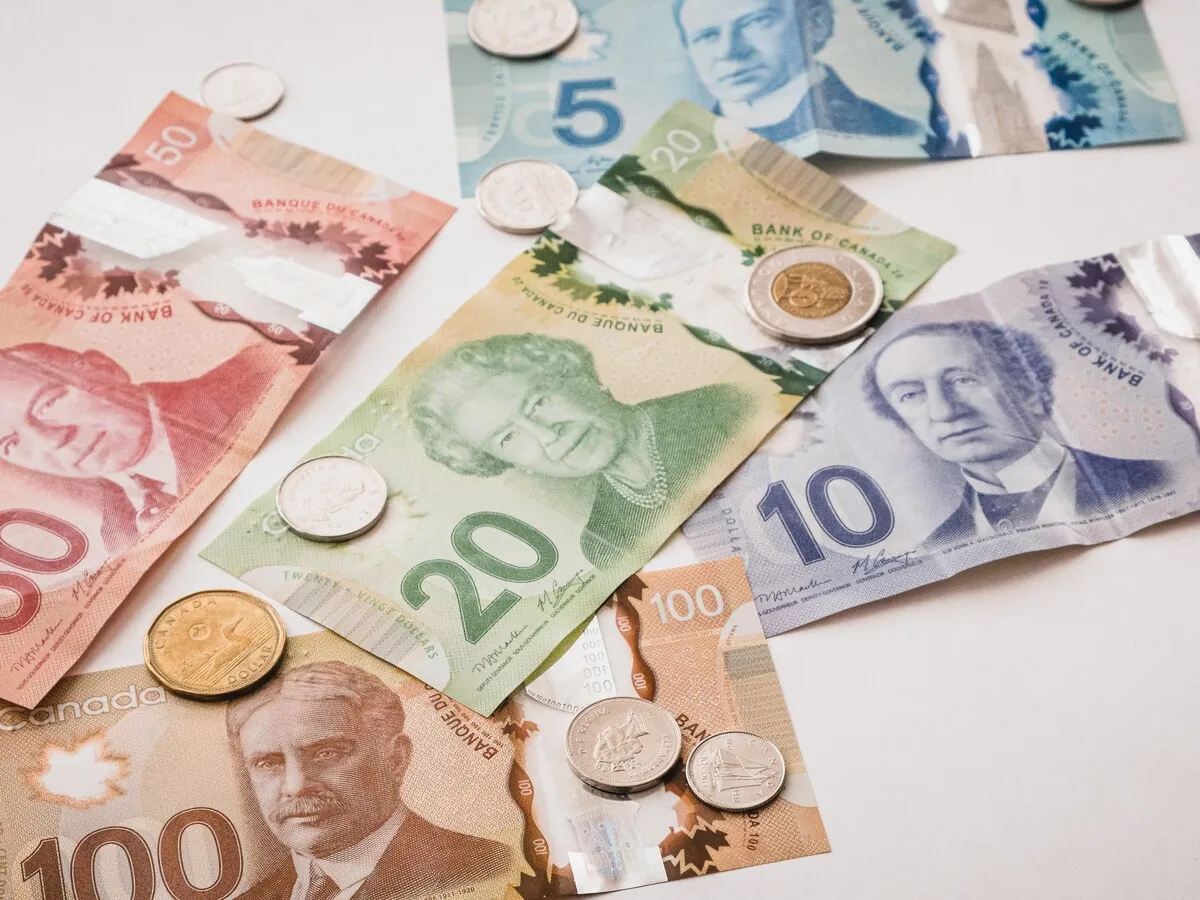
Skip to Content News Archives Economy Energy Oil & Gas Renewables Electric Vehicles Mining Commodities Agriculture Real Estate Mortgages Mortgage Rates Finance Banking Insurance Fintech Cryptocurrency Work Wealth Smart Money Wealth Management Investor Personal Finance Family Finance Retirement Taxes High Net Worth FP Comment Executive Women Puzzmo Newsletters Financial Times Business Essentials More Innovation Information Technology FP500 Podcasts Small Business Lives Told Tails Told Shopping Financial Post Store Obituaries Place a Notice Advertising Advertising With Us Advertising Solutions Postmedia Ad Manager Sponsorship Requests Classifieds Place a Classifieds ad Working Profile Settings My Subscriptions Saved Articles My Offers Newsletters Customer Service FAQ News Economy Energy Mining Real Estate Finance Work Wealth Investor FP Comment Executive Women Puzzmo Newsletters Financial Times Business Essentials HomeWealthCanadian households hit a high of $18.6 trillion in wealth last year — but geopolitics could lead to growth ‘reversal’ in 2026The ratio of financial to non-financial assets hit its highest point in more than 20 years, according to Statistics CanadaLast updated Mar 16, 2026 You can save this article by registering for free here. Or sign-in if you have an account.Canadians' household wealth rose to $18.6 trillion in the final quarter of 2025, getting a boost from stock market gains. Photo by Selensergen /Getty ImagesLast year, Canadian households added more than $1 trillion to their collective net worth, driven by significant gains in financial assets, according to Statistics Canada’s latest national balance sheet, released Monday.Subscribe now to read the latest news in your city and across Canada.Exclusive articles from Barbara Shecter, Joe O'Connor, Gabriel Friedman, and others.Daily content from Financial Times, the world's leading global business publication.Unlimited online access to read articles from Financial Post, National Post and 15 news sites across Canada with one account.National Post ePaper, an electronic replica of the print edition to view on any device, share and comment on.Daily puzzles, including the New York Times Crossword.Subscribe now to read the latest news in your city and across Canada.Exclusive articles from Barbara Shecter, Joe O'Connor, Gabriel Friedman and others.Daily content from Financial Times, the world's leading global business publication.Unlimited online access to read articles from Financial Post, National Post and 15 news sites across Canada with one account.National Post ePaper, an electronic replica of the print edition to view on any device, share and comment on.Daily puzzles, including the New York Times Crossword.Create an account or sign in to continue with your reading experience.Access articles from across Canada with one account.Share your thoughts and join the conversation in the comments.Enjoy additional articles per month.Get email updates from your favourite authors.Create an account or sign in to continue with your reading experience.Access articles from across Canada with one accountShare your thoughts and join the conversation in the commentsEnjoy additional articles per monthGet email updates from your favourite authorsSign In or Create an AccountorHousehold net worth increased by nearly $230.2 billion quarter over quarter to reach $18.6 trillion in the fourth quarter of 2025, continuing a winning streak of wealth gains since the end of 2023. At the end of last year, Canadians’ wealth stood at about $17.6 trillion.Financial assets in the fourth quarter grew 10.5 per cent year-over-year — and the ratio of financial assets, such as stocks, to non-financial assets, such as real estate, hit 120.7 per cent, its highest point in more than two decades.Get the latest headlines, breaking news and columns.By signing up you consent to receive the above newsletter from Postmedia Network Inc.A welcome email is on its way. If you don't see it, please check your junk folder.The next issue of Top Stories will soon be in your inbox.We encountered an issue signing you up. Please try again“For the last two years, financial assets have been the primary driver of gains,” said Maria Solovieva, economist at Toronto-Dominion Bank.Domestic markets stole the show, with the S&P/TSX composite index climbing 5.6 per cent in the fourth quarter of 2025, closing out the year 28.2 per cent higher than it did at the end of 2024 and marking the largest annual increase since 2009. The S&P 500 index also inched up 2.4 per cent in the fourth quarter and ended the year 16.4 per cent higher than it did at the end of 2024.As a result, financial assets grew 2.5 per cent, or $296.9 billion, to reach $11.95 trillion in the fourth quarter.Meanwhile, the value of residential real estate assets dipped 0.4 per cent to $8.45 trillion in the fourth quarter, ending the year 0.2 per cent lower compared with the end of 2024.“We’re not expecting a meaningful recovery in housing demand and prices through this year, and so that would indicate that there’s still going to be a preference towards financial assets through 2026,” said Shelly Kaushik, senior economist and vice-president of economics at the Bank of Montreal.The household savings rate declined to 4.4 per cent in the fourth quarter, as household spending rose by 1.2 per cent and well surpassed muted disposable income gains of 0.6 per cent.Kaushik said reduced interest rates have meant households have had less incentive to save, and “the overhang of strong inflation” has potentially prevented households from tucking away funds for a rainy day as well.“If the labour market is loosening, (there is) potentially a little bit less job security (and) actual money out there in the economy to be diverted to savings,” Kaushik said.At the same time, the pace of seasonally adjusted household credit market borrowing, which includes consumer credit and loans, declined slightly to $36.2 billion. Despite mortgage demand ticking up to $28.7 billion, overall household borrowing was likely dented by a slowdown in auto sales impacting non-mortgage debt, Solovieva said.“It kind of makes sense, because you have some households that continue to spend, maybe boosted by gains in the financial assets … but those are not necessarily the same households that are borrowing in the non-mortgage space,” she said.Household credit market debt was more than $3.2 trillion in the fourth quarter of 2025 and the ratio of this debt as a proportion of household disposable income increased for the fifth consecutive quarter to 177.2 per cent.Kaushik said the household debt-to-income ratio is higher compared with both historical patterns and other countries, which means households will be more sensitive to changes in interest rates in future. Still, she noted the ratio remains lower than the record high of 188.2 per cent hit in 2022.The household debt service ratio (which includes total obligated payments of principal and interest on credit market debt as a proportion of household disposable income) slipped from 14.61 to 14.57 per cent quarter-over-quarter.Moving further into 2026, geopolitical tensions and gas prices pose risks for household wealth gains, economists cautioned.The ongoing trade war with the United States, for example, means Canadian households are still grappling with a fair amount of uncertainty, Kaushik said.Ω“We’re still undergoing negotiations for the Canada-United States-Mexico Agreement (CUSMA), the big piece of legislation that is insulating the broader Canadian economy (and) Canadian households from the direct impact of tariffs,” she said.The U.S. and Israel’s war on Iran have led to skyrocketing oil prices and stock market volatility. The repercussions could show up in the household savings rate and even in financial asset returns starting in the second quarter of the year, Solovieva said, noting the S&P 500 index is currently in the red.“It is possible to see a reversal of either no growth in financial assets or even contraction in financial assets,” she said. “And we’ll also see the weakness in real estate assets.”Kaushik said she still expects to see some strength in “safe haven assets,” such as the U.S. dollar and possibly precious metals, though riskier stocks have also been buoyed by artificial intelligence demand and financial asset wealth could continue to climb.Housing is constrained by affordability challenges, she added.Kaushik said there are arguments for the Bank of Canada to cut interest rates this year, given “well-behaved inflation” and a relatively soft job market, but oil price shocks have built a case for rates to hold.“There are going to be lots of gyrations — not all of them will be because of the conflict in Iran, but we have seen a huge step-up in energy prices,” she said. “So, it’s a question of how long that lasts.” Join the Conversation This website uses cookies to personalize your content (including ads), and allows us to analyze our traffic. Read more about cookies here. By continuing to use our site, you agree to our Terms of Use and Privacy Policy.
Canadian households hit a high of $18.6 trillion in wealth last year — but geopolitics could lead to growth ‘reversal’ in 2026
Canadian households added more than $1 trillion to their collective net worth, driven by significant gains in financial assets. Keep reading
1,411 words~6 min read