Yasin Hemmati / Unsplash
Matanya Horowitz has a pitch that sounds almost too clean. His company, AMP, deploys cameras and robotic arms that can identify and sort about 90% of the material moving through a recycling facility. "Pretty much anything you and I can identify, it can learn to identify," Horowitz recently told Quartz.
The robots don't call in sick. They don't care what country a shipping container is headed to. What they can't do, yet, is conjure buyers for what they sort.
That quandry sits at the heart of a recycling industry that has spent 40 years solving the wrong problem. The U.S. recycling rate climbed from roughly 16% in 1990 to about 35% in 2017, then stopped. It has hovered near 32% for the better part of two decades, according to the Environmental Protection Agency. Every generation of technological or logistical fix has unlocked one constraint and tightened another. AI-powered robotic sorting is the newest entry in that sequence.
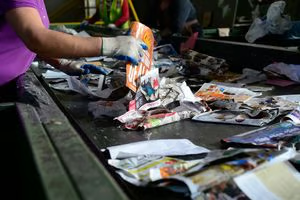
Before the mid-1990s, the American households that bothered to recycle at all did most of the sorting themselves. Residents separated metals, glass, and plastics into one bin and newspapers into another. Each material type had in its own bag, collected by trucks with three or more compartments.