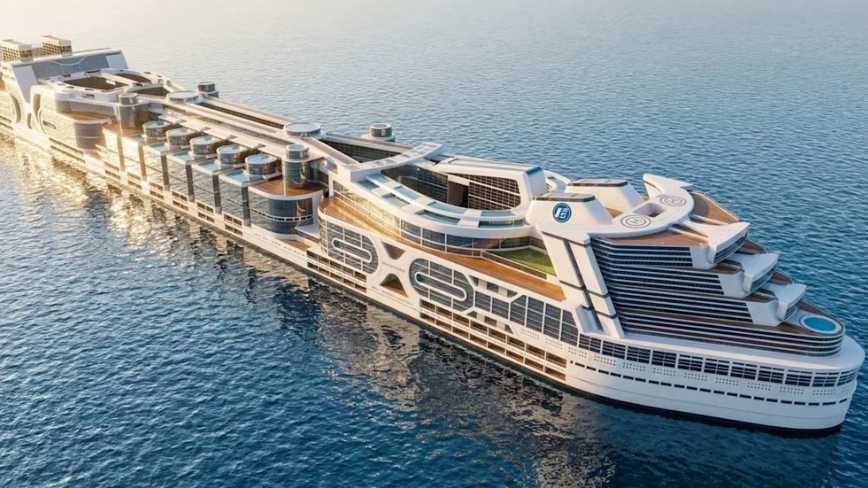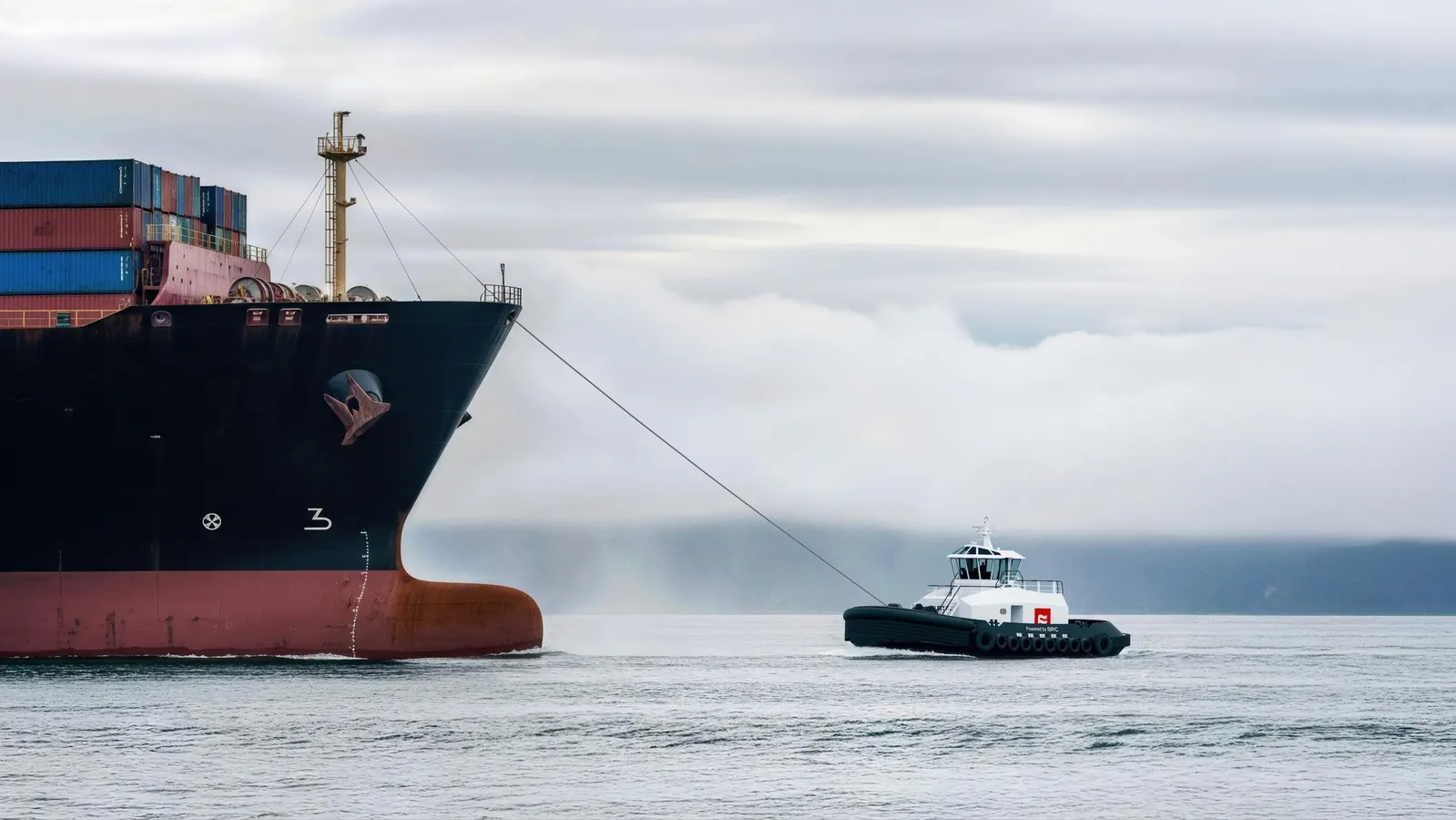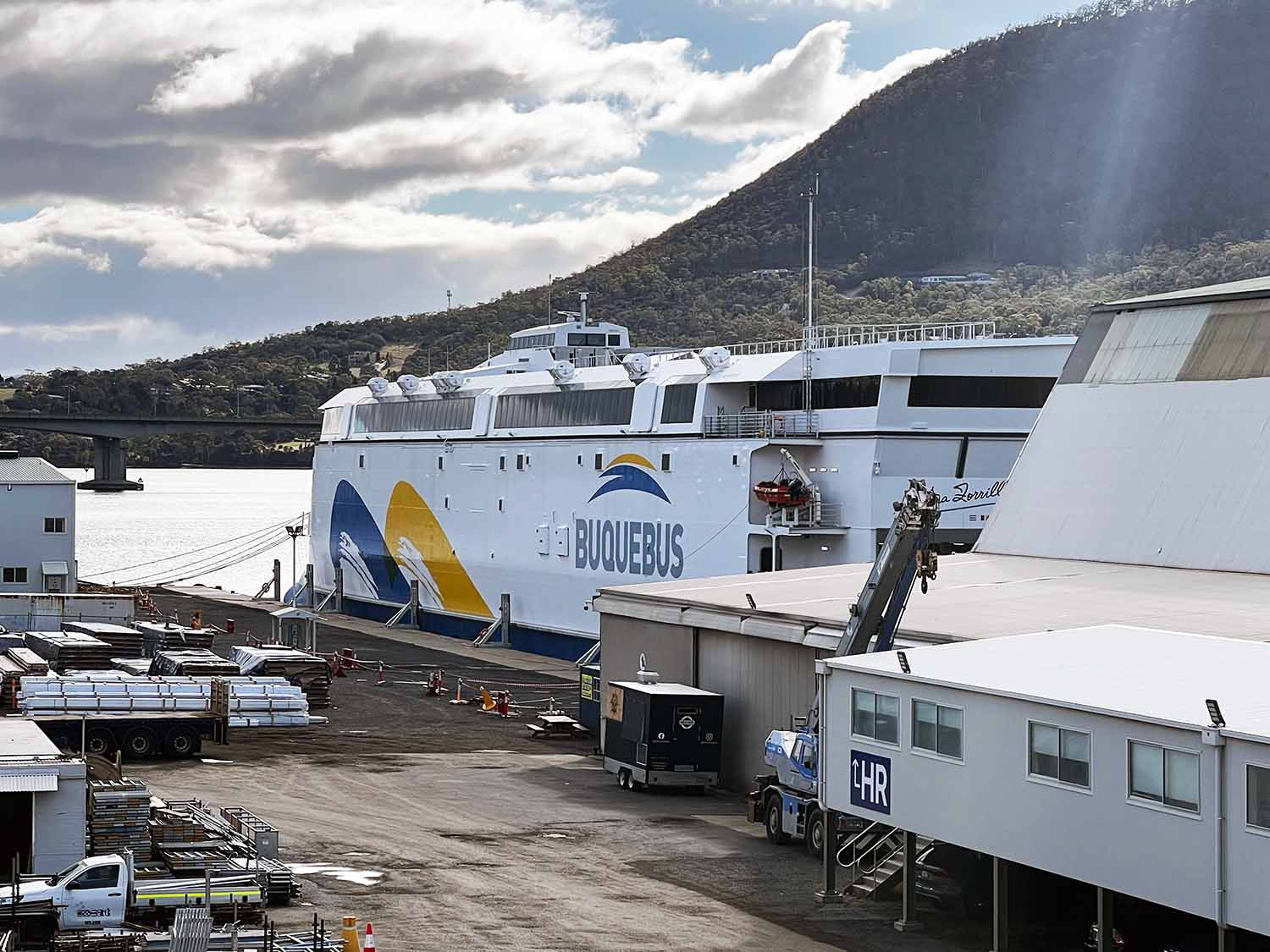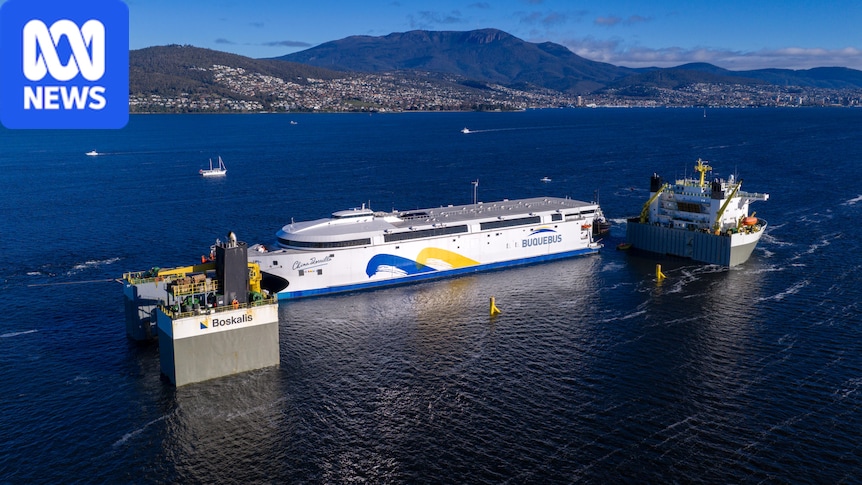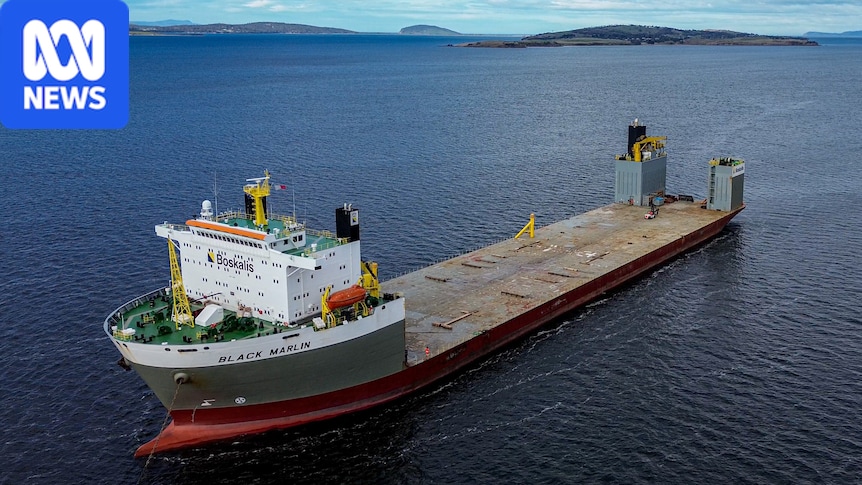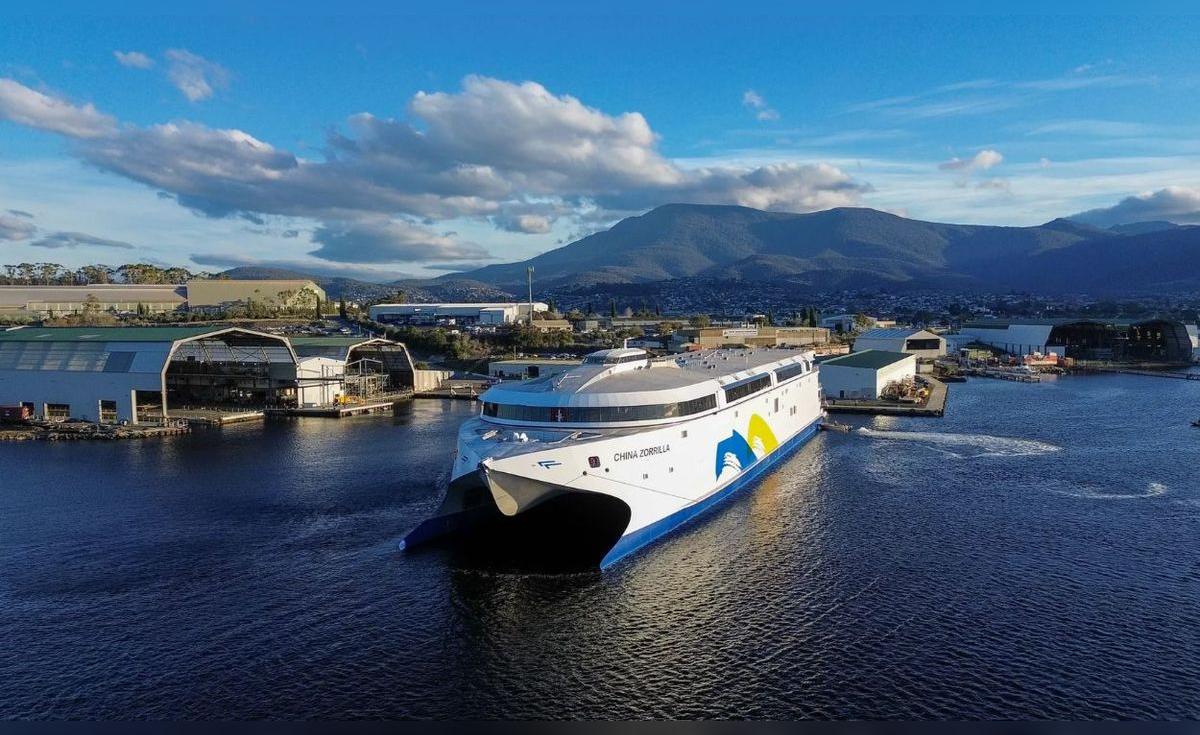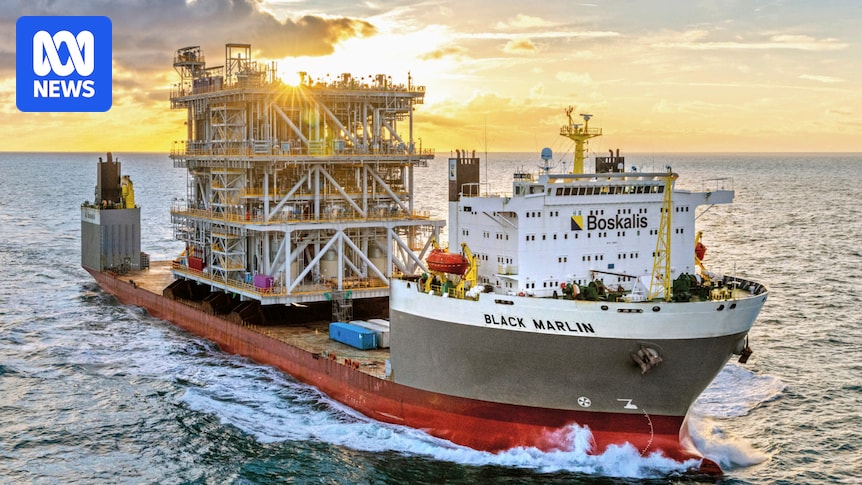
A 217-metre-long heavy-lift ship has been secured to transport the world's largest electric vessel from Hobart's River Derwent to South America. Hull 096, a battery-electric-powered catamaran capable of transporting up to 2,100 passengers, was completed by Hobart-based ship builder Incat in May last year.It was built for South American ferry company Buquebus to service the Rio de la Plata route between the Uruguayan capital of Montevideo and Buenos Aires in Argentina.Described as a landmark in sustainable shipping by Incat when it was built, the 130-metre-long ferry is equipped with more than 5,000 batteries that will allow the ferry to run for 90 minutes.The 130-metre-long ferry has a capacity for 2,100 passengers and 225 vehicles, and is powered by more than 5,000 batteries. (ABC News: Mitchell Woolnough)It underwent sea trials in January, and was ready to ship to South America by April, but has faced logistical delivery issues after the original heavy-lift vessel booked to transport the ship became stuck in the Persian Gulf due to the US-Iran conflict. Now another vessel, the 217-metre-long and 42-metre-wide transport ship MV Black Marlin, has been secured to transport the electric ferry, dubbed China Zorrilla after the Uruguayan actress, from Hobart's River Derwent.Incat chairman Robert Clifford said Black Marlin was currently off the South African coast, and, pending refuelling and a stopover in Melbourne, could be expected in Hobart as early as mid-July.Bob Clifford says the arrival of the heavy-lift vessel marks a major step in the "groundbreaking" shipbuilding project. (ABC News: Ebony ten Broeke)"Very few people ever get the chance to see an operation like this up close," Mr Clifford said."The Black Marlin is an extraordinary vessel in its own right and will be one of the largest ships ever to enter the River Derwent."Complex logisticsEnormous heavy-lift transport ships like Black Marlin are used to transport large marine vessels and cargo, as well as structures as large as oil platforms and drilling rigs."There are probably half a dozen of them that are suitable around the world, but it's a matter of getting one at the right time," Mr Clifford said.The logistics and execution of the carefully planned loading operation in the River Derwent were expected to take several days, he said.Heavy-lift ships transport other vessels, cargo and large structures like cranes and oil rigs. (Wikipedia: Max Stepanov)China Zorrilla will first need to be moved to the heavy-lift ship before being handed over to tugboats, which will help position the ferry.The semi-submersible heavy-lift ship will then submerge its cargo deck beneath the waterline, before China Zorrilla is manoeuvred into position on a cradle above the submerged deck."The cradle will have to be built on board — which is probably going to take a day — setting up the deck like you would if it were a dry dock," Mr Clifford said.The water will then be pumped out, lifting the cargo deck out of the water, before the ferry is chained down and secured.China Zorrila is the largest electric vehicle of its kind. (ABC News: Mitchell Woolnough)"All that is probably going to take one day of preparation and maybe half a day of loading, and another half a day of lashing the ship down," Mr Clifford said.Due to the size of the heavy-lift ship, Mr Clifford said the loading would need to occur in the deepest part of the River Derwent, which will be determined by TasPorts."The ship, when it's partly sunk, will actually be drawing about 23 metres," he said."It's most likely going to be somewhere off Taroona; it won't be anywhere near the Tasman Bridge."A test case for future ferriesWhen the US-Israel war with Iran scuppered the ferry builder's initial plans to transport the vessel, it considered other options, including placing diesel generators on board to power the ship's electric motors.Incat's head of projects, David Riseley, said the decision to wait for another heavy-lift ship was partly based on the need to preserve the structural integrity of the electric vessel."It's not just about battery capacity," Mr Riseley said."It's constructed to run on a relatively calm river, so the vessel's not been constructed for heavy sea operation."Mr Riseley said while heavy-lift ships had entered the Derwent before, putting a large aluminium catamaran onto a heavy-lift ship was uncommon."It's also large. It takes up a good portion of the deck, so it needs to be very accurate when it takes its position," he said.The new ferry's high-speed, low-emission design has already attracted interest from other transport operators.The superstructure of Hull 096, pictured during the construction phase in Hobart. (Supplied: Incat)After commissioning two battery-electric Incat-designed ferries last July, Danish company Molslinjen ordered a third to service one of Europe's busiest ferry corridors."I'm sure in the future we'll have vessels that will need this same kind of transportation to be undertaken, depending on the configuration of the vessels. This will be a test case," Mr Riseley said."Typical of Incat, we've picked the biggest one to start with as opposed to testing a smaller one first."Mr Riseley said he expected the trip from Hobart to Buenos Aires to take between 30 and 40 days.
Enormous ship en route to pick up world's largest electric ferry
The 217-metre-long heavy-lift vessel Black Marlin will deliver a Tasmanian shipbuilder's new electric ferry to South America, after the previous transporter became caught up in the Strait of Hormuz closure.
TL;DRAI
Incat's China Zorrilla—a 130-meter battery-electric catamaran with 5,000 batteries, 2,100 passengers—ships to Buenos Aires via heavy-lift Black Marlin. The operation validates large-scale battery-electric ferries; competitors are already ordering similar vessels, proving zero-emission maritime transport is scalable.
846 words~4 min read