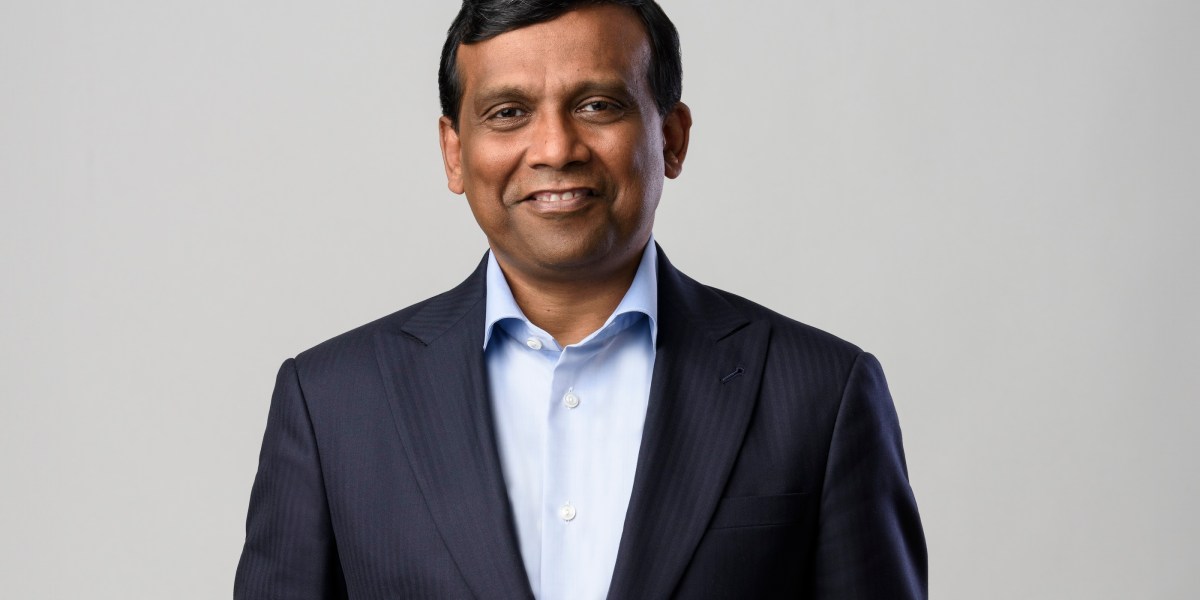
Igor Rikalo is President and COO at o9 Solutions.gettyTraditionally, the workplace hierarchy was organized in the shape of a pyramid. A select group of executives was at the top, managers responsible for coordinating teams were in the middle and individual contributors who executed tasks made up the base of the pyramid. This structure worked for many years because organizations needed large groups of people to perform operational work and serve as the primary unit of productivity. This model has shifted over the years. At my company, as with others, we've aimed to keep as close to a flat hierarchy as possible to empower our employees to take ownership of their roles and innovate. As AI begins to reshape the workplace, I imagine the flattening of the pyramid will continue, as hyper-connected organizations rely on both humans and AI. In the near future, many individual knowledge workers will operate portfolios that include AI agents that monitor signals, perform analysis, generate scenarios and execute basic operational tasks. One employee may coordinate dozens or even hundreds of AI agents. When this occurs, the traditional role of "individual contributor" begins to disappear, and every employee will have a managerial function. But instead of managing people, they are managing a digital workforce. Management is no longer a promotion. Traditionally, management was treated as a step in career advancement. Employees would spend years developing expertise as individual contributors before moving into managerial roles. However, only a small percentage of the workforce receives formal training in how to manage others in this model. AI challenges this model because if a planner, engineer or analyst supervises 100 AI agents performing specialized tasks, as NVIDIA CEO Jensen Huang predicts, that individual is no longer operating as a specialist. Instead, that individual is directing work, assigning tasks, reviewing outputs and correcting errors. These responsibilities are more aligned with management roles.With this in mind, the management title will take on a very different meaning because these responsibilities become a baseline capability that is applied to every knowledge worker within an organization. Delegation will become a core skill. In a traditional work environment, productivity stems from personal execution, and professionals build their careers by mastering the tasks they are responsible for within their role. AI shifts the source of productivity because the highest-performing employees will not be those who complete the most tasks as individuals. Instead, the highest-performing employees will design the most efficient agent systems to execute tasks. This shift in responsibilities requires a different mindset because employees must orchestrate systems that work on their behalf. Instead of completing tasks step by step, each employee will have to define clear objectives for agents, structure instructions and guidelines, evaluate outputs and continuously refine workflows. The workplace will be structured with each employee essentially running their own team of agents and delegation, prioritization and oversight will become the most valuable skills in the workplace. Accountability becomes more complex.As agent-driven capabilities expand, it raises a difficult question: Who is responsible when a digital worker makes a mistake? When employees are supervising numerous agents—which is already happening at some organizations, according to McKinsey research—actions are occurring continuously. Some can be executed autonomously, while other actions require human judgment and oversight. Organizations will need to create governance frameworks that clearly define ownership and provide employees with a clear understanding of when agents can execute actions autonomously, when approvals are required and when human intervention is necessary. Without transparent boundaries and guidelines, automations lead to confusion, not productivity. Performance shifts from effort to architecture.In traditional organizations, productivity reflects individual effort and skill. In an AI-enabled organization, it increasingly reflects how employees' systems are designed and managed. For example, two employees in the same role may achieve very different results based on how their agent networks operate. One employee might rely on a couple of basic agents to perform simple tasks, whereas their colleague may have developed a system of agents that are capable of continuously analyzing markets, testing scenarios and monitoring risks. Each respective employee's performance may vary as a result. If organizations begin measuring the output that is generated by an employee's agent system, the quality of automated decisions, the speed of error detection and improvement over time, an employee's success will depend less on the amount of work they have directly performed, and more on the quality of systems they use to perform their work. The role of leadership evolves.If every employee becomes the manager of a digital workforce, leadership responsibilities will also change. Executives will spend less time directing individual teams and instead focus on designing the operating systems used within the company. Within this purview, they will define decision rights, escalation paths and coordination mechanisms across a human and AI agent workforce. Rather than the strict, traditional hierarchy, an organization begins to resemble a network of decision units where each employee essentially operates a small command center that is supported by digital agents. A company's performance and success will depend on how well these units interact. Therefore, leadership functions become an architectural discipline, as executives define systems' structures, how agents coordinate across teams and how to proactively address any errors that occur. A different type of organization emerges.The shift from traditional workforce structures to a workforce network of humans supported by AI agents will take time. As AI systems improve, each employee gains greater access to a growing set of digital workers that perform specialized tasks. Over time, these tools evolve into autonomous agents that operate continuously. That is when the structure of organizations changes. The central focus is no longer on how many employees are inside a company. Instead, the focus becomes how many human-led agent systems operate across the enterprise. Many companies will likely soon learn that the most difficult challenge of the AI era is not building intelligent systems; it's preparing people to lead them. Forbes Technology Council is an invitation-only community for world-class CIOs, CTOs and technology executives. Do I qualify?
The Future Of Work: When Everyone Becomes A Manager
As AI begins to reshape the workplace, the traditional role of "individual contributor" will begin to disappear.
992 words~5 min read