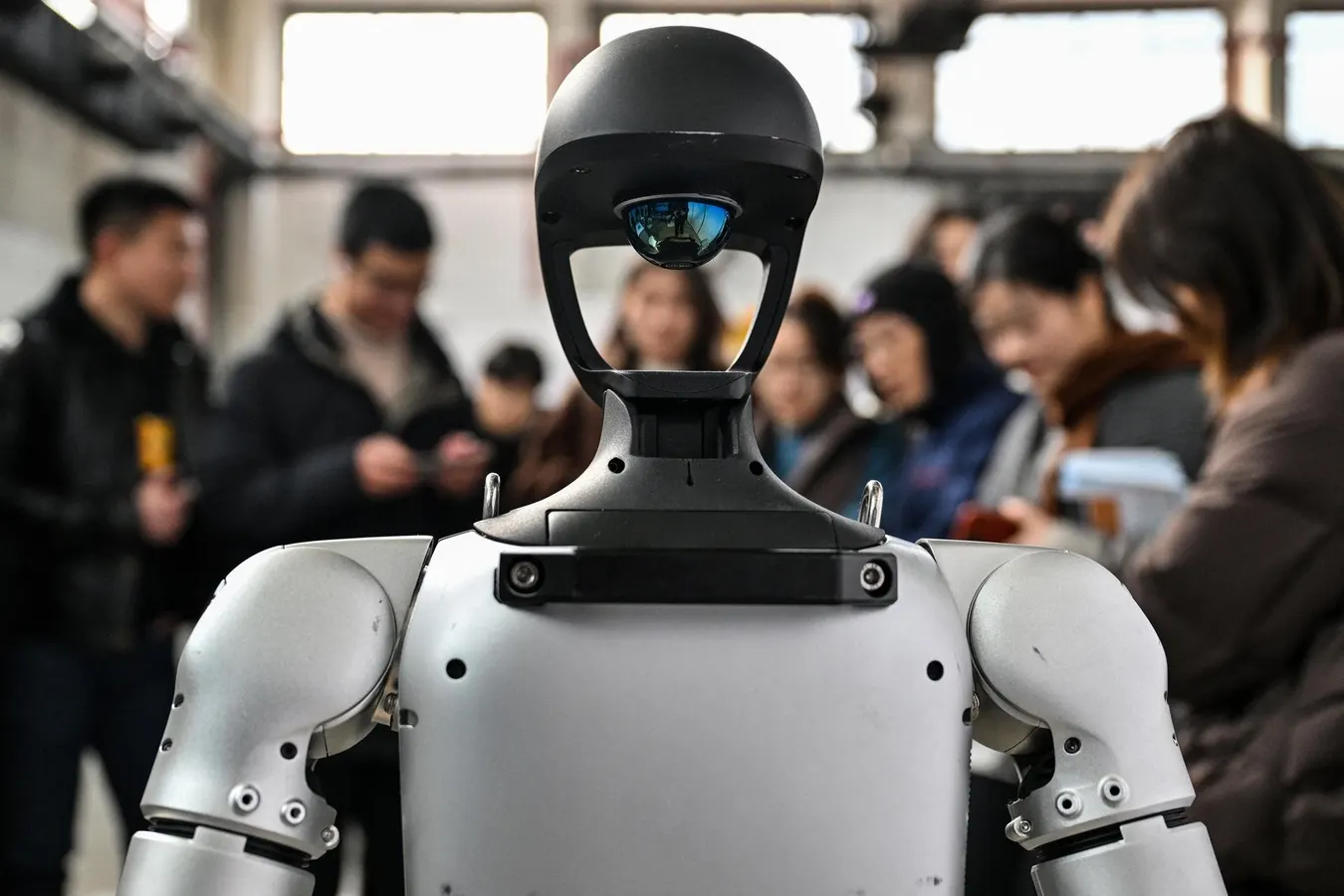
TOPSHOT - People stand next to a humanoid robot from Unitree Robotics during the Global Developer Conference, organised by the Shanghai AI Industry Association, in Shanghai on February 21, 2025. (Photo by Hector RETAMAL / AFP) (Photo by HECTOR RETAMAL/AFP via Getty Images)AFP via Getty ImagesThe corporate ladder is no longer attractive for knowledge workers, for a range of reasons. At Lovable, growth leader Elena Verna recently shed her management title to return to individual contributor work, and in doing so shipped an enterprise pricing page that previously would have required a product manager, designer, and engineering team working across at least a week of calendar time. She did it alone, in hours. This is a part of a wider trend showing what organizational design should look like when AI erases the coordination costs that made management necessary in the first place.Verna calls this new archetype the High-Impact Individual Contributor, or HI-C: a senior professional with no direct reports who can carry a project from initial hypothesis to measurable business outcome, end-to-end, independently. A traditional IC owns a slice of the workflow but a HI-C owns the whole thing.The Investor Thesis UnderneathVenture capital has been circling this structural shift for two years. In March 2026, Sequoia Capital partner Julien Bek published "Services: The New Software," arguing that for every dollar spent on software, six go to services, and that the next trillion-dollar company will sell outcomes rather than tools. The implicit corollary: the most efficient delivery mechanism for those outcomes is a small team of high-leverage individuals paired with AI, not layers of coordination overhead.The numbers support the bet. In 2025, AI startups captured 61% of all global venture capital, amounting to $258.7 billion according to an OECD analysis of Preqin data. Among early-stage deals, Carta's 2025 State of Startups report flagged leaner team structures as a defining characteristic of AI-native companies commanding premium valuations. Investors are not funding headcount. They are funding leverage ratios.Kleiner Perkins launched a $3.5 billion AI-dedicated fund in 2026, explicitly targeting companies where AI is the operational engine, not the product. Gradient Ventures, Google's AI arm, closed its fifth seed fund at $220 million in March 2026 with the same focus. The pattern across major funds is consistent: capital is flowing toward organizations that have figured out how to generate disproportionate output from small, skilled headcount.MORE FOR YOUWhat the Data Actually ShowsA 2026 METR survey of technical workers found that the median respondent estimated AI delivered roughly 2x the value of their work compared to March 2025, with expectations of 2.5x by 2027. Research from Stanford and Wharton on human-AI collaboration found that AI can explain over 20% to 60% of variance in individual productivity, a figure that drops to just 2 to 4% additional variance at the team level.That gap is the organizational chart opportunity Verna is describing; AI amplifies individuals dramatically, yet it amplifies groups modestly. The org chart built around coordination, approval chains, and information gatekeeping was engineered for a world where building was slow and expensive. When, as Verna writes, it becomes cheaper to try something than to debate it, the approval layer stops being risk management and starts being drag.Gallup’s 2026 State of the Global Workplace report added a troubling data point to the structural argument: manager engagement has dropped nine points since 2022, with the steepest decline occurring between 2024 and 2025. Managers used to outperform individual contributors on engagement metrics by a meaningful margin. The people doing the work are increasingly more engaged than the people coordinating it.Average Intelligence Is the PointVerna borrows a framing from product executive Ravi Mehta that cuts through a lot of hype: AI is average intelligence; not great, not innovative, nor differentiated. Automatically competent across design, marketing, code, and copy at a median professional level. The point is not that AI produces exceptional work. The point is that a senior person who already operates above average in their core domain can now staff the adjacent functions themselves, at sufficient quality, without waiting for cross-functional resources or running work up and down the approval chain.This reframes the HI-C model as something more specific than productivity improvement. It is a bet that the value in organizations has always resided in the judgment of senior individual contributors, and that management layers were a workaround for the absence of tools capable of executing on that judgment directly. AI does not make people smarter. It removes the organizational friction that prevented smart people from acting at the speed their judgment warranted.What Founders and Investors Should Do With ThisFor founders, the HI-C model has two immediate implications. First, recruiting senior leaders into IC roles is now a viable talent strategy, not a demotion. Verna notes that at Lovable, the pitch works: some candidates with VP-level track records actively prefer the role when compensation reflects the impact rather than the headcount managed. The lever is comp structure. Pay for output, not org chart position.Second, the single biggest blocker to HI-C performance is information access. A senior IC operating with the same context constraints as a junior employee cannot function at director-level scope. The companies making this work, overwhelmingly AI-native startups, have not built bureaucracy yet. Legacy organizations looking to retrofit the model will hit resistance at exactly the point where middle managers control information flow, because that control is how those managers justify their existence.For investors, the signal to watch is revenue per employee at the early-stage cohorts of 2025 and 2026. If the HI-C thesis holds, companies that deliberately recruit senior ICs and build information-open cultures should show meaningfully higher output per headcount than comparably funded peers with traditional management layers. That ratio, not team size or headcount growth, is increasingly what VC due diligence should be stress-testing.The management premium that drove a generation of careers, measured in direct reports and org chart altitude, is losing its structural justification. Capital and talent will follow. The question is not whether this transition happens; it is which organizations recognize it before their coordination costs become a competitive liability.
AI Turns Solo Workers Into Departments And VCs Are Paying Attention
AI is eliminating the coordination costs that made management necessary. Here's what that means for talent strategy, org design, and where smart capital is flowing.
1,007 words~5 min read