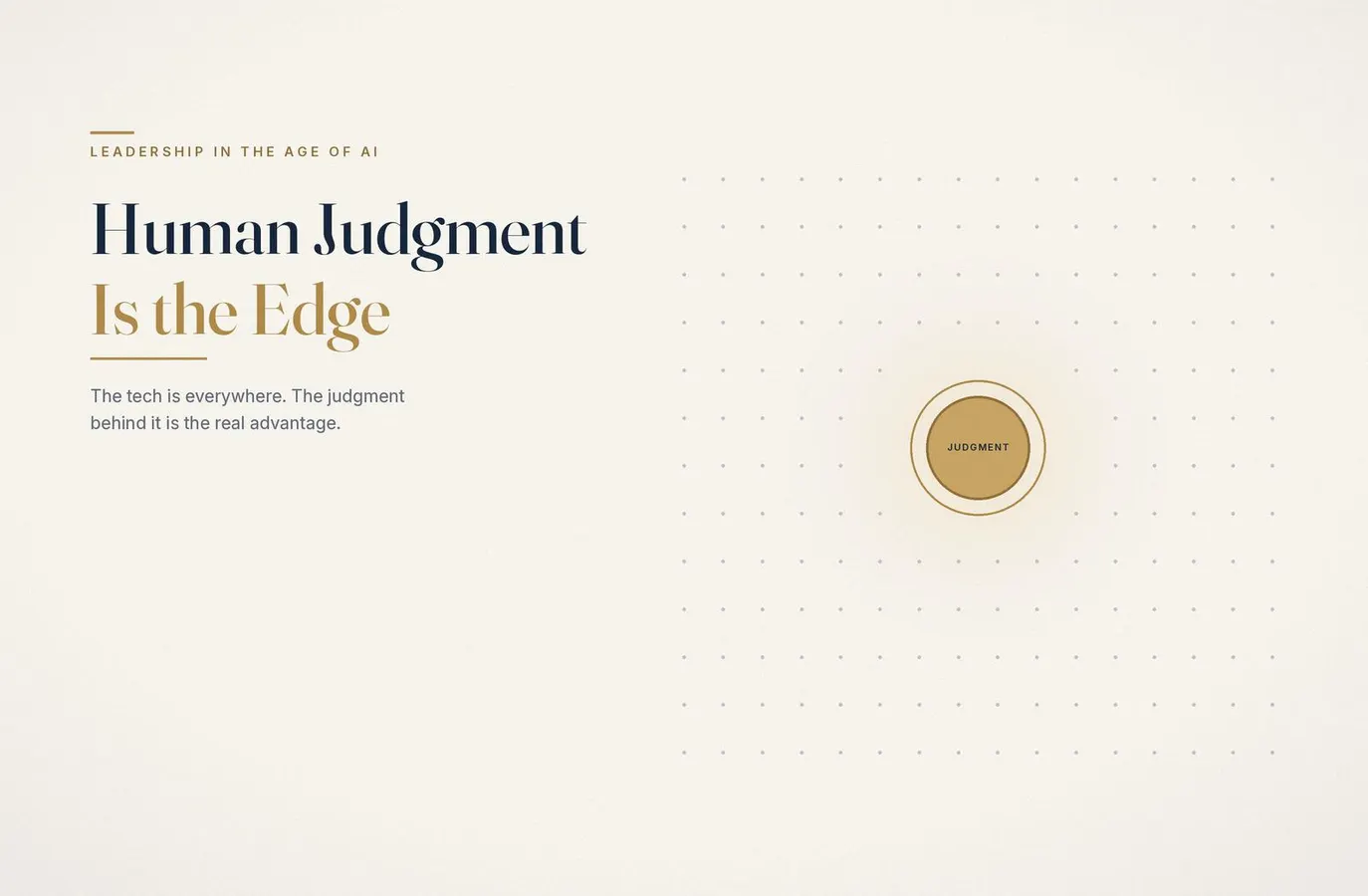
As AI reshapes decision-making, leaders must balance data-driven insights with human judgment.gettyFor decades, leadership was often defined by experience, intuition and access to information. The executive with the best data, strongest network and fastest analytical team usually held the advantage. But artificial intelligence is fundamentally reshaping that equation.Today, AI is not merely a productivity tool. It is becoming a cognitive amplifier for leaders, organizations and teams. It changes how decisions are made, how risks are evaluated, how opportunities are discovered and even how organizations understand themselves.When leaders take an AI-first approach, implementing relevant tools in a targeted, strategic manner, they can exhibit stronger leadership and decision-making that lifts their organization as a whole.The Shift To Data-Driven Decision-MakingDeloitte reports that 60% of executives use AI to support decision-making, no doubt related to the fact that the majority of leaders regret past decisions or have had situations where they could not decide because they could not trust data.With AI, data becomes clearer and more transparent. AI can deliver insights and highlight data points that might have gone completely overlooked with manual reporting. As a report from the Harvard Business School notes, “With AI, decision-making becomes more data-informed, allowing leaders to identify trends sooner, explore ‘what if’ scenarios, and move from reactive to proactive planning. AI also helps leaders understand potential outcomes, anticipate market changes, and pinpoint operational improvements across the organization.”MORE FOR YOUThe accessibility of this information can help eliminate the decision paralysis that can keep leaders from making critical decisions. Of course, leadership should always take a “trust but verify” approach, especially with new AI integrations. Using AI reports as a starting point to then dig deeper into available information can lead to even deeper insights, helping leaders avoid mistakes and uncover new opportunities.Of course, for certain levels of decisions, even decision-making itself can be handed off to AI, as long as the right parameters and guardrails have been set.AI As A LeaderWhile most leaders are relatively familiar with using AI as a support tool, a growing number of AI resources are set to take on basic leadership tasks themselves. For example, Skylar monitors live marketing campaign data to autonomously make strategic adjustments and coordinate people, budgets and other AI tools. The agent handles day-to-day execution, with only higher-level decisions surfaced to human leadership.In the recruiting space, tools like the Eightfold.ai work as an intermediary between leaders and potential hires, highlighting applicants who best match hiring criteria and handling the initial stages of the hiring process until human leadership comes in for the final decision. FlexOS helps leaders break down projects into smaller tasks with AI-powered templates and examples, making it easier for leadership to develop action plans and initiatives.In these and other use cases, AI is going beyond simply completing automated tasks. Within a given set of parameters, the AI becomes a leader in its own right. Managers spend less time on “lower-level” management tasks, with greater freedom to focus on big picture strategy and activities that require real, face-to-face human interaction.There is no one-size-fits-all approach to choosing and implementing these and other AI tools. It requires human leadership to identify which tools will deliver the greatest value for their current processes and to then convey to the rest of their team how these tools will be integrated into their work.Human Leadership Remains More Important Than EverDespite the exciting innovations being enabled through AI, this does not mean that human leadership is going to disappear. As an analysis by McKinsey notes, AI “can’t do the hard work of leadership itself. Generative AI cannot set aspirations, make tough calls, build trust among stakeholders, hold team members accountable, or generate truly new ideas. That work remains deeply human — and more important to get right than ever before, given the scope of change and uncertainty with which today’s organizations are dealing.”This is especially true in regard to big-picture decision-making. The Deloitte report mentioned earlier suggests that leaders need to establish decision frameworks with pre-assigned owners, data and guardrails for different types of decisions. With some decisions, giving an AI agent appropriate guardrails can be more than enough to keep things on track. But higher-stakes moves should always be subjected to human oversight and scrutiny.And of course, human leadership will always be responsible for setting goals and values. Human leaders are uniquely positioned to demonstrate the emotional intelligence required to lead others, putting the right people in the right jobs and knowing how to encourage them. And it is up to human leadership to know when an AI innovation will actually deliver meaningful results that build momentum for the organization, rather than being nothing more than hype.When leaders implement AI in ways that make sense for their organization, including by letting AI lead in less critical areas, they become better equipped for the uniquely human leadership that every business needs to succeed.Action Steps For Leaders And OrganizationsOrganizations that want to capture AI’s benefits should focus on practical, disciplined adoption rather than hype-driven experimentation.For Individual LeadersDevelop AI literacy personally.Use AI tools regularly to understand strengths and limitations.Learn prompt engineering and AI-assisted research workflows.Strengthen uniquely human leadership capabilities.Most importantly, remain intellectually curious.For TeamsIdentify repetitive cognitive tasks suitable for AI augmentation.Build collaborative AI workflows rather than isolated experiments.Encourage cross-functional AI learning.Create environments where employees can safely experiment with AI tools.For OrganizationsEstablish responsible AI governance frameworks early.Invest in high-quality data infrastructure.Focus on business outcomes, not AI theater.Train employees continuously.Balance automation with human oversight.Organizations that approach AI strategically rather than reactively will create significant long-term competitive advantages.The Real Leadership ChallengeThe central challenge of AI is not technological. It is philosophical and organizational. AI forces leaders to reconsider:How decisions are madeWhat expertise meansHow authority functionsWhat uniquely human value looks likeBy using AI to support data-driven decision making and to streamline the “grind” of day-to-day management, leaders can have greater confidence in their decisions and be better able to offer meaningful support to the people within their organization.
How AI Innovation Reshapes Leadership And Decision-Making
As AI reshapes decision-making, leaders must balance data-driven insights with human judgment. Why and action steps to take included.
988 words~4 min read