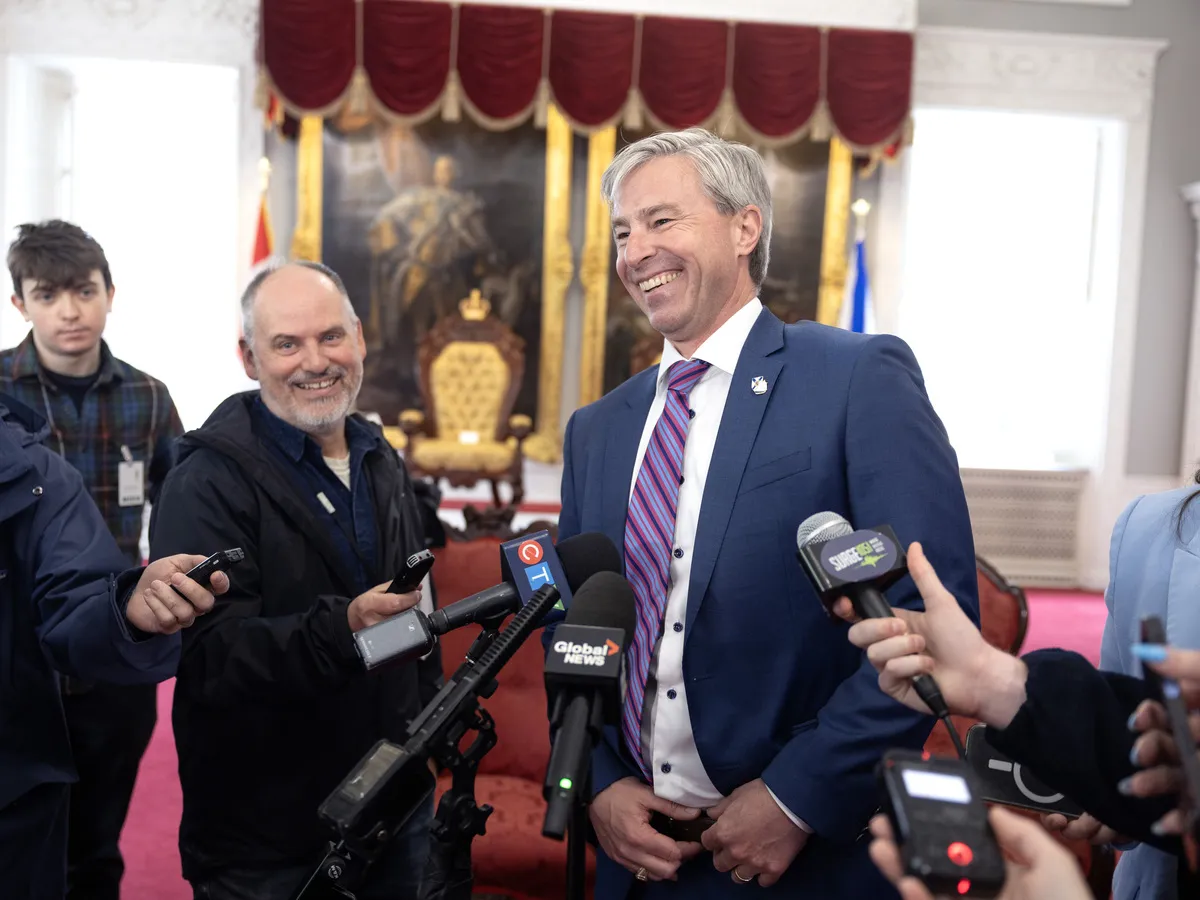
Skip to Content News Archives Economy Energy Oil & Gas Renewables Electric Vehicles Mining Commodities Agriculture Real Estate Mortgages Mortgage Rates Finance Banking Insurance Fintech Cryptocurrency Work Wealth Smart Money Wealth Management Investor Personal Finance Family Finance Retirement Taxes High Net Worth FP Comment Executive Women Puzzmo Newsletters Financial Times Business Essentials More Innovation Information Technology FP500 Podcasts Small Business Lives Told Tails Told Shopping Financial Post Store Obituaries Place a Notice Advertising Advertising With Us Advertising Solutions Postmedia Ad Manager Sponsorship Requests Classifieds Place a Classifieds ad Working Profile Settings My Subscriptions Saved Articles My Offers Newsletters Customer Service FAQ News Economy Energy Mining Real Estate Finance Work Wealth Investor FP Comment Executive Women Puzzmo Newsletters Financial Times Business Essentials HomeFP CommentOpinion: In Nova Scotia, governments are getting mining-friendlierAfter years of stop-go signals federal and provincial officials are now making approvals easier on the groundLast updated 1 hour ago You can save this article by registering for free here. Or sign-in if you have an account.Nova Scotia Premier Tim Houston before taking questions from reporters at Province House on May 27. Photo by Ryan Taplin/The Chronicle Herald filesWe have spent our careers working on resource projects in Nova Scotia and it’s been tough, to put it mildly. Governments of all stripes typically lack commercial instincts and employ government-style processes, and that drives industry (including us) crazy. But the policy environment we are operating in today is markedly different. After years of stop-and-go signals from governments at every level, the alignment between Nova Scotia and Ottawa on natural resource development is real, tangible, and making a measurable difference for companies trying to build things.Subscribe now to read the latest news in your city and across Canada.Exclusive articles from Barbara Shecter, Joe O'Connor, Gabriel Friedman, and others.Daily content from Financial Times, the world's leading global business publication.Unlimited online access to read articles from Financial Post, National Post and 15 news sites across Canada with one account.National Post ePaper, an electronic replica of the print edition to view on any device, share and comment on.Daily puzzles, including the New York Times Crossword.Subscribe now to read the latest news in your city and across Canada.Exclusive articles from Barbara Shecter, Joe O'Connor, Gabriel Friedman and others.Daily content from Financial Times, the world's leading global business publication.Unlimited online access to read articles from Financial Post, National Post and 15 news sites across Canada with one account.National Post ePaper, an electronic replica of the print edition to view on any device, share and comment on.Daily puzzles, including the New York Times Crossword.Create an account or sign in to continue with your reading experience.Access articles from across Canada with one account.Share your thoughts and join the conversation in the comments.Enjoy additional articles per month.Get email updates from your favourite authors.Create an account or sign in to continue with your reading experience.Access articles from across Canada with one accountShare your thoughts and join the conversation in the commentsEnjoy additional articles per monthGet email updates from your favourite authorsSign In or Create an AccountorThat’s worth saying plainly, because most days the headlines do not.Get the latest headlines, breaking news and columns.By signing up you consent to receive the above newsletter from Postmedia Network Inc.A welcome email is on its way. If you don't see it, please check your junk folder.The next issue of Top Stories will soon be in your inbox.We encountered an issue signing you up. Please try againStart with the provincial government headed by Premier Tim Houston. In a remarkably short period, the premier has repositioned Nova Scotia as arguably the most attractive natural resource jurisdiction in the country. Resource development is not just one priority among many in his second term. It is the priority, written into the letters he handed his cabinet ministers and reflected in nearly every major file since. An example? We took on a brownfields mining project in Cape Breton in 2012 that is still not fully operational. But we’ve had more support in the past two years than the preceding dozen.Advancing a project used to require clearing serial permit hurdles one after the other, which routinely took four to six years. Today those same permit approvals can proceed in parallel. No environmental checks have been removed but the co-ordination has changed, materially shortening the timeline.Last year the province launched a critical and strategic minerals strategy that named the commodities it wants to support, including aggregate — the unglamorous but essential rock that builds roads, bridges, buildings and the foundations for offshore wind. It also lifted the long-standing ban on uranium exploration, which matters less for any single deposit than for signalling that Nova Scotia is again open for mining investment. It enabled onshore natural gas development for the first time in over a decade and it established a 10-member “large industrial file team” inside the Department of Environment and Climate Change to accelerate approvals for major projects, because timelines matter as much as policy.The premier himself has shown up — at a major mining conference in Toronto and on several trips to Texas — pitching Nova Scotia to investors who actually move capital.Ottawa is now at the table, too. In March, the federal government committed to making Canada the fastest mining permitting jurisdiction in the G20, with its new Major Projects Office targeting two-year timelines from referral to production-ready decision. That office is already co-ordinating a slate of mining projects valued at over $116 billion, and Ottawa has launched a $1.5-billion fund for infrastructure that connects mines to markets. Though we ourselves haven’t yet seen evidence of these measures on the ground, in view of the other good things going on we’re optimistic.On environmental assessments, Canada and Nova Scotia are taking a “one-project, one-review” approach. Though unglamorous such co-ordination shortens the path for proponents. The tone we encounter with federal agencies today is genuinely encouraging — constructive, responsive and focused on moving good projects forward.The offshore tells the same story. Last month, the Canada-Nova Scotia Offshore Energy Regulator approved a bid on two offshore oil and natural gas exploration parcels — the first meaningful step back into the offshore in years. Later this year, it will open a call-for-bids offering licences for up to five gigawatts of offshore wind through the nation-building Wind West project. In March, Hydro-Québec launched a formal assessment of the transmission potential of Nova Scotia’s offshore wind energy. These are not announcements about announcements. They are real steps by serious counterparties on real timelines.None of this guarantees any individual project succeeds. Building anything is still hard, and it should be. The bars for environmental performance, impact mitigation, Indigenous partnership, and community benefit are higher than they have ever been, and rightly so. But for the first time in a long time, the system is better set up to help good projects clear such bars rather than wear them down on the way.Like many Canadians, the two of us have regularly used a pejorative expression — moving at the speed of government. Now, for the first time in a long time, the push is on. Nova Scotia is leading the way, and that deserves to be said out loud.Dawson Brisco is president and CEO and John Budreski executive chairman of Morien Resources Corp., a Halifax-based resource development company. This is a summary of their presentation to Morien’s AGM last month. Join the Conversation This website uses cookies to personalize your content (including ads), and allows us to analyze our traffic. Read more about cookies here. By continuing to use our site, you agree to our Terms of Use and Privacy Policy.
Opinion: In Nova Scotia, governments are getting mining-friendlier
After years of stop-go signals federal and provincial officials are now making mining approvals easier in Nova Scotia. Read more.
TL;DRAI
Nova Scotia and Ottawa are cutting mining approval timelines from 4-6 years to 2 years for critical minerals and uranium permitting. Faster permitting improves supply chain stability for tech companies, reducing North American sourcing risk for critical materials.
1,263 words~6 min read