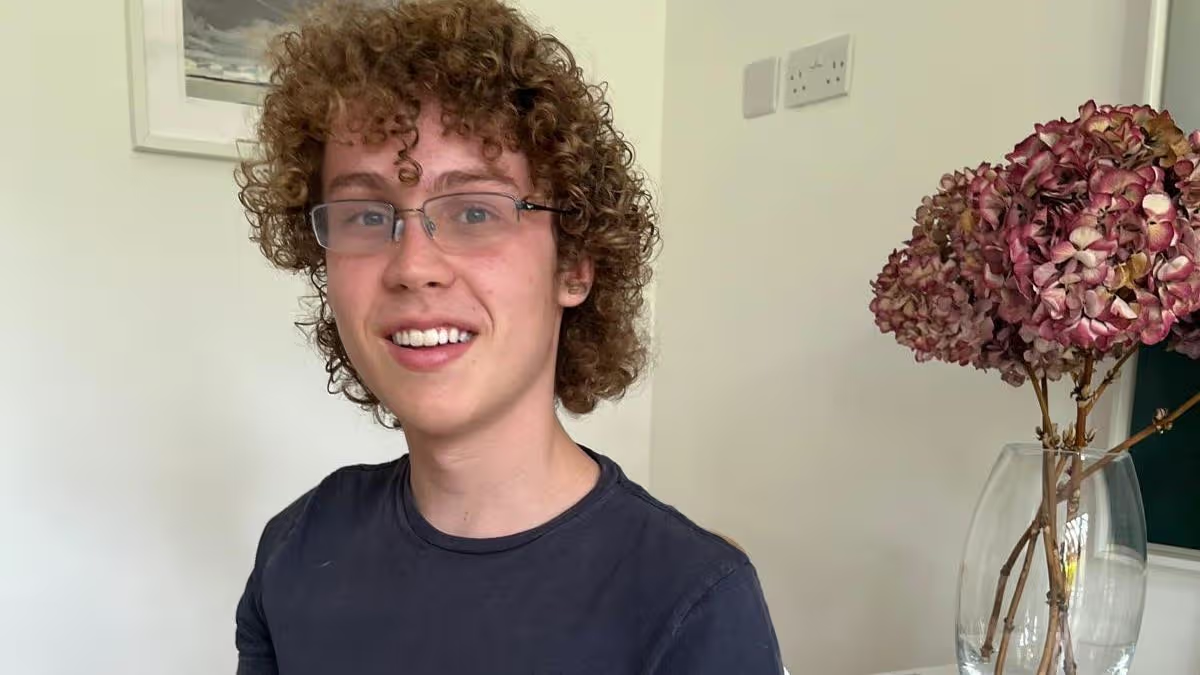
EXCLUSIVE: Patrick Leonard, 18, died of a catastrophic epileptic fit before his organs went to save the life of three other patients13:16, 02 Jun 2026Updated 13:35, 02 Jun 2026A teenager donated his organs to save three other people following a catastrophic epileptic fit.Patrick Leonard, 18, was inspired by his headteacher - who told a school assembly how he had had become a bone marrow and stem cell donor with the charity Anthony Nolan - to pledge his organs in the event of his death. He was so moved he told his family he wanted to help others in the event of his death.Tragedy struck on August 26 last year when Patrick had a catastrophic seizure and was left brain dead in hospital. Three people on the transplant list were saved by his actions - his lungs went to a man in his 20s and both kidneys to a man in his 40s and a woman in her 50s.Speaking after his son's inquest, grieving dad Christopher, 55, said: “We couldn’t be more proud of him. When we learned Patrick was not going to survive, making a decision for him to become an organ donor was easy to make in such tragic circumstances. Knowing his wishes was incredibly comforting."We know many people have now had these same conversations and that’s wonderful. Via the organ donation services, we received a thank you letter from one recipient describing a life that they had not thought possible without an organ donor. It’s a very precious letter to us.”During the autumn of 2023 Patrick had attended a school assembly where Peter Martin, the head of sixth form at Heathside School in Weybridge, Surrey, spoke about how he had become a bone marrow and stem cell donor with the charity Anthony Nolan.Mr Martin had been a perfect match for a five-year-old boy with an autoimmune disease and donated, saving the little boy's life. Patrick was inspired and signed up. He too was a match for someone, but wasn't allowed to donate because he had suffered a recent epileptic seizure.Patrick had not developed epilepsy until 2024. Around the same time he began to suffer from depression, which was out of character for him and which his family are now convinced was an early symptom of his epilepsy. He was studying A-levels in physics, maths, advanced maths and computer science and loving sixth form at Heathside School in his home of Weybridge.His first seizure came out of the blue that October. He was rushed to hospital and came round after 24 hours with no memory of what had happened. The NHS suspected a seizure and booked him in to see a neurologist but the wait was long so the Leonards took him to see a private expert thanks to a work insurance scheme.Epilepsy was diagnosed and he began medication that Christmas. The NHS and private neurologists worked incredibly hard to stabilise the condition. Incredibly, after he began medication his depression also seemed to lift. But Patrick continued to have seizures, some small, some larger.His condition meant he missed a lot of school and was completing his A-levels via an online provider. “He took these changes very well and always reminded others that he considered himself lucky to have everything he did,” Chris, 55, said.In August 2025, Patrick had an appointment with an NHS neurologist who outlined the risk of SUDEP - Sudden Unexpected Death in Epilepsy, a standard procedure at such appointments. Epilepsy affects around 600,000 people in Britain. About one in 1,000 die annually from the condition."We never focused on the idea it could be fatal,” Chris, a chief people officer, admitted. “We wanted him to live a full life and have fun with his friends. He took his medications as prescribed and followed all the guidance.”Patrick's mother, Hermione, 52, would check on him intermittently at home to make sure he was OK. Every morning she would send him a good morning text showing his dog - his favourite animal. On August 26 last year Patrick didn't reply.His mother ran up to his room and saw he was fitting and had been repeatedly sick. She put him in the recovery position but he didn't come around in the usual time. An ambulance was called and Patrick was rushed to St Peter's Hospital in Chertsey, but doctors quickly realised that the teen had suffered catastrophic brain damage and would never recover.Chris explained: “The doctors were amazing, they sat down with us and they were polite, direct and informative but we quickly realised it was exceptionally serious. A day later we were told his brain had started to swell. That’s when we were told he wasn’t going to make it.“We accepted the situation very quickly. We knew it wasn’t going to be easy but we knew he’d be fulfilled and humbled to have donated. In the circumstances I don’t think he could have predicted a better outcome in the context of such a sad event. He was such a generous person - he would have given everything away.”Chris, Hermione and Patrick’s younger sister Darcy, now 18, say that knowing Patrick had been so keen to help others has been a great comfort to them as they grieve his loss. By raising awareness of Patrick’s story, over £27,000 was raised for the Anthony Nolan Trust, something he would have been truly happy to have seen.SUDEP accounts for 7% to 17% of epilepsy-related deaths overall. Sammy Ashby, CEO of charity SUDEP Action, said families were often not aware that epilepsy could be fatal - or that depression was linked.She said: “We know there is a clear link between epilepsy and depression – though it’s not clear whether having epilepsy means you are more pre-disposed to having depression, or if it is more a consequence of living with epilepsy on a daily basis. For a long time, it was suggested that SUDEP was more prevalent in adults than children, but a 2023 research study showed that wasn’t the case and rates were generally comparable.“SUDEP is thought to be the highest cause of epilepsy-related death for both children and adults, but often affects young people.” An inquest into Patrick’s death at Surrey Coroner’s Court last month found that he died from SUDEP due to his Temporal Lobe Epilepsy.Article continues belowThe Mirror campaigned for the introduction of Max and Keira’s Law, an opt-out organ donation law, that was finally rolled in May 2020. The ground-breaking law assumes that people will donate their organs unless they opt-out, giving hope of new life to millions who need organ transplants. The organ law was named after Max Johnson who received a heart from nine-year-old Keira Bell, who died in 2017.
Epileptic teen donated his organs to save three other people
EXCLUSIVE: Patrick Leonard, 18, died of a catastrophic epileptic fit before his organs went to save the life of three other patients
1,112 words~5 min read