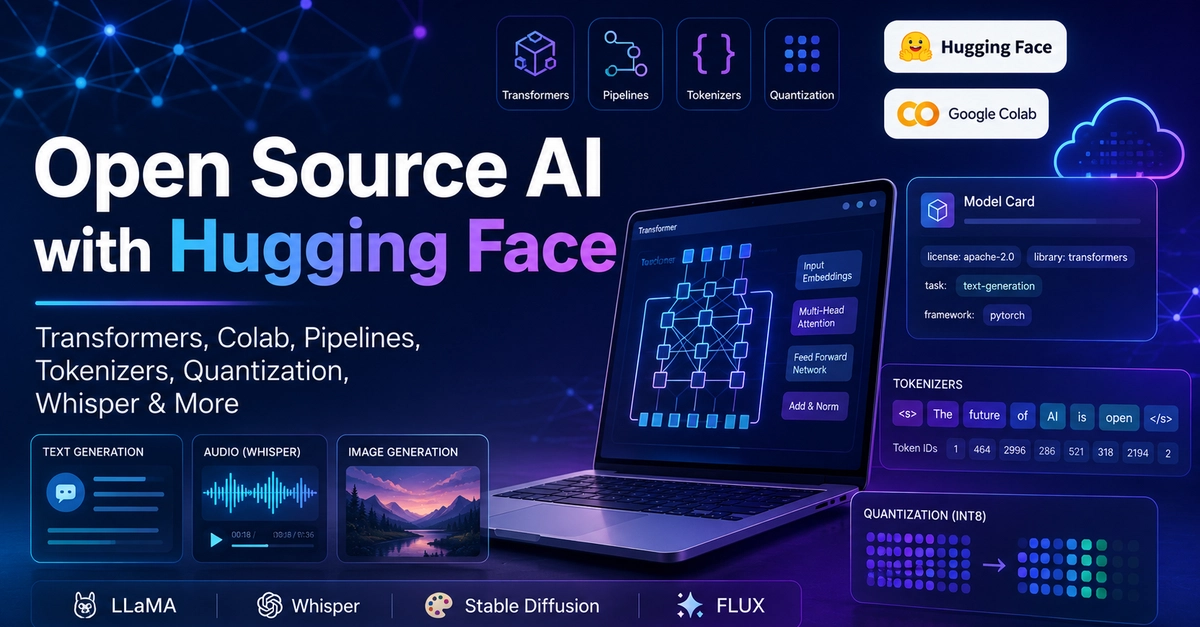
Open-source AI has made it much easier for developers to experiment with powerful models without building everything from scratch.
Today, we have access to platforms, libraries, and tools that allow us to run text models, audio models, image-generation models, and even large language models with just a few lines of code. One of the biggest names in this ecosystem is Hugging Face.
Hugging Face has become a central place for working with open-source AI models, datasets, and applications. But to use it properly, it is important to understand the ecosystem around it — models, datasets, pipelines, tokenizers, transformers, quantization, and tools like Google Colab.
This blog gives a simple overview of these concepts and how they fit together.
What is Hugging Face?