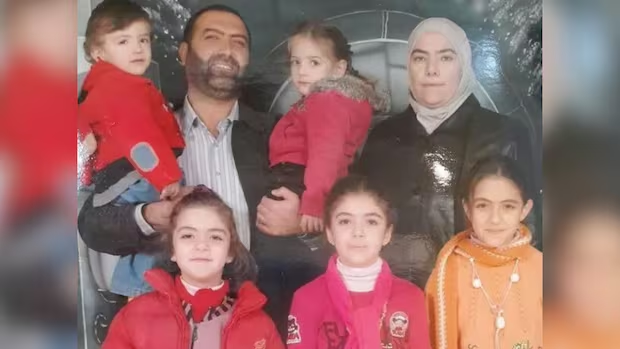
For years, the family of Rania Al-Abbasi has been searching for answers on the fate of her six children, who were detained along with Rania and her husband, Abdul Rahman Yasin, in 2013 by Syria's former Assad regime and thrust into its vast network of prisons.Rania's siblings, haunted by the forced disappearance of the family of eight, say they received video from authorities involved in investigating missing Syrians that appears to show the six children dead just days after they were taken."They turned out to be our children," Rania's brother Hassan Al-Abbasi, said in a video posted online on Saturday. "What we were waiting for, to reunite with [them], to see them ... and at last, we saw them. We saw their features. But they [turned out to be] among the martyrs." Rania, 43, a dentist and former national chess champion, had five daughters and one son: Dima, 13; Entisar, 12; Najah, 11; Alaa, 8; Ahmed, 6; and Layan, 1. Syria's Interior Ministry said investigations conducted with "a number of detainees" revealed evidence indicating that the children were killed "at the hands of groups and militias affiliated with the defunct regime." Rania Al-Abbasi is seen with her husband, Abdul Rahman Yasin, and five of their six children. Her brother Hassan Al-Abbasi said on Saturday that her six children are believed to be dead, after his family verified video of the siblings more than 13 years after they were taken. (Submitted by Hassan Al-Abbasi)After Syria's government was overthrown in December 2024, dictator Bashar al-Assad, whose family ruled Syria for 53, years fled to Russia. The Assad regime's grim legacy was marked by large-scale detention, torture, enforced disappearance and killing of tens of thousands of Syrians, according to widely circulated leaked reports — practices that intensified dramatically after the 2011 uprising against the government but had been widely used for decades beforehand. The Interior Ministry said preliminary findings unveiled that Amjad Yousef — a former intelligence officer who appeared in a leaked video that purportedly showed him and other gunmen fatally shooting dozens of people in the notorious 2013 Tadamon massacre — was involved in the children's deaths.Yousef had been arrested by security forces in April in connection to his alleged role in the 2013 massacre.The Assad regime detained these 6 Syrian children with their parents in 2013. Where are they now?Syrian authorities arrest suspected leader of notorious Tadamon massacreRania's brother Hassan Al-Abbasi said the children were clearly identifiable in the video recordings linked to Yousef and were wearing the clothes they were last seen in. He said most of the children looked like they were peacefully sleeping except for Dima and Najah, who had visible bruises."I was in shock," said Al-Abbasi, who lives in Ottawa. Al-Abbasi described one of the videos, allegedly recorded by Yousef. In it, he says you could see a dark room as a phone camera is held up and pans to the face of each of the six siblings in the room. The man speaking in the video says it is recorded on March 11, 2013, and he is allegedly heard paying respect to his brother, a Syrian soldier killed in early 2013, according to state news agency reports. He is also allegedly heard saying that the bodies seen on video are children of "major financiers of terrorism." CBC News has not been able to independently verify the footage, which authorities say will not be publicly published.Residents gather in a street after Friday prayers in Tadamon, Syria on April 24 to celebrate the arrest of Amjad Yousef, accused of leading the 2013 Tadamon massacre, which killed hundreds of people. (Khalil Ashawi/Reuters)Ongoing efforts to find remainsIn March 2013, Rania's husband, Abdul Rahman Yasin, was taken by intelligence officers when they raided their home, her brother previously told CBC News. Two days later, Rania was detained along with her children and Rania's secretary Majdoline Al-Qady, who was with them at the time. Her fate also remains unknown.The couple were accused of providing humanitarian help to those in need during the Syrian revolution, which erupted in March 2011. Hassan Al-Abbasi says he was also involved in assisting Syrians in support of the revolution while he was abroad, which security forces were made aware of. Al-Abbasi has demanded information on his sister and her family's whereabouts for years and says he was led astray by what he believes was both intentional misinformation and dead ends from orphanages and former detainees. He made appeals to those involved in the former regime's operations to give him any information, hoping to be reunited with the family members.He told CBC in 2025 that the family believes his brother-in-law was tortured and killed roughly a month after he was detained and was part of the smuggled "Caesar" photos documenting the torture and brutal deaths in Assad's prisons, but his remains are also unknown.Syria's National Commission for Missing Persons, which was formed last year by the new government to investigate missing and forcibly disappeared people, said it reached a "high degree of professional certainty" that the six children are dead, after reviewing cross-referenced data and information with national authorities.In January, the Syrian Network for Human Rights called for an 'immediate and comprehensive' investigation into the organizations that received dozens of children from the Assad regime’s security agencies and stripped them of their identities. (Syrian Network for Human Rights)In a news release on Saturday, the commission said its findings were based on "multiple verification and analysis procedures." It noted that efforts to find the remains are ongoing.The commission said it will not publish any images or details of the children to protect the dignity of the children and not cause further harm to the victims or their families."The National Commission for Missing Persons extends its deepest condolences to the family members affected by these findings, and affirms its commitment to continuing to fulfill its responsibilities towards all families of missing persons in Syria," the release said.'Systematic criminal pattern'Rania's case quickly became one of the most prominent within Syria, after it received widespread international attention from humanitarian organizations including Amnesty International and news coverage, casting a grim light on the disappearance of entire families under Assad's brutal rule. Thousands of other families have yet to know their loved ones' fate."Rania has become a part of the memories of Syrians. Every story is just as upsetting as Rania's story if not more painful," her brother said.Her fate remains unknown, her brother said, along with that of hundreds of thousands of other detainees in Assad's prisons. Mass graves were uncovered after the fall of the Assad regime, but authorities have said it could take years to identify the remains.WATCH | Torture, killings documented under fallen regime:Leaked files expose torture, killing of detainees in SyriaDecember 5, 2025|Duration 2:11Leaked files from Syria’s former regime under dictator Bashar al-Assad reveal new details about the torture and killings of more than 10,000 detainees during the country’s 13-year civil war. The 134,000 Syrian security and intelligence records were obtained by German public broadcaster NDR and shared with the International Consortium of Investigative Journalists (ICIJ) and its global network of media partners, including CBC News.
6 siblings missing since 2013 were killed by Assad regime, authorities say | CBC News
The family of Rania Al-Abbasi and Syrian authorities say that investigations have unveiled that her six children, who were detained along with Rania and her husband in 2013 by Syria's former Assad regime, are believed to be dead.
1,386 words~6 min read