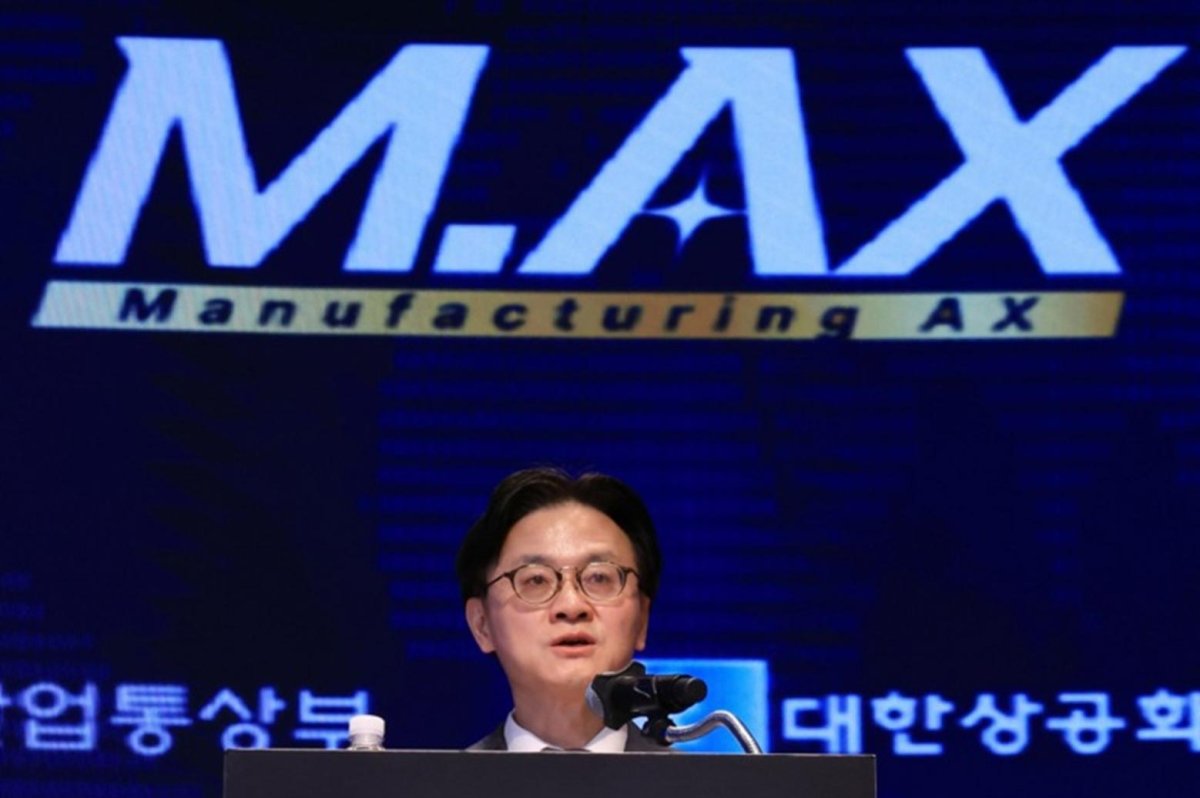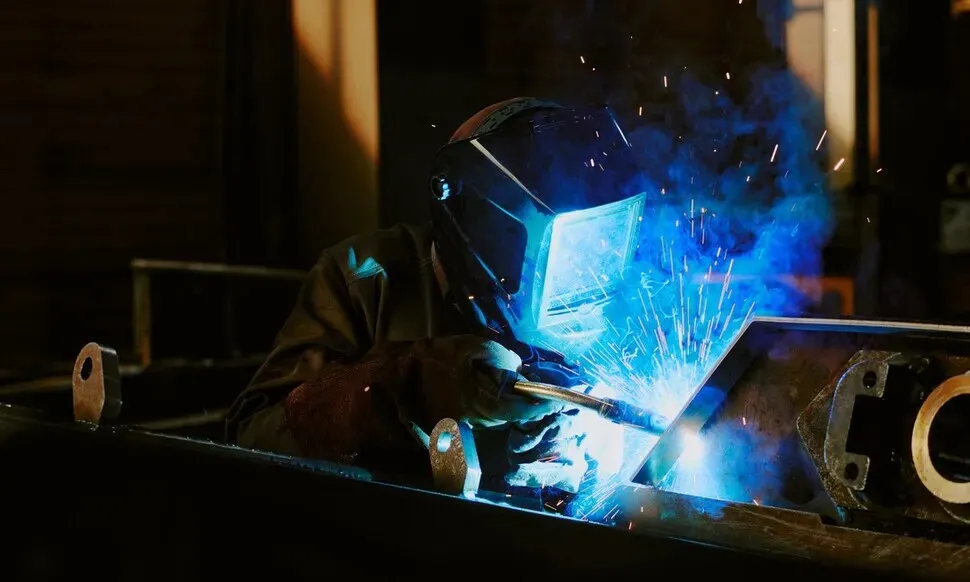
A skilled worker performs manual arc welding. (Getty Images Bank)
Lee Yeong-jin, a 58-year-old oxygen blower, is one of 29 master craftspeople selected by POSCO to pass on their skills to the next generation of steel refiners.“We used to rely on our five senses to judge more than 70 subtle indicators, including the pitch of molten metal sloshing around in the converter, the angle of the flames, and even minute temperature changes inside the workspace," the craftsman recalled.Lee’s job is to blow oxygen into molten metal flowing out of the furnace to remove impurities and adjust the steel’s qualities to match its intended use. In short, it’s one of the essential jobs at a steel mill.Lee and others in his position are expected to recognize the exact temperature of the fire, which often runs as high as 1,600-1,700 degrees Celsius. They also have to determine how much oxygen to blow, and how long, based on the color, sound and temperature of the molten metal and the shape of the flames.“Techniques can be taught with a manual, but it takes a long time to refine the ability to intuitively gauge the state of the molten metal,” Lee told the Hankyoreh.“Younger workers sometimes struggle with how long it can take to accumulate that knowledge. I think that having those workers observe the work, as if they were in patient dialogue with the molten metal, is more important than ever. That’s how we instill craftsmanship that goes beyond techniques,” he said.Since the 2010s, POSCO has worked continuously on its smart factory platform, which blends technology together with the experience, intuition and knowledge of skilled workers who know the field like the back of their hands. “We have been conducting deep learning to digitize the key variables determining the condition of the converter and to replicate the know-how of skilled workers with over 30 years of experience to achieve optimal results,” an official from POSCO said. Now, the five senses of master craftspeople like Kim have been transformed into a one-touch converter operation automation system that executes the optimal process with a simple press of a button. This process has ensured that the quality variations evident in the work done by individuals are essentially nonexistent. South Korea is a manufacturing powerhouse, where manufacturing represents the second-highest proportion of GDP among OECD members. By establishing itself as a key player in global supply chains, South Korea has built up the resilience to weather the US-China trade war and recurring geopolitical crises. Powering that industry are a class of master craftspeople, like those found at POSCO, who make world-class products with their tacit knowledge — instincts that have been ingrained in their bodies through decades of experience. As AI increasingly replaces or assists workers in offices and production facilities, the tacit knowledge needed for this sort of manufacturing — knowledge that cannot be easily seen or heard — still belongs to humans. But South Korea’s second generation of baby boomers, born between 1964 and 1974 and who make up the backbone of the country’s manufacturing competitiveness, are now beginning to reach retirement age. Conglomerates have long pondered how best to preserve and pass on workers’ tacit knowledge — knowledge that cannot be fully captured in words or manuals but lies at the heart of their competitiveness. However, many small and medium-sized manufacturers cannot afford to anticipate what will happen when their seasoned workers hit retirement age over the next few years. This is why the government has defined tacit manufacturing knowledge, acquired through hands-on experience, as a “national core asset” and has launched efforts to preserve it. The Ministry of Trade, Industry and Resources began a project in April to develop AI models based on tacit knowledge. “Tacit knowledge in the manufacturing field, which includes tips on the process, judgment criteria, and sensory know-how of master craftspeople that cannot be quantified, is at risk of being lost or forgotten when these workers retire, as it is difficult for such information to be passed on,” the ministry said. This ambitious plan focuses on securing unstructured data containing the tacit knowledge of skilled workers in key manufacturing sectors, including automotives, shipbuilding, steel, machinery, electronics (including semiconductors and displays), bio-based chemicals, defense, textiles, and what’s known locally as the “root” industry (casting, molding, welding, surface treatment). Small to medium-sized enterprises that are at risk of losing access to tacit knowledge are the main targets of the project. The Trade Ministry stated the goal of the project was to “accelerate the AI transformation in the manufacturing sector by utilizing tacit manufacturing knowledge embodying the experience, intuition and judgment of master craftspeople.” Approximately 30 projects will be selected, with each project provided with 1.6 billion won (US$1.05 million) in funding. Digitizing labor that relies on subtle intuition and deft, sensitive hands is no easy task.The Korea Planning & Evaluation Institute of Industrial Technology (KEIT) will be in charge of reviewing and evaluating the project of capturing tacit knowledge in manufacturing. The biggest challenge lies in how to acquire unstructured data — movements, sounds, vibrations, and judgment calls — that is difficult to quantify and how to use it to train AI. The tacit knowledge of skilled workers exists in contexts of data that are challenging to verbalize. Various types of data (multimodal data), such as relevant videos, audio, and images, must be extracted and refined in a time-series format.“There are various data formats that suit the tacit knowledge from each sector,” explained Jin Jong-cheol, the head of the KEIT’s department of manufacturing AI transformation diffusion policy. For example, when it comes to the “root” industry, molding and surface treatment rely heavily on the sensitivity of one’s fingertips. It is an instinct tied to external factors such as the weather and humidity. Among engineers, some identify problems on the automotive production lines by vibrations and sounds that are generated there. In shipbuilding factories near the sea, humidity levels soar whenever it rains, causing air bubbles to form within the welds, leading to poor weld quality. Skilled workers take this into consideration and use more filler metal than they would use on a sunny day. “Relevant data includes the weather, temperature, humidity, sounds, and the physical properties of the welding rods. On top of all that, it is also possible to quantify the process and results of how a worker strayed from their usual process into a format that can be utilized by artificial intelligence. Through this, we can compare and verify how closely the results match when an unskilled worker performs the same task based on the ‘judgment’ of an AI model trained on a master craftsperson’s tacit knowledge,” Jin said.