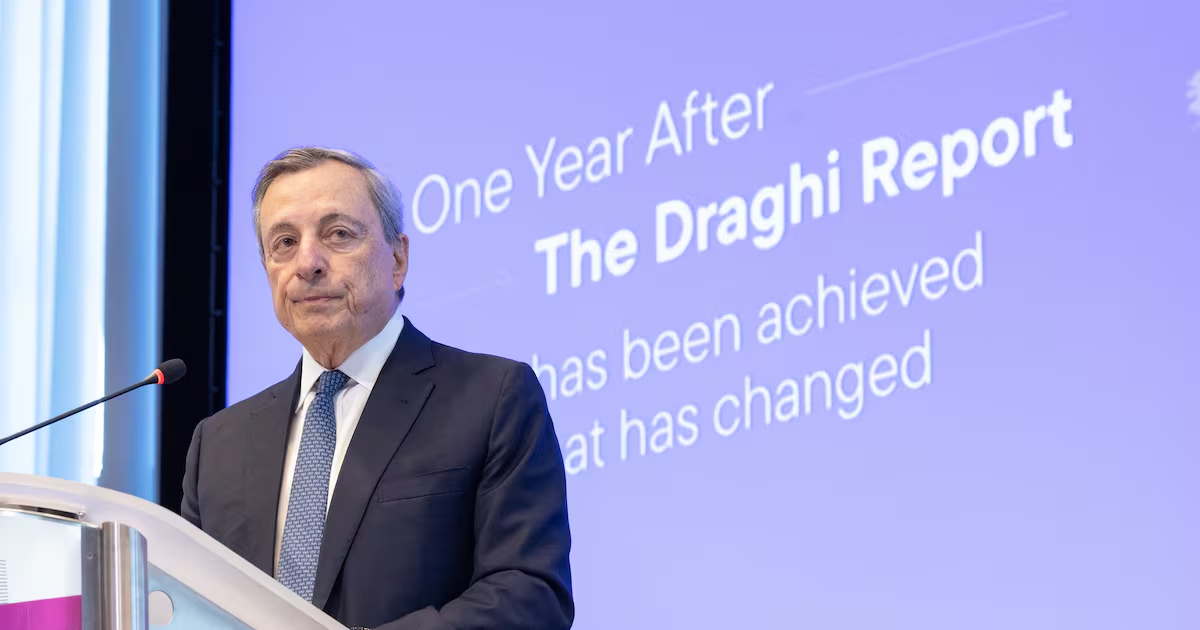
Europe is asking itself a familiar but increasingly urgent question as to how to restore competitiveness in an increasingly contested global economy.It is a timely debate. Europe faces mounting challenges – from funding the green and digital transitions, to supporting housing, infrastructure and innovation, and defending its place in a more fragmented world. All these ambitions have one thing in common, which is they require substantial, sustained investment. Mario Draghi’s report on European competitiveness calls for a massive increase in investment – about €750 billion to €800 billion in additional annual capital to address low productivity, the digital transition and the green energy shift. Public finances cannot do this alone, nor can private capital. Retail investors remain relatively risk‑averse and increasingly look for growth opportunities outside Europe. The Savings and Investment Union is an important structural reform, but it is a long-term solution and will not address the challenge in the near term.Yet for all the attention given to industrial policy and capital markets, one reality remains unchanged: Europe is, and will remain for the foreseeable future, a bank‑based economy. Banks still provide the overwhelming majority of finance to households and businesses. If we want investment to flow then we must ensure the banking framework allows that to happen efficiently and responsibly.[ EU economy falls behind global rivals due to ‘complacency’, warns Mario Draghi ]That is why Banking & Payments Federation Ireland recently responded to the European Commission’s consultation on the competitiveness of the EU banking sector, setting out a clear and constructive case for targeted reform. Our message is simple and it is not a call for deregulation, but for better regulation.European and Irish banks today are fundamentally different institutions from those that existed before the financial crisis. They are strongly capitalised, highly liquid and subject to far more rigorous supervision. Underwriting standards, risk governance and consumer protections have all improved materially. In short, the system is safer.However, the regulatory response to the crisis – layered on year after year – has created a framework that is now overly complex, fragmented in its application and increasingly capital‑intensive. The cumulative effect is that capital, which could otherwise support lending and investment, is instead absorbed by overlapping buffers, duplicative requirements and divergent supervisory interpretations.This matters because there is a direct relationship between lending, investment and growth. Every euro of capital locked unnecessarily on bank balance sheets is a euro not available to finance a new home, a business expansion or a renewable energy project. At a time when Europe urgently needs to mobilise private investment, that is a problem we cannot ignore.The policy focus must therefore shift towards simplification, proportionality and deeper integration.First, the regulatory framework itself needs streamlining. The interaction between different capital requirements imposed by rules agreed at the Basel level, supervisory judgment and multiple macroprudential buffers has become increasingly opaque. Different tools often address the same risks. Simplifying the capital stack and reducing excessive reliance on detailed secondary legislation would improve transparency, predictability and lending capacity without weakening financial stability.Second, capital requirements should more accurately reflect underlying risk. In several areas, including mortgage lending, banks already operate under strict loan‑to‑value and loan‑to‑income limits that materially reduce risk. Yet capital rules remain heavily backward‑looking and do not sufficiently recognise these safeguards. Updating calibrations to reflect today’s risk profile and aligning with approaches taken in other major jurisdictions would support lending where it is demonstrably prudent.Third, we must embed genuine proportionality. Despite repeated commitments, smaller and less complex banks face regulatory and reporting burdens designed for larger institutions. A simplified EU‑wide regime for low‑risk banks would bolster competition, diversity and resilience across the financial system.Fourth, Europe needs to complete the Banking Union. Capital and liquidity are still too often trapped within national borders, limiting banks’ ability to operate efficiently across the single market. Reducing national discretions and promoting supervisory convergence would unlock scale, support cross‑border activity and strengthen Europe’s financial sovereignty.Finally, competitiveness requires a level playing field – within the EU and globally. Gold‑plating of EU rules, divergent implementation of international standards, sector‑specific taxes and domestic remuneration restrictions all undermine Europe’s ability to attract capital and talent. None of these issues enhances financial stability, but all weaken competitiveness.None of this diminishes the importance of strong prudential standards. Financial stability remains non‑negotiable. But stability and growth are not opposing goals. A well‑regulated banking system should be an enabler of economic progress, not a constraint upon it.As the European Commission prepares its competitiveness roadmap, there is a real opportunity to modernise the banking framework, so that it reflects today’s realities rather than yesterday’s crises. Europe needs banks that are safe, certainly – but it also needs banks that can lend, invest and support long‑term prosperity.Getting that balance right will be critical to Europe’s economic future. Europe is a bank‑financed economy and will remain so for years to come. Without European banks stepping up, progress will simply not happen.Brian Hayes is CEO of Banking & Payments Federation Ireland
Brian Hayes: Banks need smarter regulation to boost Europe’s competitiveness
European and Irish banks today are fundamentally different institutions from those that existed before the financial crisis
TL;DRAI
Simplify EU banking rules to unlock €750B (Draghi target) without weakening safety; overlapping requirements currently trap growth capital. Tech implication: streamlined rules redirect bank capital to digital transformation and innovation—essential for Europe's competitiveness.
825 words~4 min read