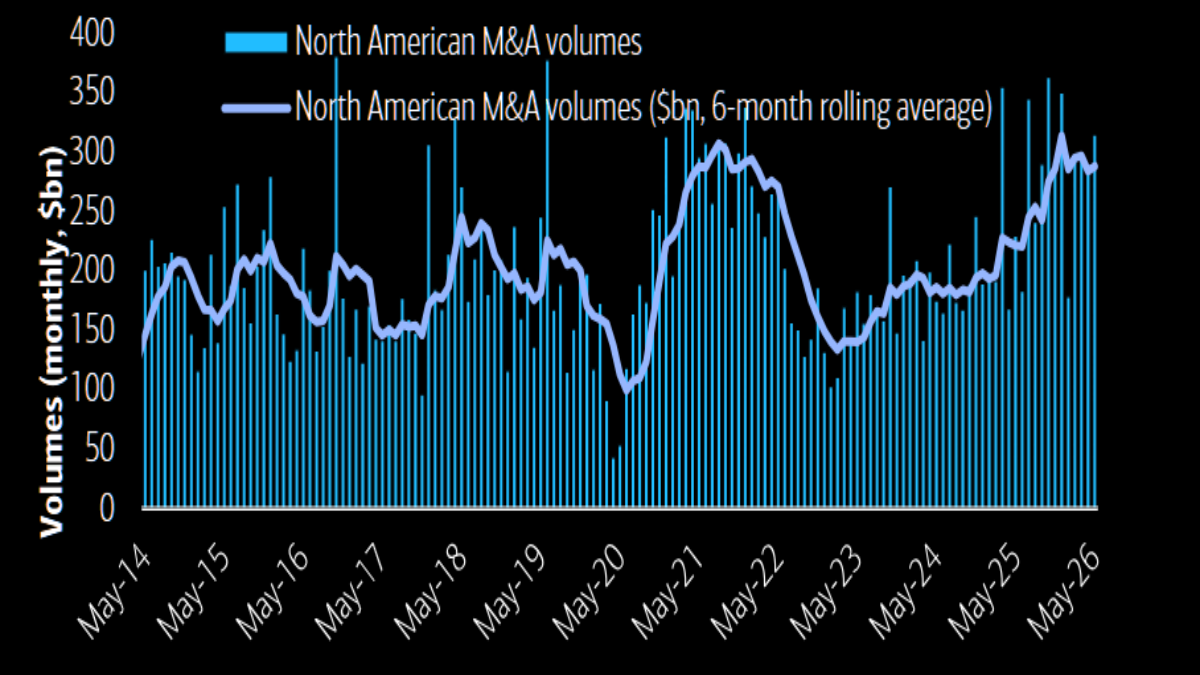
M&A deals are up, both in terms of numbers and valuations. Deals with a value of more than $100 million were up 15% February through April of this year compared to the same period in 2025, according to a report from EY Parthenon. And while easier access to capital and shifting economic conditions can make this a good time to strike a deal, there’s another factor that makes dealmaking smoother: AI. The technology can help with due diligence and integration, compressing what was once a long process into one that customers might not notice.Scott Brighton, CEO of software-for-good platform Bonterra, has worked on several acquisitions throughout his career—and he said AI is changing them for the better. Bonterra has been able to more quickly integrate its two most recent acquisitions: digital fundraising solution provider OneCause last October and workplace giving platform Deed in March. I talked to him about how AI has helped in this process, and an excerpt from our conversation is later in this newsletter.Until next time.This is the published version of Forbes’ CEO newsletter, which offers the latest news for today’s and tomorrow’s business leaders and decision makers. Click here to get it delivered to your inbox every week.Economic IndicatorsgettyLooking at corporate profits alone, these are boom times. In the last quarter, corporate profit hit a new record of $4.39 trillion, writes Forbes senior contributor Erik Sherman. Corporate profits have skyrocketed—especially since the Covid-19 pandemic—and keep on increasing. And it isn’t just the tech sector—retail trade, construction, wholesale trades, durable goods manufacturing and healthcare are responsible for 73% of the post-pandemic corporate profit surge. Most of that money—76%—has gone toward shareholder dividends, but 15% represented retained profits.Companies can increase their profits by passing along higher costs to consumers, and today’s consumers are feeling more and more strain. Forbes senior contributor Mayra Rodriguez Valladares writes overall, Americans are spending more to buy less, and getting into more precarious financial positions. Credit card balances stand at $1.25 trillion—up 63% from five years ago—and nearly three out of 10 buy now, pay later users say they’re using that financing to buy groceries. The personal saving rate is down to 2.6%—down from close to 5% in January. As AI use expands, the way we measure business success could hide consumer pain. Forbes’ Brandon Kochkodin writes as AI allows companies to potentially do the same work with fewer people, unemployment could increase—and businesses do even better. Economists say that at the very least, this means people need to stop thinking about economic conditions through textbook-era models. And yes, AI could bring both high corporate profits and high unemployment—but it could also have a similar type of impact on profits and jobs as other technological revolutions, including automated manufacturing, computers in the workplace and the internet.From The HeadlinesLululemon’s founder, largest shareholder and biggest critic Chip Wilson has won a round of his public bout with the company he started. The athleisure retailer reached a cooperation agreement with Wilson, adding two of his candidates to its board and silencing Wilson’s public criticism of the company for 18 months, writes Forbes senior contributor Pamela Danziger. The company will appoint another board member with apparel product and brand expertise by October.The agreement ends a bitter and public fight between the company, in which Wilson currently has no direct involvement, and its founder. Wilson has consistently railed against the company—resulting in the hire of Heidi O’Neill as its new CEO this spring—and presented a five-point plan to fix the company last month, Danziger wrote. Since the beginning of 2026, the brand’s stock is down almost 38%.BP also saw some board changes last week, removing chairman Albert Manifold eight months into his tenure. According to a statement from the board, there were “serious concerns” related to “governance standards, oversight and conduct.” Manifold, a longtime executive, reportedly told people he had the experience and outsiders’ perspective to shake things up at the oil company, the Wall Street Journal reported. He reportedly clashed with several at the company over his scrutiny of company expenses—including chauffeurs, private jets and Wimbledon tickets—and with a nonexecutive director over sensitive communication about a deal.Tomorrow’s TrendsHow AI Improves Acquisition IntegrationBonterra CEO Scott Brighton.McLendon PhotographyBonterra provides a wide range of software to connect and manage nonprofit organizations, volunteers, foundations and socially responsible corporations. It was founded in 2021 through the merger of four software companies focused on enterprise management for social good, and has continued to grow through acquisitions, most recently buying digital fundraising solution provider OneCause last October and workplace giving platform Deed in March.CEO Scott Brighton has deep experience in technology, serving as CEO of companies Aurea Software and Artemis International before joining Bonterra. I spoke to him about one way he’s putting that expertise to good use at Bonterra: Using AI to help with M&A and post-purchase integration. A more technical side of this conversation was featured in the Forbes CIO newsletter. This conversation has been edited for length, clarity and continuity. What does Bonterra do in terms of technology integration, and how is it different from the processes involving people? Brighton: In my prior company, we did 20-plus different acquisitions over the course of a decade, and the process was always the same. It was 12 to 18 months of integration with the long pole in that tent being the back office systems and the software product itself, getting that moved over into your deployment methodology, and putting in place all the appropriate integrations. There was a ton of planning and understanding the code base, such that for a year, customers wouldn’t see much innovation because we were doing so much work on raw integration. I used to be very transparent with customers: Things are going to slow down for a period of time while we focus on that. That’s changing rapidly with these last couple of acquisitions, because the pace at which AI is enabling us to understand the code base and pinpoint the elements of focus, we’re able to work on integration at the same time we’re continuing to ship code. From a core product standpoint, customers are feeling the impact of integration much less. On the people side, that hasn’t changed. It is still very much you’ve got to sell the incoming employees on the bigger collective vision. You have to understand their culture and make sure that you’re not eradicating it. You’re sustaining the most important parts of it. You’re making sure you’re retaining the critical folks, you’re dealing with all of their [issues]. Lots of things are changing for them: their benefits and work policies may be changing, and managing them through all that. That continues to be an entirely human experience.As somebody who has overseen many acquisitions in your career, how smooth are acquisitions now with the advent of AI compared to the acquisitions of years ago?The part that has gotten smoother is the customer disruption. When you’re acquiring a company and redirecting its focus onto integration and how everything’s plugging in—and we would often do code freezes for months while we were figuring a lot of those things out—customers would see that. I remember having meetings with our team where I said, ‘Customers are going to give us some amount of permission to do that. We have to take advantage of these six months to get the integration done, because if we’re still integrating two years from now, they’re going to leave.’With both Deed and OneCause, we were shipping big new features and software effectively immediately after we acquired the company. We were able to do the integration work, which now is isolated to very specific high-value-added things, in parallel with continuing to develop on the platform. From a customer standpoint, it feels very different. You’re continuing to ship and it’s now Bonterra, but it feels like things are moving and there’s exciting things coming.On the internal side with the employees, that still feels the same because they’re going through a lot of change: a new organization, new bosses, and sometimes there’s restructuring. Being able to increasingly isolate that from the customer experience is dramatically different. How much trauma are we going to introduce to the customers over the six months of this acquisition? Now, it feels like very little.What advice would you give from your experience and current use of AI technology to make acquisitions in a way that is best for the company and customers?Get clarity early on what are the magical, distinctive elements of this business that must be sustained—even if that operates differently than the way you are operating today. Understand what that is, sustain it.For everything else, move really quickly to get it integrated as fast as possible. The good news is that AI enables substantial compression in how long that can take. That was always 12 to 18 months in the past. We’re going to be done with a fairly complex integration with OneCause in six.Comings + GoingsFood processing and meatpacking company Tyson Foods named Jeff Schomburger as its next president and CEO, effective October 4. Schomburger joined the company in 2016 and most recently worked as the company’s lead independent director. He will succeed Donnie King, who has spent 43 years with the firm.Auto retailer Group 1 Automotive appointed Daniel McHenry as president and CEO of its U.K. business, effective May 19. McHenry adds the leadership role to his current duties as chief financial officer and he succeeds Mark Raban, who is leaving the firm.Apparel company Gap Inc. selected Donald Kohler to be its global brand president and CEO of Banana Republic, effective in July. Kohler will join the firm from PVH Corp., where he most recently worked as chief executive officer of PVH Americas, overseeing Calvin Klein and Tommy Hilfiger.Strategies + AdviceIt is well past the time in which AI is seen as a magical formula to improve everything at your company without much effort. In order to truly succeed with AI, a company needs to have a tailored strategy to infuse it throughout—and it needs to come from the top. Here are six suggestions to create a strategy with your company’s needs at the core. It’s been repeatedly said that AI is flattening the org chart. And while that may be true, there are some pretty big downsides to this—including cutting off career pathways from entry-level to executive. Before you make big changes, here’s a look at some of the other consequences of a severely and quickly flattened workforce.QuizMeta’s stock price jumped last week following the announcement that it would do what on its Instagram, Facebook and WhatsApp social apps?A. Create a premium subscription tierB. Require two-factor age verification for accounts currently registered to people under 25 and all new onesC. Add interactive AI-targeted advertisingD. Make it easier for users to block all data sharingSee if you got the answer right here.
How CEOs Can Use AI To Speed Up M&A And Integration
Also in the Forbes CEO newsletter: Corporate profits belie consumer pain—and AI could make it worse, contentious board movement could reshape Lululemon and BP.
TL;DRAI
M&A deals are up 15% (Feb-Apr 2026); Bonterra's CEO uses AI to compress integration timelines from 12-18 months to shorter windows. AI-driven due diligence and system consolidation cut integration risk and accelerate synergy realization—key as deal values rise.
1,806 words~8 min read