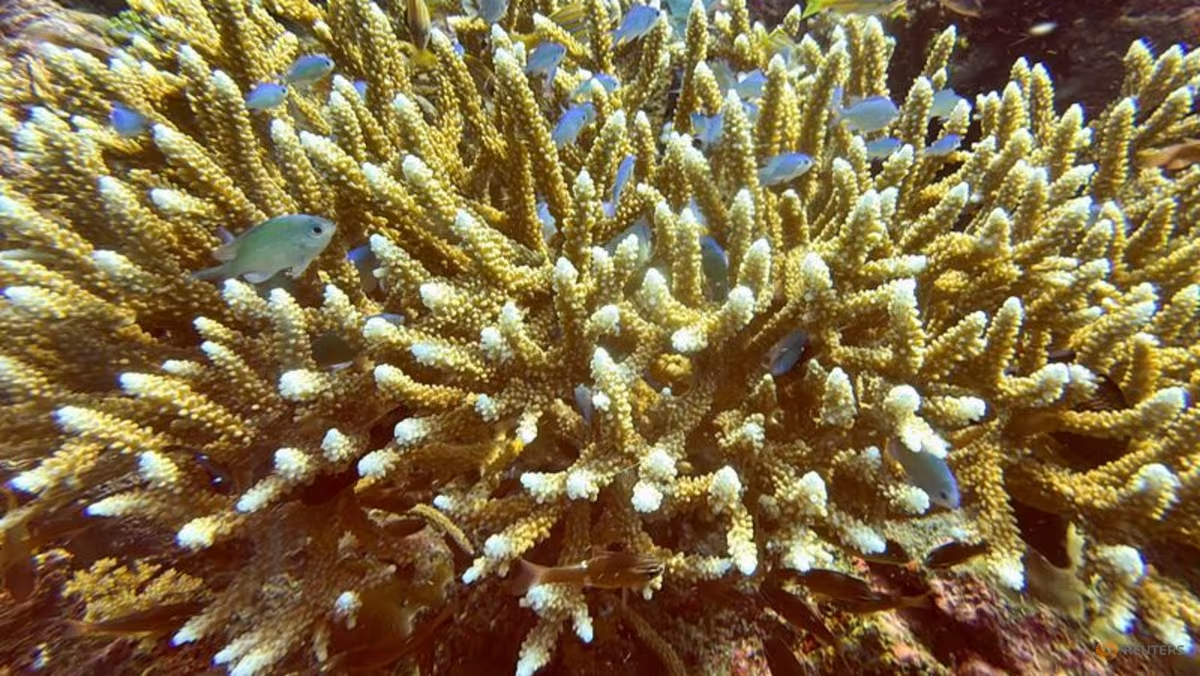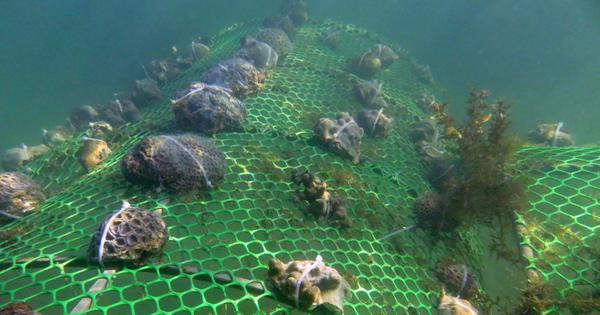
Coral reefs, often called the rainforests of the sea, are among the most productive and vibrant ecosystems on earth. Despite occupying less than 1% of the sea floor, they harbour over 25% of all marine species, including fish, lobsters, clams, seahorses, sponges and sea turtles.Reefs form over thousands of years as coral polyps, the tiny marine animals that make up hard or stony corals that attach to hard surfaces such as submerged rocks and secrete calcium carbonate (limestone), creating rigid, protective skeletons.Since the 1950s, the world’s living corals and their capacity to provide ecosystem services have declined by half. Climate change, which has led to rising ocean temperatures and acidification is one of the major threats to corals. Local, human-driven causes impacting coral reefs include pollution from land, unsustainable and destructive fishing practices, coastal development and sedimentation, unsustainable tourism and boating, as well as environmental threats such as disease and predator outbreaks.Coral restoration, introduced in the 1970s, is an active, human-led process aimed at rebuilding and accelerating the recovery of damaged or degraded reefs. This is achieved by growing corals underwater or in land-based nurseries, then transplanting them back into the seabed using adhesives such as cement.The goals of coral restoration are to enhance reef resilience to future stresses, restore biodiversity, protect coral genetic diversity, and sustain ecosystem services such as coastal protection and tourism.The Mithapur Coral Reef Recovery Project has installed 2,310 artificial reefs, supported by 57 coral garden nurseries, where corals are nurtured on rescued coral boulders until they can be transferred to the artificial reefs. Image by BM Praveen Kumar/WTI, via Mongabay.Where are coral reefs found in India?Along India’s coast, coral reefs cover an average area of 2,375 square kilometres and are primarily found in Gulf of Mannar (including Palk Bay), the Andaman and Nicobar Islands, Gulf of Kachchh, and the Lakshadweep Islands. The first three locations consist mainly of fringing reefs, that grow directly on the coastline or close to the shore. Lakshadweep Islands consist of atolls, ring-shaped reefs surrounding a lagoon.With approximately 1,021 sq km of coral, the Andaman and Nicobar Islands has the highest coral cover in India, followed by the Lakshadweep Islands (934 sq km), Gulf of Kachchh (352 sq km), and Gulf of Mannar/Palk Bay (76 sq km).Patchy reefs are also found along the central west coasts of Maharashtra, Goa, and Karnataka — often located in the intertidal zones such as in Ratnagiri, Malvan and Redi.Submerged patchy reefs on the west coast include: Angria Bank off Sindhudurg in Maharashtra; Grande Island in Goa; Netrani Island on the Karnataka coast; Gaveshana Bank off the Malpe coast; and near Quilon and Vizhinjam along the Kerala coast.Are corals in India protected?Coral reef ecosystems support millions of coastal livelihoods. India grants corals the highest level of legal protection under Schedule I of the Wildlife (Protection) Act, 1972, prohibiting the collection, trade, and possession of both live and dead corals. Violations can result in imprisonment for three to seven years. The Coastal Regulation Zone (CRZ) Notification, 2019, bans development and waste disposal in the fragile reef ecosystems.The 21 islands and surrounding shallow waters of Gulf of Mannar, covering an area of 560 sq km, constitute a marine protected area, known as the Gulf of Mannar Marine National Park. This area is a “no-go” and “no take” zone for fishermen.An aerial view of Upputhanni Island, one of the 21 islands of the Gulf of Mannar. Image by Suganthi Devadason Marine Research Institute, via Mongabay.Where and how are corals being restored in India?Across all reefs of India, coral restoration programmes of varying scales have been underway.The earliest and largest restoration programme began in 2002 in the fringing reefs of Gulf of Mannar, led by the Suganthi Devadason Marine Research Institute, with initial experiments using different types of artificial substrates. In 2024, the programme was expanded into the adjacent Palk Bay. Smaller-scale coral restoration activities have been conducted in the Lakshadweep Islands, Gulf of Kachchh and the Andaman and Nicobar Islands.Currently, the restoration project in Gulf of Mannar involves transplanting coral fragments onto specially designed concrete frames and cement slabs. These efforts have been implemented in degraded reef areas of nine of the 21 islands in Gulf of Mannar, isolated patch reefs in Tuticorin Port, and a distinct patch reef called Harbour Reef. The team deployed 5,550 artificial substrates and transplanted over 51,000 coral fragments representing 20 native species to restore 40,000 sq m of degraded reefs in Gulf of Mannar over 20 years.Acropora muricata corals in the Gulf of Mannar, a year after transplantation. Image by Suganthi Devadason Marine Research Institute.In 2020, a team from the National Centre for Coastal Research in Chennai initiated experimental coral restoration at two sites in Palk Bay: Thonithurai and Munaikadu. They used cement slabs to transplant 800 coral fragments of four species covering an area of 45 sq m.In 2016, in the Lakshadweep Archipelago, a coral nursery was established using 180 coral fragments of fast-growing coral species collected from different sites in the lagoon of Kavaratti atoll. The coral fragments were transplanted onto concrete blocks fixed within iron mesh frames that covered an area of 40 sq m near reefs inside a shallow lagoon of Kavaratti atoll.In the Andaman and Nicobar Islands, a non-profit organisation called ReefWatch Marine Conservation has been transplanting corals since 2018, covering an area of 20 sq m. Coral fragments were collected from naturally broken colonies from adjacent reefs and transplanted onto semi-spherical structures, secured with 300 kg anchors. At the Mithapur Reef, located 12 km south of Gulf of Kachchh in Gujarat, a coral recovery project was launched in 2008 as a joint venture between the Wildlife Trust of India and the Gujarat Forest Department, with support from Tata Chemicals Limited. Since 2012, artificial reefs have been created by stacking limestone and/or basalt boulders into a conical shape, approximately one metre in basal diameter and one metre in height. This particular shape was selected because it provides extended stability to the modules, while also increasing surface area, offering more space for the colonisation of benthic marine species – those that live on, in, or near the seafloor.The Gujarat team also installed five “biorocks” off the coast of Mithapur from 2020 to 2024. Biorock is a technology that uses low-voltage electricity to amplify mineralisation on a given structure, which boosts coral growth rates.BM Praveen Kumar, the manager and head of the Mithapur Coral Reef Recovery Project, said that till date, 2,310 artificial reefs have been installed, covering over 5,800 sq m. The team also established 57 coral garden nurseries from 2016-’17, using rescued coral boulders from the intertidal region and attaching them to metal tables. These coral boulders had been damaged by fishing activities such as the use of bamboo poles to steer boats, anchoring boats and trampling. After one to two years of growth, the corals were transferred to the artificial reefs.‘Biorocks’ installed off the coast of Mithapur, Gujarat. Biorock is a technology that uses low-voltage electricity to amplify mineralisation on a given structure, which boosts coral growth rates. Image by Charan Kumar Paidi/WTI, via Mongabay.Has restoration worked?In a global review of coral restoration, researchers found that most projects reported coral survival between 60 to 70%.In Gulf of Mannar, the overall survival of transplanted fragments from 2002 to 2024 ranged from over 55% to around 80%. The genus Acropora had the highest average growth rate across all sites, while the genus Porites had the lowest.Transplanted corals in Gulf of Mannar showed a higher growth rate than natural corals for four species. The average growth rate of Acropora corals was around 10 cm per year at the restored reef, while it was only around 8 cm per year at the natural reef. Live coral cover increased sevenfold over 14 years (2006-2020), despite coral mortalities during two major bleaching events in 2010 and 2016. As a result, fish density in the restored area soared 21-fold over the same period, benefitting coastal communities.Acropora spp. in the Gulf of Mannar, four years after transplantation. Image by Suganthi Devadason Marine Research Institute.“Restored corals become sexually mature within four years and thus help in expediting the recovery rate. Coral spawning and proper development of gametes have been recorded among the restored corals,” explains Edward Patterson, Director of SDMRI, Thoothukudi, Tamil Nadu. “Coral cover enhanced through restoration supplies more sand than a degraded area, which is important for stabilising island coasts,” he adds.In Palk Bay, transplanted branching coral species demonstrated significant growth over 18 months. Acropora muricata (staghorn coral) exhibited the highest average monthly growth rate (up to 0.67 cm per month in Munaikadu), followed by Acropora hyacinthus (table coral) and Montipora digitata (finger coral). “Growth differences were significant among species but not between sites, indicating that the transplantation method was broadly effective across varying substrate types,” says Koushik Sadhukhan, a scientist at the National Centre for Coastal Research, Chennai.Coral fragments at initial stages of restoration at Palk Bay. Image by National Centre for Coastal Research via Mongabay.Acropora muricata at Palk Bay, 12 months after transplantation. Image by National Centre for Coastal Research via Mongabay.Survival rates ranged from 50% to 80% for three branching coral species: Acropora muricata (staghorn coral), Acropora hyacinthus (table coral), and Montipora digitata (finger coral). This demonstrates moderate to strong restoration success, says Sadhukhan.Nine months after the transplantation, researchers recorded a high abundance of fish (1,060 individuals) from seven different families. The most common types of fish were grunter, damselfish, and rabbitfish. According to Sadhukhan, “This suggests that coral restoration not only enhances benthic structure but also supports reef-associated fisheries and biodiversity recovery.”Rescued coral boulders (around 1,040) in Mithapur’s coral nurseries showed an overall survival rate of more than 95% after seven years, which is among the highest in the world, Praveen Kumar, points out. Since 2016-17, the team recorded an additional seven fish species and higher fish densities on the natural reefs. The amount of fish caught by fishermen, known as catch per unit effort, surged tenfold from 2015-2016 to the end of 2025.A school of fish aggregate at a coral garden nursery in Mithapur. Credit: BM Praveen Kumar/WTI, via Mongabay.These positive effects are attributed to the artificial reefs, which served as refugia for herbivorous fishes, allowing their populations to increase, says Kumar. The heavy nutrient load in these waters, coupled with a lack of herbivorous fish, led to algal overgrowth on corals, Kumar explains, noting that the increase in herbivorous fish led to grazing on the algal patches. This boosted live coral cover on the natural reefs from 11% in 2008 to around 19% at the end of 2025. “Slowly, the reef is transforming from an algal-dominated reef to a more resilient reef system.”Researchers are currently monitoring 200 coral fragments in the Andaman and Nicobar Islands. As of March 2026, transplanted corals in the artificial reefs showed a growth rate of 9.4 cm per year and a survival rate of 55%. In 2025, they recorded 111 species of fish and cryptofauna and 2,344 individuals. In 2026, the number of species fell to 50 but the number of individuals surged to 3,139.The growth of transplanted corals over the years in the Andaman and Nicobar Islands. Images by Sumer Verma and ReefWatch Marine Conservation via Mongabay.In the lagoon of Kavaratti Atoll in the Lakshadweep Archipelago, researchers found that transplanted corals showed promising growth along with a diverse fish assemblage after two years. Acroporid corals (also known as staghorn corals) grew faster than the non-acroporid corals, with the rate varying widely between species.Among faster-growing acroporid corals, A. muricata showed the highest growth (31.1 cm) while Isopora palifera (catch bowl coral) had the lowest growth (15.9 cm). Pocillopora damicornis (cauliflower coral) had the highest growth (481.9 cubic centimetres) by volume among the non-acroporid corals, while Hydnophora microconos (spine coral) had the lowest growth rate (33.4 cubic centimetres).Survival rates across all nursery coral fragments ranged from 64% to 99%. Another positive sign: the team recorded 21 fish species across 10 families at the transplantation site, with two damselfish species as the dominant species.This article was first published on Mongabay.
How India’s coral reef restoration efforts are paying off
The ‘rainforests of the sea’ are important marine ecosystems that support coastal livelihoods.
2,019 words~9 min read