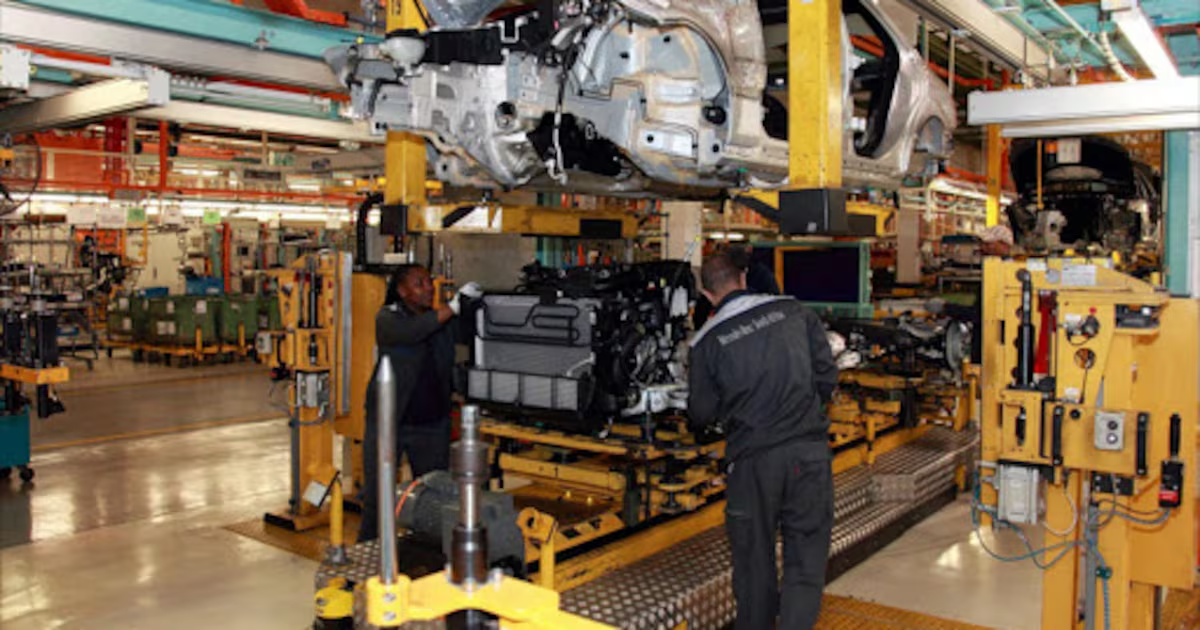
Government anticipates that the implementation of any approved amendments to the Automotive Production Development Plan (APDP) will begin in the fourth quarter of the current financial year, trade, industry & competition minister Parks Tau has indicated. This would follow the conclusion of the review process now under way and after having obtained the necessary approvals, including from National Treasury. Both the South African Automotive Masterplan and the APDP are under review. “The review of the automotive policy is expected to be completed by September,” Tau said in a written reply to a question from DA MP and member of parliament’s trade, industry & competition committee Mlondi Mdluli. The motor industry has complained bitterly about government’s tardiness in introducing the amendments to the APDP – the incentive scheme for the industry — which it says are badly needed to improve their competitiveness in the face of the upsurge of vehicle imports from China and India. Chinese vehicle makers expanded their share of the South African passenger car market to 16.8% in 2025, up from 11.2% in 2024. South Africa’s vehicle trade deficit with key Brics partners China and India reached R90bn last year, R57.7bn of which was with China.Tau said an APDP modelling study was undertaken to review the programme and identify possible short-term interventions to enhance the competitiveness of domestic vehicle manufacturers in relation to importers of fully built units. He gave details of the proposed amendments under consideration. These include a review of the ad valorem tax structure to create clearer differentiation between locally produced and imported vehicles. This might involve adjustments to the tax base and the local adjustment factor to support domestic production competitiveness, the minister said. Also under consideration are measures to address structural imbalances within the APDP, particularly regarding the operation and accumulation of production rebate certificates, to strengthen localisation incentives. Revisions to the volume assembly local allowance parameters are being looked at to better align incentives with broader industrial policy objectives. Finally, Tau said, regulatory refinements related to semi-knocked-down operations (SKD), including the introduction of potential time-bound provisions to encourage a transition towards higher-value complete-knocked-down (CKD) production, are on the table. “These proposals are being discussed and refined through consultations with key industry stakeholders, including original equipment manufacturers (OEMs), labour representatives, National Treasury, the South African Revenue Service and the International Trade Administration Commission,” he noted. Mdluli said the APDP was designed to incentivise domestic vehicle production and grow South Africa’s automotive sector but the programme had not kept pace with the changing dynamics of the industry.Over time, structural imbalances have emerged, particularly around the accumulation and trading of production rebate certificates, which have inadvertently made it more attractive in certain instances to import fully built units rather than manufacture locally. The ad valorem tax structure also does not create sufficient differentiation to reward local production meaningfully. The parliamentary committee conducted an oversight visit to the Eastern Cape earlier this year and engaged with industry players across the automotive sector. Mdluli said OEMs flagged that the SKD regulations allowed some assemblers to operate at minimal local content levels without a clear obligation to transition towards fuller CKD production. “In short, OEMs feel that the policy instruments meant to support them are being diluted and that without intervention, South Africa risks losing investment and production volumes to other markets. “South Africa’s OEMs are competing in an increasingly cost-sensitive global environment, and the current policy framework is no longer providing the competitive edge that domestic manufacturers need. Amendments are not a luxury; they are a necessity if we are serious about protecting jobs and growing local production,” Mdluli said. “The sense of urgency on the ground far outpaces the pace of response we have seen from the department. The fact that we are only now at the stage of an APDP modelling study, with a review completion target of September 2026 and implementation anticipated in the fourth quarter of this financial year, raises legitimate questions about how seriously government has treated these concerns. “Every quarter of delay has real consequences — for investment decisions, for production planning, and ultimately for workers on the factory floor. Government must now move with urgency and ensure that the September 2026 deadline is met without further slippage.”
Much-anticipated auto plan review to be completed by September
Parks Tau expects implementation of APDP changes to begin in fourth quarter
707 words~3 min read